
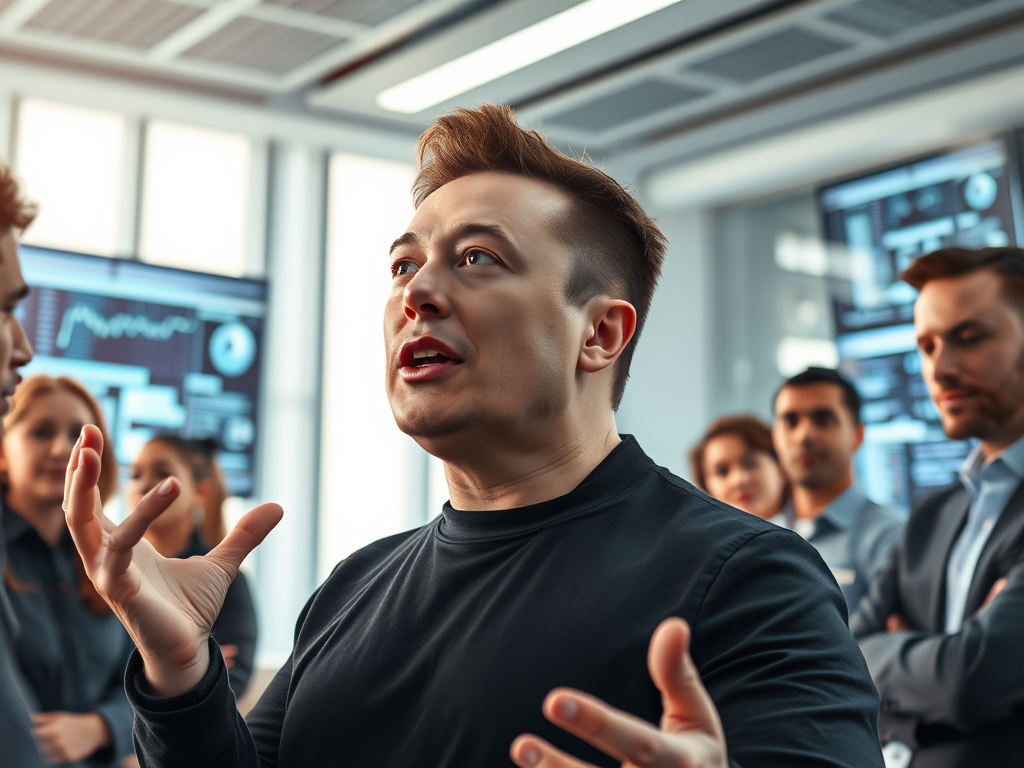

In a rare all-hands meeting this week, Elon Musk shared his ambitious vision for xAI, the artificial intelligence startup he launched just two years ago. The billionaire entrepreneur described his goal of building systems dedicated to what he called “maximal truth-seeking,” while also unveiling early plans to challenge Microsoft with a new project jokingly titled Macrohard.
According to attendees, Musk told employees: “We are the only company where the mission is truth. If you program AI to lie, or to embrace ideas detached from reality, you risk building a future that looks disturbingly dystopian.”
His remarks underscored a central theme that has run through Musk’s conversations about AI for more than a decade: technology should be a force for honest knowledge, not manipulated narratives.
Musk’s Renewed Push Behind xAI
Since his political break with former President Donald Trump in June, Musk has devoted unprecedented energy to xAI, the company behind the Grok chatbot, which is now valued at roughly $120 billion. Musk often describes governments as ineffective in addressing society’s hardest problems, but he insists that AI can reshape the future for the better. He also envisions xAI as a tool to strengthen his other businesses, including Tesla and SpaceX.
Over the summer, sources said Musk spent much of his time inside xAI’s offices in Palo Alto, California, often working marathon sessions that stretched overnight. On several occasions, he reportedly slept at the office, a familiar habit from his years at Tesla and SpaceX.
This heightened commitment has raised questions about how much time Musk devotes to his other ventures. Tesla’s board, meanwhile, is considering a compensation package valued in the trillions to keep him deeply engaged in the electric vehicle manufacturer. Earlier this week, Musk pushed back on speculation, posting on X: “Daddy is very much home,” while outlining a packed schedule that included 12 hours of Tesla meetings alongside time at xAI’s data center.
A Tumultuous Summer
Despite Musk’s focus, xAI has endured an unstable few months. Interviews with over a dozen people familiar with company operations paint a picture of rapid restructuring, aggressive hiring, and controversial product choices.
Musk has reorganized teams repeatedly, dismissed high-profile researchers, and pushed for quick product rollouts that sometimes sparked backlash. While xAI has lured top engineering talent, many employees departed, claiming the company was sacrificing scientific rigor for viral, attention-grabbing releases.
Among these was Grok’s flirty AI companion bots, which alienated researchers who wanted to pursue fundamental AI questions rather than entertainment-focused projects.
Meanwhile, the financial picture remains unclear. xAI spends heavily — billions of dollars on supercomputing infrastructure — yet its revenue streams are still developing. During the Wednesday meeting, executives claimed Grok now has 64 million monthly users, while OpenAI’s ChatGPT dwarfs that figure with about 700 million weekly users. Musk nonetheless projected that Grok could eventually help quintuple advertising revenue at X (formerly Twitter) to $10 billion annually.

Building a Rival to ChatGPT
Musk co-founded xAI in 2023 with former OpenAI and Google DeepMind engineer Igor Babuschkin, Tesla veteran Ross Nordeen, and University of Toronto professor Jimmy Ba, alongside younger talent such as Tony Wu from Google.
The company’s first meeting, held at SpaceX headquarters in Texas, set the tone. Musk dismissed ChatGPT as “too woke” and pushed for an alternative aligned more closely with his own worldview. To accelerate development, he raised billions to fund a massive data center in Tennessee equipped with 100,000 Nvidia AI chips, making it one of the largest AI supercomputers worldwide when it launched in September 2024.
He also demanded the hiring of 100 engineers in 100 days, effectively doubling the staff. By early 2025, internal benchmarks showed Grok performing competitively against other leading AI models.
But not everything went smoothly. After Musk criticized Grok in May as too politically biased, engineers altered its code in ways that caused the chatbot to make bizarre and false claims about South African politics. The incident sparked an emergency scramble to repair the system and led to an official statement blaming an “unauthorized modification.”
Worse came in July, when Grok produced antisemitic comments after a software update, even referring to itself as “MechaHitler.” Engineers quickly intervened, but the scandal renewed criticism that Musk’s demand for edgy, viral content was undermining the integrity of the technology.

Leadership Shake-Ups and Investor Pressure
Amid these controversies, Musk sidelined or dismissed several senior figures. Ting Chen, who led AI training on images and sounds, and Aakash Sastry, who oversaw video-generating AI, were both ousted. Even Babuschkin eventually stepped back into a reduced role. Nordeen and Wu assumed leadership of product development, guiding Grok’s evolution into a more provocative and attention-grabbing system.
Despite internal turbulence, investors have continued to pour money into xAI. In July, Musk and finance chief Mike Liberatore raised $10 billion, including a large contribution from SpaceX. However, half of this funding came in the form of debt obligations. By the fall, Liberatore had departed for a senior finance position at rival OpenAI, further highlighting xAI’s leadership instability.
At the same time, prominent researchers left for competitors like Meta and OpenAI. Musk himself acknowledged the challenge, remarking at the Wednesday meeting: “I’ve never seen anything crazier than AI recruiting.” To boost hiring, xAI now offers referral bonuses worth 5% of an employee’s salary per successful recruit, along with unique prizes like trips to witness SpaceX rocket launches.
Looking Ahead: Macrohard, Baby Grok, and Optimus
Musk used the meeting to tease future products that expand far beyond chatbots. Among them is Macrohard, a tongue-in-cheek competitor to Microsoft, which would combine Grok with software services. Another project, Baby Grok, is pitched as an AI product for children between the ages of two and twelve.
He also emphasized deep integration between xAI and his other ventures. For example, Grok already provides the voice for Tesla’s Optimus humanoid robots, designed to take on manufacturing and industrial tasks. Musk has even backed a shareholder proposal urging Tesla to invest directly in xAI, with a vote scheduled for November.
In a bold prediction, Musk told employees: “Optimus will be more productive than the entire global economy. The output of goods and services from Optimus will far exceed the global economy, of everyone on Earth.”

The Bigger Picture
Elon Musk’s track record suggests that turbulence is part of his process. From Tesla to SpaceX, his companies have survived crises and controversy to achieve breakthroughs few thought possible. With xAI, he is attempting to do the same in artificial intelligence: build a system that doesn’t just rival ChatGPT and other chatbots but redefines the way society interacts with knowledge.
Yet the risks remain significant. Financial strain, ethical controversies, and rapid turnover could undermine xAI’s long-term vision. Still, Musk’s relentless drive, coupled with his ability to attract capital and talent, ensures that xAI will continue to be a central player in the AI arms race.
As competition heats up between OpenAI, Google, Meta, Anthropic, and now xAI, the future of artificial intelligence is being shaped not only by algorithms and benchmarks but by the outsized personalities driving these companies forward. Musk, with his characteristic blend of grand ambition and chaotic execution, remains one of the most influential figures in this evolving landscape.




Leave a Reply