
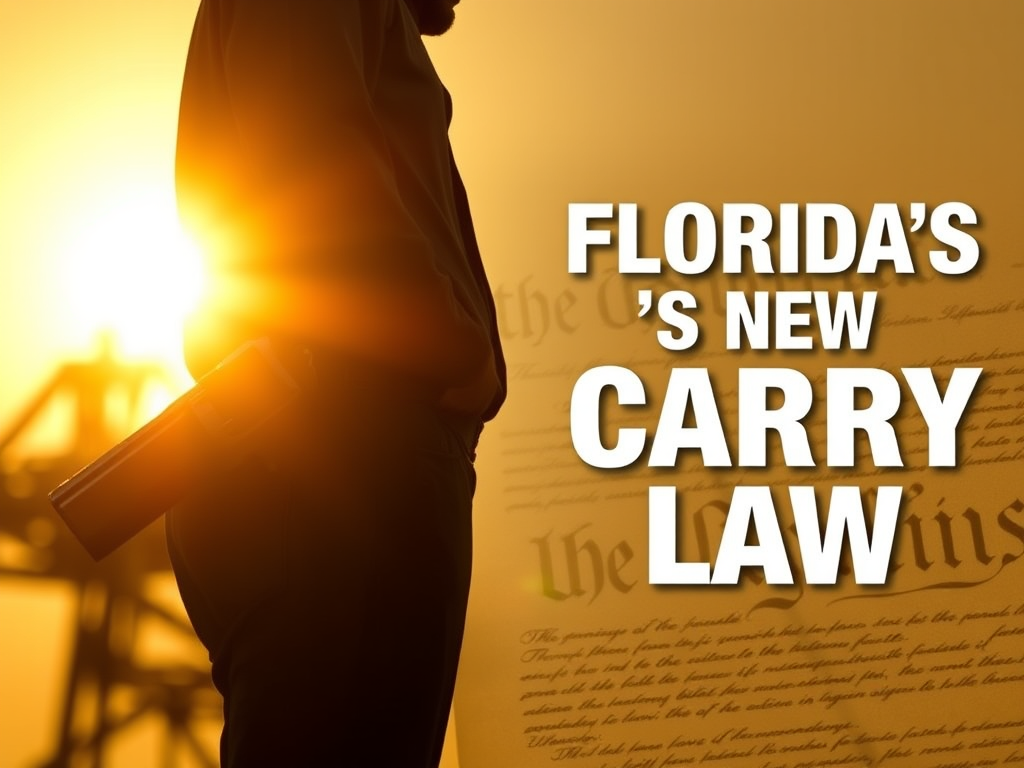

Florida is now on the verge of a dramatic shift in gun policy following a significant legal interpretation from the state’s attorney general. On Monday, Attorney General James Uthmeier announced that police officers and prosecutors should no longer arrest or charge individuals for openly carrying firearms in public. His statement came just days after a state appeals court struck down a decades-old ban, ruling that the law was unconstitutional under the Second Amendment.
This interpretation, which Uthmeier outlined in a formal memorandum sent to sheriffs, police chiefs, and prosecutors across the state, effectively clears the way for open carry in Florida. For decades, Florida had been the last Republican-led state still enforcing such a prohibition, even as most of the country embraced more expansive gun rights.
Court ruling reshapes Florida gun law
The case that triggered this sweeping change dates back to 2022. A man in Pensacola openly carried a holstered pistol while livestreaming himself holding both the firearm and a copy of the U.S. Constitution. His act of protest set the stage for a broader legal battle. While Florida’s Supreme Court had previously upheld the state’s ban in 2017, the U.S. Supreme Court’s landmark 2022 decision in New York State Rifle & Pistol Association v. Bruen—which struck down New York’s strict limits on carrying guns in public—changed the legal landscape.
Last week, a three-judge panel of the First District Court of Appeal in Tallahassee concluded that Florida’s open carry ban, in place since 1987, could no longer stand in light of the Bruen ruling. Writing for the panel, Judge Stephanie W. Ray declared, “No historical tradition supports Florida’s open carry ban. To the contrary, history confirms that the right to bear arms in public necessarily includes the right to do so openly.” Judges Lori S. Rowe and M. Kemmerly Thomas, both appointed by former Governor Rick Scott, joined her opinion.

DeSantis celebrates ruling as political victory
Governor Ron DeSantis, a Republican who has long supported eliminating the open carry ban, praised the decision. For years, DeSantis and allies in the legislature pushed unsuccessfully to repeal the law, facing resistance even within their own party from sheriffs and local officials who worried about public safety.
After the ruling, DeSantis posted on social media: “This decision aligns state policy with my long-held position and with the vast majority of states throughout the union. Ultimately, the court correctly ruled that the text of the Second Amendment — ‘to keep and bear arms’ — says what it means and means what it says.”
DeSantis, who has prioritized expanding gun rights during his tenure, is now seeing one of his central policy goals realized not through legislation, but through the courts.
Opposition warns of risks to public safety and tourism
Not everyone welcomes the change. Democratic leaders and law enforcement officials have raised sharp concerns. Nikki Fried, chairwoman of the Florida Democratic Party, warned in a statement that the ruling will have “negative long-term effects on our communities and further erode Floridians’ trust in one another.” She emphasized that sheriffs’ associations, police departments, and bipartisan coalitions have historically opposed open carry, fearing it could escalate tensions and endanger both residents and tourists.
Florida’s tourism industry, one of the largest in the nation, has also been cited in debates over the ban. Critics argue that visible firearms in crowded public spaces could alarm visitors and harm the state’s global image as a family-friendly destination.
Historical roots of the open carry ban
The prohibition on open carry in Florida has deep historical roots. The state first restricted visible firearm possession in the 19th century. Although the ban was lifted in the 1980s due to what lawmakers later admitted was a mistake, it was swiftly reinstated in 1987 under Governor Bob Martinez. For more than three decades, the law stood as one of the strictest open carry bans in the country.
That legacy may now be coming to an end. Uthmeier, who became attorney general earlier this year after Governor DeSantis appointed his predecessor Ashley Moody to the U.S. Senate, said his office will not request a rehearing or appeal the ruling to the Florida Supreme Court. This effectively signals acceptance of open carry as state policy moving forward.
Timeline for enforcement
Technically, the appeals court ruling does not take effect until September 25, giving time for the state to request a rehearing. Some sheriffs, such as Pinellas County’s Bob Gualtieri, have urged caution. Gualtieri questioned whether the First District Court of Appeal’s ruling could override the Florida Supreme Court’s earlier 2017 decision that upheld the ban.
Still, Uthmeier has made clear that law enforcement should immediately align with his guidance, meaning prosecutions for open carry will not proceed. The attorney general stressed that no other state appellate court has yet considered the constitutionality of Florida’s ban in light of the Bruen precedent, but he argued that the ruling leaves no legal room for enforcement.
Florida’s identity as the “Gunshine State”
Gun rights have long shaped Florida’s political identity. Since Republicans took full control of the state government more than 25 years ago, Florida earned the nickname “the Gunshine State” for its strong support of firearm ownership and self-defense laws. However, the 2018 mass shooting at Marjory Stoneman Douglas High School in Parkland, which killed 17 people, led to rare bipartisan agreement on tighter gun restrictions. That year, lawmakers raised the minimum age to purchase rifles from 18 to 21 and introduced other measures.
Now, Attorney General Uthmeier has signaled that even those post-Parkland restrictions could be vulnerable. He has openly stated his view that raising the minimum purchase age is unconstitutional and should be struck down as well. If courts agree, Florida could see a sweeping rollback of gun regulations in the coming years.
National implications
Florida’s move carries implications beyond its borders. Until now, it had been one of just four states — along with California, Connecticut, and Illinois — that broadly prohibited open carry. With Florida now effectively joining the majority of states, national momentum has tilted further toward expanding visible gun rights in public spaces.
Legal experts say the ruling underscores how transformative the Bruen decision has been. By requiring that gun restrictions be rooted in “historical tradition,” the U.S. Supreme Court has made it increasingly difficult for states to justify modern regulations that lack clear historical precedent. Florida’s appeals court cited this reasoning directly, concluding that the 1987 ban had no firm grounding in American legal history.
What comes next
The future of open carry in Florida will likely depend on whether opponents find a legal path to challenge the appeals court ruling. Without intervention from the Florida Supreme Court or the U.S. Supreme Court, the state is poised to fully embrace open carry before the end of 2025.
For supporters, this marks a long-awaited recognition of Second Amendment rights. For critics, it represents a dangerous erosion of public safety and community trust. As Uthmeier’s memorandum circulates among law enforcement agencies and Floridians await September 25, the debate over guns in public is far from over.




Leave a Reply