

For more than forty years, Ethan Hawke has occupied a unique space in American film, constantly reinventing himself through roles that test both his range and audience expectations. His career is defined by versatility: he has embodied charming romantics, flawed antiheroes, men burdened with conscience, and restless souls searching for meaning. Once celebrated as the quintessential Gen X star, Hawke moved beyond the trappings of youthful fame to establish himself as one of the most consistently fascinating actors of his generation. His dedication, even down to his trademark goatee, has made him a familiar yet unpredictable figure in Hollywood.
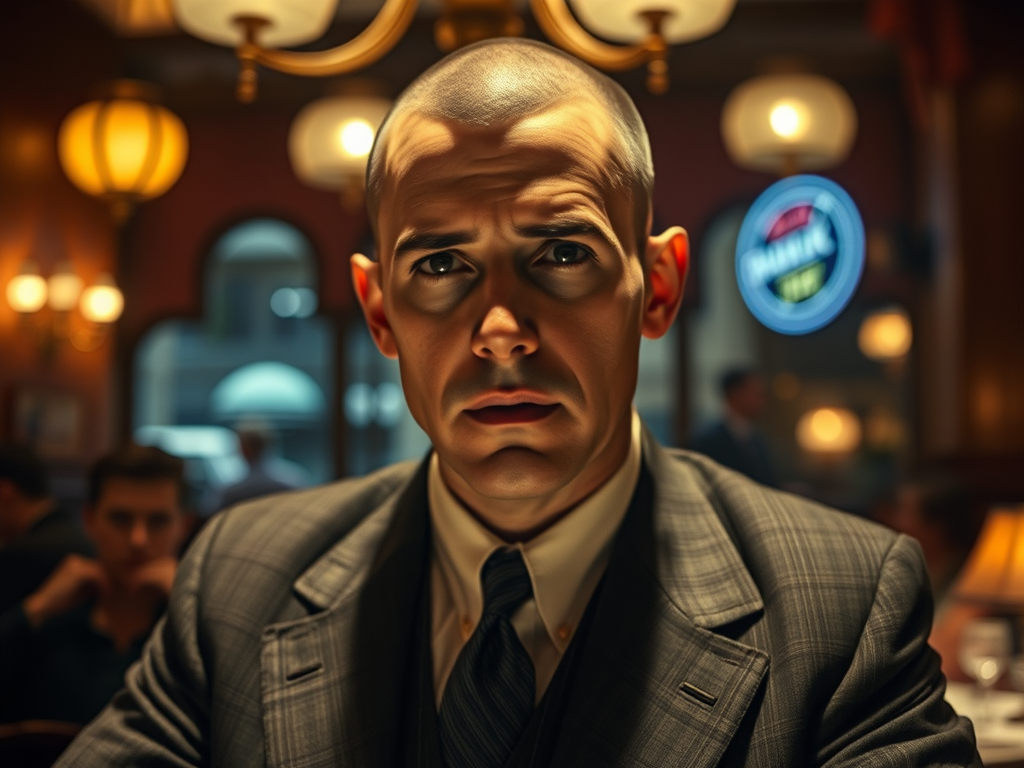
That recognizable goatee is gone in his latest project, Blue Moon, which premieres on October 17. Written by Robert Kaplow and directed by Hawke’s longtime collaborator Richard Linklater, the film captures a single tense night in Sardi’s restaurant in 1943. Hawke takes on the role of lyricist Lorenz Hart, whose career and personal struggles collide on the evening of a Broadway premiere. The production is Rodgers and Hammerstein’s Oklahoma!, destined to become a landmark in American musical theater. But Hart, once Richard Rodgers’ songwriting partner, is on the sidelines, left behind as Oscar Hammerstein II provides the lyrics that Hart once would have written.
To bring Hart to life, Hawke transforms dramatically: a shaved head with a tragic comb-over, posture adjusted to match Hart’s shorter stature, and a physical presence that mirrors the character’s fragility. While his appearance alone sparks awards speculation, Hawke’s performance digs deeper. He portrays Hart as witty, bitter, and deeply vulnerable, a man collapsing inward under the weight of his losses. Much like other Linklater collaborations, Blue Moon meditates on time itself—its power to preserve, destroy, and transform.

The Power of Time on Screen
Movies freeze time, but actors like Hawke remind audiences that time also flows alongside us. Watching his career unfold has meant growing older with him. From his breakout roles as a sensitive teen in Dead Poets Society (1989) to a disillusioned slacker in Reality Bites (1994), Hawke became a generational icon. Later, with Linklater’s Before trilogy—Before Sunrise (1995), Before Sunset (2004), and Before Midnight (2013)—audiences witnessed his character Jesse age in real time, reflecting life’s passage as viewers themselves grew older. That blend of frozen cinematic moments and lived human experience is what gives Hawke’s career such resonance.
Hawke’s story began in earnest at age 14, when he starred in Explorers (1985). Though the film underperformed at the box office, critics saw promise in the young actor. Growing up in New Jersey after being born in Texas, Hawke described himself as a “regular kid” who spent summers biking, playing sports, and hanging out with friends. Yet acting was already pulling him toward something bigger: that same summer, he appeared in a local production of Shakespeare’s Pericles. When asked about his ambitions, his teenage response was simple but telling: “I just want to be respected as an actor.”
That desire has guided every step of his career. Over the decades, Hawke has built an eclectic résumé spanning film, stage, television, writing, and even directing. He has penned novels, directed indie films, and experimented across genres. He directed the music video for Lisa Loeb’s 1994 hit Stay (I Missed You) and even appeared in Taylor Swift’s music video for Fortnight. Far from being complacent, Hawke has continually sought new outlets for creativity, showing both restlessness and discipline.

Collaborations That Define a Career
Hawke’s collaborative spirit has fueled much of his success. His partnership with Richard Linklater is perhaps the most significant, encompassing nine films, from Before Sunrise to the groundbreaking 12-year project Boyhood (2014). He has also worked repeatedly with directors Michael Almereyda and Antoine Fuqua. In Fuqua’s Training Day (2001), Hawke played an earnest young cop opposite Denzel Washington’s menacing detective. Washington won the Academy Award for his role, but Hawke’s understated performance was essential, grounding the story and giving audiences someone to empathize with.
Similarly, in Sidney Lumet’s crime drama Before the Devil Knows You’re Dead (2007), Hawke held his own alongside Philip Seymour Hoffman. While Hoffman dazzled as a ruthless older brother, Hawke’s portrayal of the vulnerable younger sibling provided the film’s emotional core. Again and again, Hawke proves that his power lies not in overshadowing co-stars but in deepening the films around him.

From Criticism to Admiration
Not everyone was always a fan. Early in his career, some critics dismissed Hawke as too self-conscious or emblematic of Gen X clichés. In Reality Bites, his scruffy, guitar-toting character annoyed detractors who saw him as more attitude than substance. Even in Before Sunrise, some resisted his charming yet seemingly shallow Jesse. But as time passed, Hawke grew into roles that revealed greater depth, maturity, and vulnerability.
By the time Boyhood was released, the perception had shifted. His performance as a flawed but loving father earned wide praise, cementing his reputation as a thoughtful and authentic actor. Hawke himself has shown humor about past criticism, even quoting harsh reviews during award speeches with a laugh. That resilience reflects an artist who understands that time, like film, changes perspective.
Experimentation and Evolution
Hawke has also taken bold risks on stage and screen. In Almereyda’s modernized Hamlet (2000), he delivered the iconic soliloquy “To be or not to be” while wandering through a Blockbuster video store. The unconventional setting, coupled with Hawke’s layered delivery, initially felt absurd but gradually revealed a haunting vulnerability. By blending inner voiceovers with spoken dialogue, the film highlighted Hawke’s ability to explore the fractured psychology of complex characters.
His performance in Paul Schrader’s First Reformed (2017) is perhaps his most powerful to date. Playing a tormented minister facing a crisis of faith, Hawke gave a performance that was haunting, restrained, and deeply human. Schrader remarked that Hawke carried “lessons in his face that he doesn’t have to act—life put them there.” That quality, of embodying experience without needing to overplay it, has become Hawke’s signature strength.

The Enduring Legacy
What makes Ethan Hawke remarkable is not a single performance but the evolution of a lifetime in film. Audiences have grown up with him, watched him stumble, transform, and ultimately triumph as one of the most enduring actors of his generation. He has moved from being dismissed as a Gen X stereotype to becoming a cinematic mainstay whose work continues to challenge and inspire.
Actors, like films, are not static. They age, change, and redefine themselves. Hawke’s journey shows how a career can deepen over decades, how youthful promise can mature into artistry, and how even critics can be won over by time and talent. Today, he stands not only as a respected actor but also as a filmmaker, writer, and cultural figure whose influence stretches far beyond the screen.
Ethan Hawke once said, as a boy, that he wanted nothing more than respect as an actor. Four decades later, with a career full of risks, reinventions, and unforgettable performances, he has earned exactly that.




Leave a Reply