
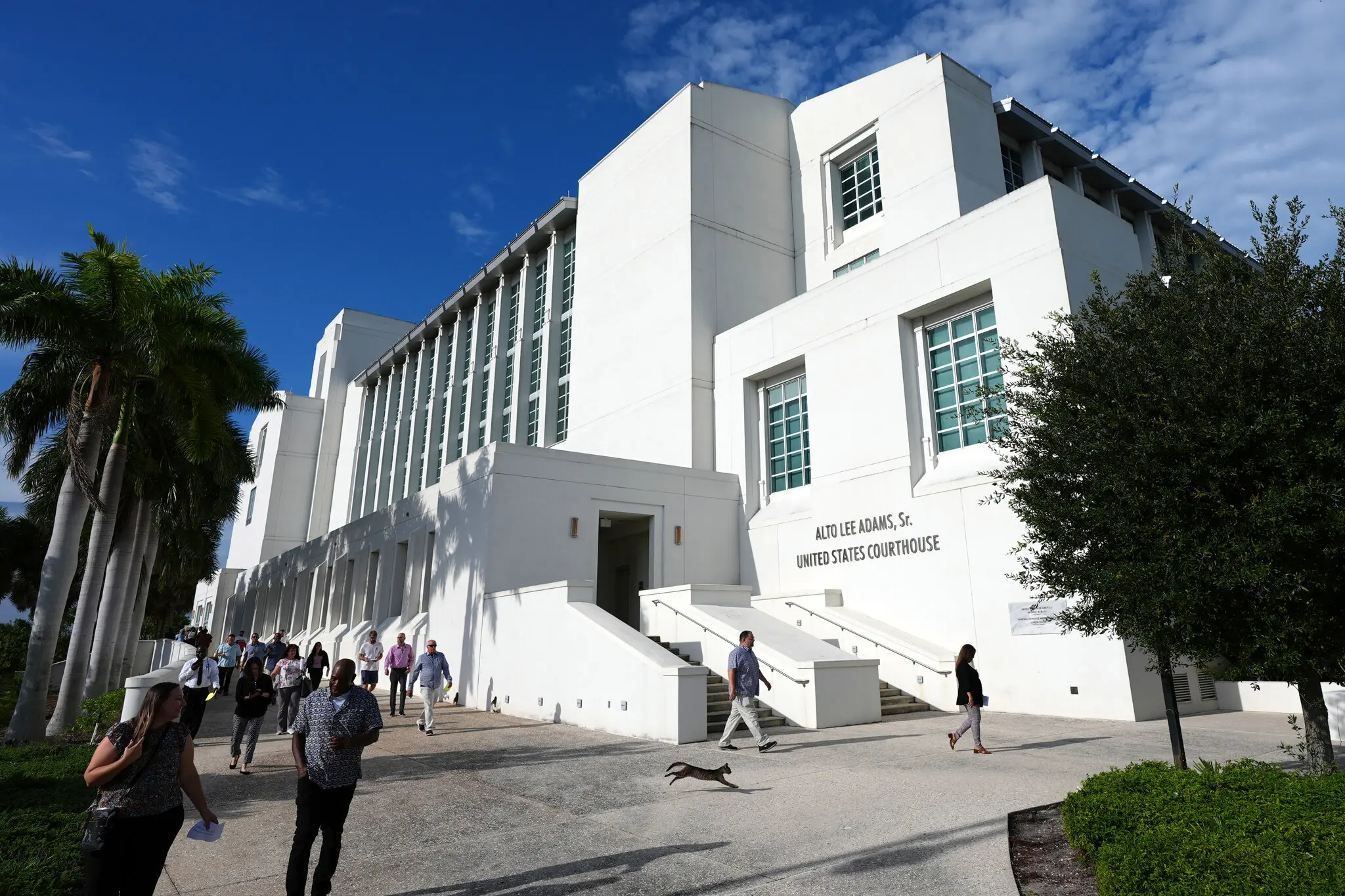

The federal trial of Ryan W. Routh, the man accused of attempting to assassinate former President Donald Trump during a golf outing in Florida last year, began with confusion and controversy on Thursday. The case, unfolding in Fort Pierce, Florida, has already drawn national attention—not only because of the seriousness of the charges, but also because Routh has chosen to represent himself in court despite lacking any legal training.
A Rocky Opening Statement
Routh, 59, delivered his own opening statement, but it lasted barely five minutes before U.S. District Judge Aileen M. Cannon intervened. Instead of focusing on the facts of his case, Routh made cryptic remarks about the “future of humanity,” invoked Adolf Hitler, Ukraine, Henry Ford, and the Wright brothers, and even declared that “this case means absolutely nothing.” His remarks left both jurors and court officials bewildered.
Judge Cannon promptly cut him off, cautioning him against making a “mockery” of the trial. The abrupt interruption underscored the high risks of his decision to act as his own defense attorney while facing one of the most serious charges in American criminal law—an attempted assassination of a presidential candidate.
Serious Charges, Maximum Stakes
Prosecutors have charged Routh with attempting to assassinate a major presidential candidate, assaulting a federal officer, and multiple firearm violations. The most severe charge alone carries a potential sentence of life in prison. Despite the weight of the accusations, Routh has pleaded not guilty and insists on handling his own defense.
The trial officially began just one day after the assassination of conservative activist Charlie Kirk, an event that intensified the climate of political violence in the United States. Law enforcement officials have warned of a disturbing rise in politically motivated attacks in recent years, with Trump-related incidents becoming flashpoints.
Tight Security Surrounding the Trial
Since jury selection began on Monday, armed federal officers have surrounded the courthouse in Fort Pierce. Heavily armed patrols and tight restrictions underscored the gravity of the case. Outside, Trump supporters gathered, including one man who parked a car covered in Trump flags near the courthouse as a sign of solidarity.
Inside the courtroom, prosecutors urged jurors to focus solely on the evidence presented rather than their personal views of the former president. “This case is not about whether you like Donald Trump or not,” prosecutor John Charlton Shipley Jr. told the jury. Instead, he argued, the trial revolves around a “carefully crafted and deadly serious plot” to assassinate the Republican candidate.
A Planned Attack at Trump’s Golf Course
According to prosecutors, Routh, a drifter and building contractor from North Carolina, spent weeks preparing his alleged attack. On September 15, 2024, he positioned himself just outside Trump International Golf Club in West Palm Beach, rifle in hand, waiting for an opportunity.
Secret Service agent Robert Fercano testified that he spotted the rifle barrel poking through thick brush near the sixth hole as Trump played nearby. Fercano was patrolling the course on a golf cart when he heard radio chatter referencing “Mogul on five green”—the code name for Trump’s location.
Realizing the potential threat, Fercano shouted at Routh before Routh allegedly raised the weapon toward him. The agent fired his pistol in response, shouting into his radio, “Shots fired! Shots fired!” Prosecutors argued that these quick actions forced Routh to drop his semiautomatic rifle and flee the scene.
In the courtroom, Fercano held up the weapon for jurors to see, underscoring the immediacy of the danger.
Routh’s Defense Tactics Raise Eyebrows
Cross-examining Agent Fercano, Routh bizarrely referred to himself in the third person, asking how “the defendant” could have aimed through the chain-link fence near the golf course. Fercano replied bluntly: “I don’t know your mind-set that day, but I know you pointed a rifle at my face.”
Routh then argued that if he had truly wanted to fire at the agent, he could have done so—implying that his intentions were not lethal. The exchange left the courtroom unsettled, raising questions about whether Routh’s defense would help or harm his case.
Another witness, Tommy McGee, recounted hearing shots and seeing Routh flee in a car. McGee pursued him, recorded the license plate, and later identified him to police. Routh surprised observers by complimenting McGee during cross-examination: “You’re an American hero,” he said. His unorthodox courtroom demeanor prompted Judge Cannon to adjourn proceedings early on Thursday.
Jury Selection Reveals Divided Views on Trump
The process of selecting a jury highlighted the political polarization surrounding Trump. More than 180 potential jurors were screened before 12 jurors and four alternates were finally seated.
Some prospective jurors admitted they could not be impartial. One woman said outright, “I don’t like Trump,” while another declared, “I am MAGA, and I love my president.” Both were dismissed. Another individual was removed after revealing he had witnessed Routh’s arrest, while yet another was caught violating court rules by taking a cellphone photo of the defendant.
Judge Cannon reminded jurors repeatedly that their duty was to remain impartial, regardless of their political views or affiliations.
Prosecutors Stress Evidence Over Politics
Prosecutors emphasized that the trial should not devolve into partisan arguments. Instead, they framed the case as a straightforward attempt to kill a political candidate, noting that this was the second attempt on Trump’s life in less than three months.
By focusing on evidence such as the rifle, eyewitness testimony, and Routh’s suspicious behavior, prosecutors hope to persuade jurors that the defendant’s actions were deliberate and premeditated.
A Case Reflecting America’s Political Violence
The trial comes at a time when the U.S. is grappling with increasing political hostility and violence. Trump, as both a former president and a polarizing political figure, has become a lightning rod for these tensions. The alleged attempt on his life—and the chaotic nature of the trial—symbolizes deeper challenges facing the nation’s legal system and democracy.
For now, the jury will weigh not only the credibility of government witnesses but also the effectiveness—or lack thereof—of Routh’s self-representation. With the possibility of life imprisonment at stake, the case is expected to continue drawing widespread attention in the weeks ahead.




Leave a Reply