
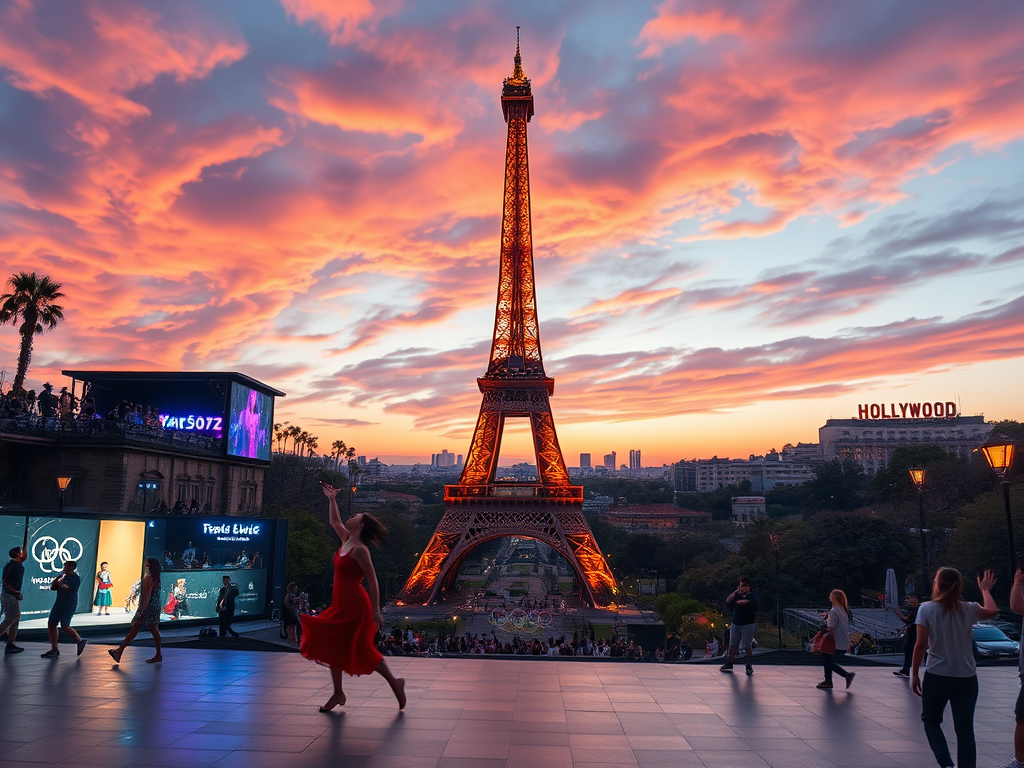

Paris, long celebrated as a global center of art and culture, set a high bar during the 2024 Summer Olympics. The French capital hosted not only sporting events but also a sweeping celebration of creativity that highlighted the deep connection between the Olympic Games and artistic expression, a tradition that dates back to ancient Greece.
Over a span of three years, the Paris “Cultural Olympiad” presented more than 2,500 official projects across more than 5,000 venues throughout France and its overseas territories. This monumental effort transformed the Olympics into an extraordinary cultural experience. Visitors could enjoy everything from theatrical productions and major museum exhibitions to innovative performances that bridged modern artistry with the Olympic spirit.
One of the highlights was the creation of an official Olympic dance by hip-hop choreographer Mourad Merzouki, designed to represent contemporary French creativity. At the Théâtre du Châtelet, a large-scale theatrical production explored the dramatic and cultural dimensions of soccer, while exhibitions at the Musée de l’Immigration and the Panthéon examined the long history of Olympic and Paralympic movements.
Cultural researchers viewed the program as more than just entertainment. “This is how you show that arts and culture are not just decorative extras but fundamental to civic identity,” said Beatriz Garcia, who authored a comprehensive report on Paris’s cultural programming. “It creates a legacy that outlives the Games themselves, offering a narrative about who we are and what values we share.”
Los Angeles Lags in Cultural Planning for 2028
With Paris’s success still fresh in memory, attention has now turned to Los Angeles, host of the 2028 Summer Olympics. Yet many local cultural leaders worry the city is falling behind. The organizing committee, LA28, has yet to unveil a clear cultural strategy. At present, only two individuals are assigned to cultural planning — and one is a volunteer. No significant fundraising efforts for large-scale cultural programming have been announced.
“By now we should be much further along,” said Laura Zucker, former executive director of the Los Angeles County Arts Commission. “There’s growing concern across the artistic community that a once-in-a-lifetime opportunity is slipping away.”
To be fair, Los Angeles has been navigating a turbulent few years. The pandemic disrupted every sector of life, while Hollywood strikes, devastating wildfires, immigration protests, and persistent homelessness strained city resources. On top of that, budget deficits and delays in major infrastructure projects such as high-speed rail have demanded attention.
Daniel Tarica, general manager of the Los Angeles Department of Cultural Affairs, admitted that recent challenges have slowed momentum but insisted he remains “wholeheartedly optimistic” that cultural planning will catch up before the Games.
The Financial Factor
Unlike many Olympic host countries, where national governments subsidize cultural programs, the United States operates on a privately financed Olympic model. LA28’s total budget stands at $7.1 billion, with the city and state responsible for any cost overruns. This structure makes officials wary of committing large sums to arts initiatives.
“We must make sure there are zero financial losses,” explained Casey Wasserman, chairman of LA28 and a well-known sports agent. He confirmed that a cultural plan will be unveiled before the end of the year but cautioned that it will be aligned with strict cost control. “We will only announce programming that we know we can deliver and afford,” he said, adding that some ideas may have to be scaled back.

Remembering Past Successes
The tradition of pairing culture with sport goes back more than a century. Past Olympiads have featured folklore in Mexico City in 1968, expansive choral festivals in Beijing in 2008, and an iconic Cultural Olympiad in Los Angeles in 1984. That earlier Los Angeles festival featured legendary dancer Pina Bausch, three full productions from London’s Royal Opera House, and ultimately led to the founding of Los Angeles Opera.
“The 1984 Olympiad was transformative for Los Angeles,” recalled Zucker. “It marked a turning point in how the city was seen as a cultural hub, which is why the arts community is so passionate about ensuring 2028 has a strong cultural dimension.”
Why Culture Matters for LA28
Arts leaders argue that a vibrant Cultural Olympiad would reinforce Los Angeles’s reputation as a world cultural capital. The timing also aligns with major new projects, including architect Peter Zumthor’s addition to the Los Angeles County Museum of Art, the opening of the Lucas Museum of Narrative Art, and the expansion of the Broad museum.
Institutions such as the Museum of Contemporary Art, which has faced financial struggles and leadership turnover, could benefit from the international attention. “There is a huge opportunity for Los Angeles to showcase its cultural identity to the world,” said Snehal Desai, artistic director of the Center Theater Group. “But that requires commissioning new works now, not waiting until the last minute.”
Some worry that LA28 may simply attach the Olympic brand to existing events instead of creating original, ambitious projects. “If they want to commission new works, they’re already late,” said Raymond T. Grant, former artistic director of the 2002 Olympic Arts Festival in Salt Lake City. “This requires serious investment and commitment. Routine programming will not be enough.”
The IOC’s Expectations
The International Olympic Committee (IOC) has made cultural programming part of its mission, explicitly encouraging host cities to blend sport with education and the arts. Contracts signed with host cities emphasize that a Cultural Olympiad should engage broad communities and foster partnerships with cultural institutions, artists, and performers.
Yet Los Angeles’s arts community feels this spirit of collaboration has not been visible. “We’re waiting for leadership,” said Danny Feldman, producing artistic director of the Pasadena Playhouse. “The pieces are all here — world-class institutions, creative talent, enthusiastic audiences. But time is running short.”

Independent Efforts Already Emerging
Some local organizations have started preparing their own Olympic-linked cultural programs. West Hollywood, for example, has launched a “Creative Triennium” designed to turn the city into a cultural hub during the 2028 Olympics and Paralympics. The Soraya Performing Arts Center in Northridge circulated a white paper urging coordinated investment and shared infrastructure to amplify cultural programming across the region.
“This is a once-in-a-generation chance to unify around a cultural vision,” wrote Soraya’s executive director, Thor Steingraber. “But that opportunity is slipping away.”
Looking Ahead
Despite frustrations, some leaders remain hopeful. Kristin Sakoda, director of the Los Angeles County Department of Arts and Culture, said the focus should be on moving forward: “Looking back won’t help. The best path is to concentrate on what can still be accomplished before 2028.”
Zucker pointed out that Los Angeles had an unusually long preparation window after winning the 2028 bid in 2017. “Commissioning new work is time-intensive. Yet instead of building steadily, there’s been a sense of starting from scratch repeatedly, with limited resources. That’s why urgency is so high now.”
For his part, Wasserman rejects the notion that cost discipline means ignoring culture. He highlights his family’s long tradition of supporting the arts and his personal involvement with the Los Angeles County Museum of Art. He also takes a broad view of what culture means. “Culture isn’t only about art museums and theaters,” he said. “It also includes fashion, cuisine, and the everyday lifestyle of the city. Millions of visitors will want to experience Los Angeles beyond the Games — the beaches, the Hollywood sign, even Disneyland. The Olympics should showcase all of it.”

Conclusion
The contrast between Paris’s 2024 Olympics and Los Angeles’s current preparations underscores the importance of cultural programming as part of the Olympic legacy. Paris demonstrated that the Games can be an expansive celebration of human creativity, not just athletic competition. Los Angeles now faces the challenge of rising to that standard while navigating financial constraints and community concerns.
If LA28 manages to launch a compelling Cultural Olympiad, it could cement the city’s reputation as a global cultural capital for decades to come. But the clock is ticking, and the world is watching to see whether Los Angeles can deliver.




Leave a Reply