
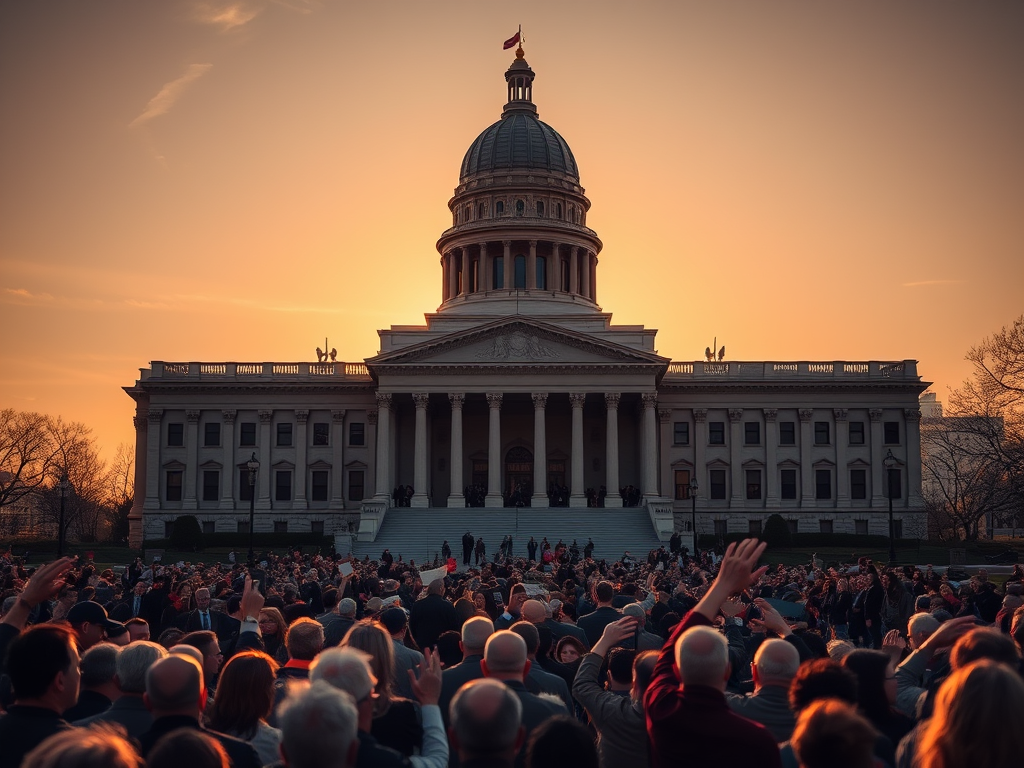

The Missouri House of Representatives has set off a political firestorm after approving a new congressional redistricting plan designed to strengthen Republican control of the state’s representation in Washington. The proposal, passed on Tuesday with a 90–65 vote, would redraw the state’s eight congressional districts in a way that increases Republican-leaning seats from six to seven. The move reflects a broader national effort, backed by former President Donald Trump, to reshape electoral maps and secure long-term advantages ahead of upcoming midterm elections.
A Contentious Debate in Jefferson City
Inside Missouri’s Capitol, the atmosphere was tense as lawmakers clashed over the measure. Democratic legislators, heavily outnumbered in the chamber, condemned the plan as undemocratic and unnecessary. They argued that the new boundaries were “shameless,” “brazen,” and amounted to political manipulation aimed at protecting Trump’s influence rather than protecting voters’ rights.
Representative Kem Smith, a Democrat from the St. Louis region, voiced a strong warning: “If we sanction this midcycle redraw, we will be joining a long and shameful line of states that have used legal language to silence voters rather than to protect them.”
Typically, congressional maps are redrawn only once every ten years following the release of census data. Missouri last completed this process just three years ago. Democrats contend that revisiting the issue mid-decade is both legally questionable and damaging to democratic norms.
Republicans countered that they are fully within their authority to revisit district lines. State Representative Dirk Deaton, a Republican supporter of the plan, argued that the map “meets every constitutional requirement” and provides a “better representation of Missouri.”
Impact on Missouri’s Political Landscape
The most dramatic change would affect Representative Emanuel Cleaver’s Kansas City-based district. Cleaver, a Democrat who has served in Congress for two decades and was once Kansas City’s first Black mayor, represents an urban area with a diverse population. Under the new proposal, the district would be carved up and merged with more conservative rural regions. Critics say this would effectively dilute the voting strength of urban communities and minority populations.
If enacted, the new map would leave Democrats with only one reliably safe district—the St. Louis-based seat, where Black voters form a plurality. Any substantial changes to that district could trigger lawsuits under the Voting Rights Act.
The proposal underscores Missouri’s dramatic political shift over the past two decades. Once considered a battleground state, Missouri now reliably votes Republican. Trump carried the state by 19 points in the last presidential election, and Republicans hold every statewide office.
Democratic Pushback and Grassroots Resistance

Despite their limited numbers in the legislature, Democrats are mobilizing against the redistricting plan. They have scheduled rallies, town halls, and protests, including one planned for the Capitol this week. The Democratic National Committee even announced that lawmakers from Ohio would travel to Missouri to join demonstrations, signaling concern that the Missouri plan could inspire similar moves in other Republican-controlled states such as Indiana and Ohio.
Representative Wick Thomas of Kansas City questioned the long-term implications of frequent redistricting: “We just redistricted three years ago. Are we going to redraw the lines every time we don’t like the outcome? What does that say about our Republic, our state, our democratic institutions?”
Some Democrats also raised concerns that the proposal intentionally undermines the political power of Black and nonwhite voters, a charge Republicans reject. Nonetheless, both parties acknowledged that lawsuits challenging the map are almost inevitable. Democratic leaders have also signaled plans to pursue a veto referendum, a process that could pause the law and send the issue to Missouri voters in a statewide election.
Fractures Within the Republican Party
Although Republicans enjoy a commanding majority, not every member of the party supported the redistricting measure. House Speaker Jonathan Patterson was among the Republicans who voted against it. Representative Tony Harbison, from southeast Missouri, openly criticized the decision to prioritize redistricting over more pressing state issues. “Our plate is full of things we need to be doing for the people of this state, and this ain’t one of them,” Harbison said, drawing applause from Democrats.
Still, Governor Mike Kehoe, who called the special session that produced the map, has strongly supported the proposal. He and other Republican leaders argue that the new districts will give voters a more accurate reflection of Missouri’s political reality.
National Implications and Broader Redistricting Battles
The Missouri debate is part of a much larger national struggle over redistricting. Across the United States, both Republicans and Democrats are engaged in fierce battles to redraw congressional boundaries in ways that could determine control of the U.S. House for years to come.
In Texas, Republican lawmakers—encouraged by Trump—recently pushed through maps that eliminated five Democratic-leaning districts. Meanwhile, Democrats in California countered with their own proposal to eliminate Republican-leaning districts. The result has been a growing patchwork of partisan maps, each designed to maximize advantage in an era of razor-thin congressional majorities.
Missouri’s case has attracted outsized attention because of the state’s symbolic role. Once viewed as a bellwether, its steady drift toward the GOP mirrors broader national trends in rural and Midwestern states. Republicans in Missouri argue that the new map ensures their dominance reflects the majority’s will, while Democrats insist it undermines fair representation and voter equality.
Concerns About Democratic Institutions
For Democrats in Missouri, the redistricting fight is about more than congressional seats. They see it as part of a broader Republican campaign to limit citizens’ ability to influence state government. At the same time the House approved the new map, lawmakers advanced another measure that would make it more difficult for voters to amend the State Constitution through citizen-led ballot initiatives.
In recent years, Missouri voters have used initiatives to pass measures on issues ranging from abortion rights to healthcare expansion, often against Republican leadership’s wishes. Critics argue the new measure would weaken direct democracy in the state.
Representative David Tyson Smith of Columbia put the stakes in stark terms: “Our Republic is on the brink. A thousand years from now, people will look back and ask, what did we do today?”
Looking Ahead
The proposed map now heads to the Missouri Senate, where it is expected to pass given the Republican majority. From there, it would go to Governor Kehoe’s desk for final approval. But the political and legal battles are far from over. Court challenges are likely, and Democrats are preparing for a veto referendum campaign.
For Missouri residents, the debate over district lines has become a flashpoint in a larger conversation about democracy, fairness, and representation. For the nation, it is another reminder of how redistricting battles can shape the balance of power in Congress.
As midterm elections approach, the Missouri case highlights the deep divisions that continue to define American politics. Whether voters see the new map as a reflection of their voices or as a distortion of democracy may ultimately determine not just Missouri’s political future, but also the trajectory of national governance in the years ahead.




Leave a Reply