
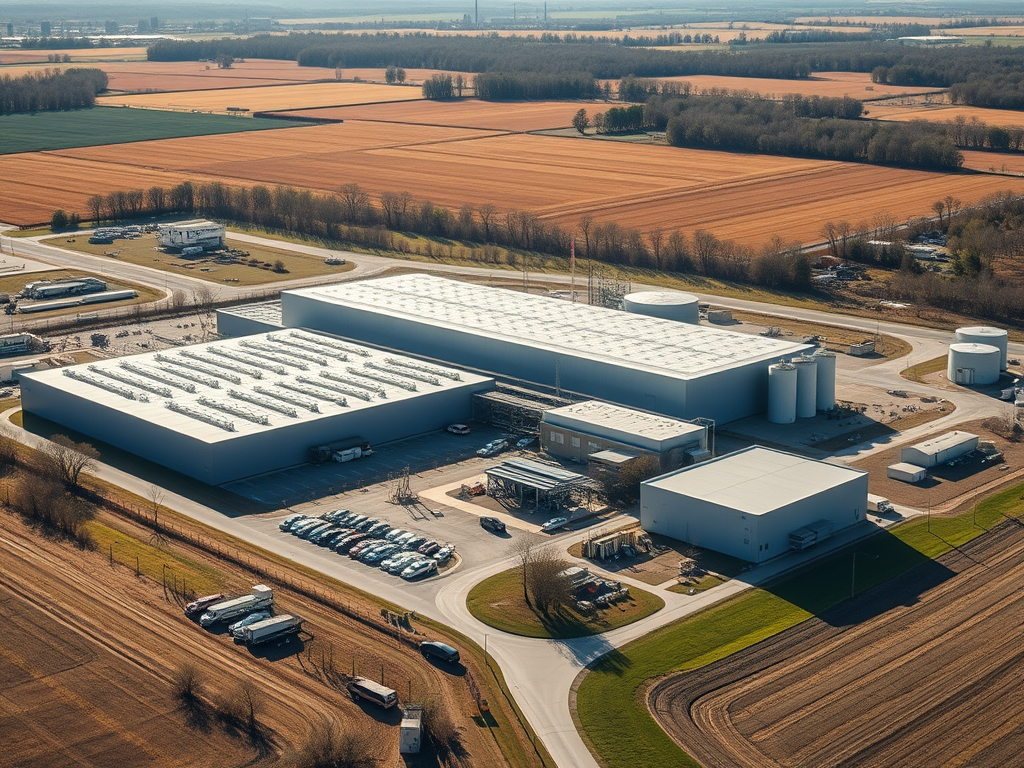

In the quiet rural outskirts of southeast Georgia, just a short drive from Savannah, a sweeping transformation has been underway. Once known for farmland and sleepy towns, the area has become the epicenter of a bold vision: a manufacturing hub capable of producing nearly half a million vehicles each year. This sprawling industrial development has symbolized not only the rise of clean energy in the United States but also the growing ambitions of South Korean automakers eager to secure a lasting foothold in the American market.
For years, Georgia officials worked tirelessly to attract South Korean investment, seeing the opportunity to reshape the region’s economy with high-tech jobs and billions in foreign capital. That dream, however, faced a sharp and sudden disruption last Thursday when federal immigration agents conducted an unexpected raid on one of the complex’s centerpiece projects — a massive electric vehicle (EV) battery plant jointly operated by Hyundai Motor Group and LG Energy Solution.
The operation, described by U.S. authorities as the largest single-site enforcement action in Homeland Security’s history, resulted in the arrest of nearly 500 workers. Many of those detained were South Korean citizens brought in to help with construction. The raid halted progress at the $12.6 billion facility and immediately cast doubt on the future of a project once hailed as a cornerstone of U.S.-South Korea economic partnership.
A Clash of Priorities: Manufacturing Growth Meets Immigration Crackdown
The raid exposed a deep contradiction at the heart of U.S. policy. On the one hand, American leaders — particularly in Georgia — have aggressively courted South Korean companies with lucrative subsidies, tax breaks, and public commitments. Hyundai alone has pledged to invest more than $40 billion into U.S. facilities between 2025 and 2028, on top of billions already spent. Much of this expansion has been spurred by federal incentives for electric vehicles and semiconductors passed during the Biden administration, along with strong support from state governments in the Southeast.
On the other hand, the Trump administration’s hardline stance on immigration has clashed with the labor demands of these ambitious projects. Building giant factories requires thousands of workers, and with construction labor shortages across the country, contractors often look overseas. Federal officials said the Georgia raid followed a months-long investigation into “unlawful employment practices” at the HL-GA Battery Company site. Margaret E. Heap, the U.S. attorney for southern Georgia, explained the enforcement was meant to prevent employers from gaining “an unfair advantage by hiring unauthorized workers.”
For local communities, the raid struck at existing tensions. Residents of Ellabell, a small unincorporated town where the plant is located, have been divided over the pace of change. While some welcome new jobs and business opportunities, others fear the region is being reshaped too quickly, with little input from long-term residents.
Shockwaves Across the Pacific
The fallout from the raid has not been contained within Georgia. In Seoul, South Korean officials voiced frustration with Washington, worried that the arrests could sour relations and undermine years of goodwill. For South Korean executives, the message seemed contradictory: the U.S. government seeks massive foreign investment but is willing to disrupt billion-dollar projects over immigration disputes.
Tami Overby, a former head of the U.S.-Korea Business Council, summed up the sentiment: “Talking to my colleagues in Asia, one said, ‘We’re hearing mixed signals — you want our investment, but not our people.’ It’s sending a chilling message through boardrooms across Asia.”
South Korea and the United States eventually reached an agreement to repatriate detained Korean workers, but details about their employment status, roles at the construction site, and work conditions remain unclear. As of now, no criminal charges have been filed.
Local Voices: Promises and Frustrations
Within Georgia, labor leaders and local politicians have raised sharp concerns. Some allege that undocumented workers may have been hired in place of local tradesmen. Barry Zeigler, representing plumbers, welders, and HVAC technicians at UA Local Union 188, argued that Georgians were promised these jobs. His members, he said, were dismissed from the project months ago despite being fully qualified.
“I don’t have a problem with Koreans being here and working hard,” Zeigler said. “But unauthorized workers taking opportunities away from us — that’s different.”
The controversy has been further fueled by reports of worker fatalities at the complex. Three workers have died since 2021, raising questions about safety standards. Neither Hyundai nor LG Energy Solution has directly commented on employment practices, though both companies confirmed that contractors and partner employees were affected by the raid. Hyundai stated that none of its direct employees were detained but pledged to review labor practices across its subcontractors.

Economic Stakes: Billions in Play
The numbers at stake are staggering. The Hyundai-LG EV plant alone is expected to employ 8,500 people by 2031, with state and federal governments offering up to $2.1 billion in incentives. In total, the complex — stretching over 2,900 acres — has been marketed as a project that could generate nearly 40,000 jobs across Georgia. The development includes not only production facilities but also solar-powered parking lots, recreational areas, and green spaces designed to highlight its sustainability.
Yet for many residents, the reality has been more complicated. Country roads once used by tractors now struggle under five lanes of traffic. Commutes have doubled, and the small-town character of Ellabell feels permanently altered. Long-time resident Jennifer Mutcherson expressed her frustration: “This is a small community. Nobody asked us if we wanted this here.”
Trade Tensions and Tariffs
The timing of the raid comes as U.S.-South Korea economic ties are already strained by tariffs. Hyundai reported losing more than $600 million in the second quarter due to Trump’s 25 percent tariff on automobiles. In response, South Korea struck a deal with the White House in July to set tariffs at 15 percent for other imports while pledging to invest $350 billion into the U.S. economy.
For companies balancing supply chain challenges, steep tariffs, and immigration uncertainty, the Georgia raid adds another layer of risk. “It’s like running with a weighted vest,” explained Didi Caldwell, CEO of Global Location Strategies. “Every policy change or enforcement action makes the investment environment that much heavier.”
A Community in Transition
Despite the uncertainty, the new arrivals have already left a mark on Ellabell. Small businesses catering to Korean workers have opened, such as Viet Huong grocery, which stocks Korean staples from red bean paste to bone soup. Store owner Sammie Rentz said business was booming thanks to the influx of Korean workers. Now, he fears the raid will devastate his investment. “Korean workers keep this store going,” he said. “And now everything is up in the air.”
For some, the raid also revives long-standing cultural challenges. Abraham Kim of the Council of Korean Americans noted that the arrests risk fueling harmful stereotypes. “Our community has worked hard to overcome the idea that Asians are outsiders in America. This kind of event takes us a step back.”
Looking Ahead
Georgia’s governor, Brian Kemp, has been one of the strongest advocates for South Korean investment, visiting the country multiple times and celebrating each new announcement — from battery plants to semiconductor material facilities. Yet his administration has also supported tough immigration enforcement, even involving the Georgia State Patrol in last week’s raid. His office reaffirmed: “In Georgia, we will always enforce the law, including all state and federal immigration laws.”
This dual commitment — welcoming billions in investment while aligning with strict immigration policies — highlights the tightrope Georgia must walk. For companies like Hyundai and LG, the question remains whether the U.S. is truly a reliable partner for long-term investment.
As Ellabell residents, business owners, and Korean executives wait for clarity, one thing is certain: the raid has transformed what was once a symbol of shared economic opportunity into a flashpoint of political, cultural, and economic tension. The future of the $12.6 billion complex, and the broader U.S.-South Korea partnership in clean energy manufacturing, hangs in the balance.




Leave a Reply