
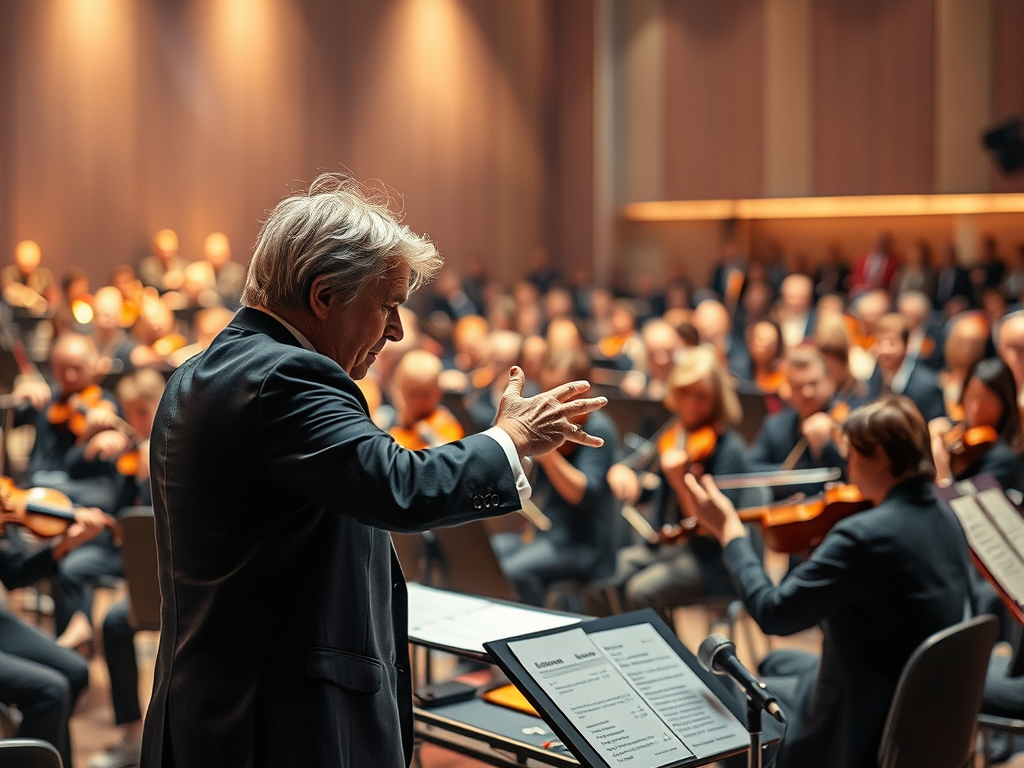

For decades, conductor and composer Esa-Pekka Salonen has been recognized as one of the most innovative figures in classical music, constantly testing the limits of tradition and pushing his art form into new territory. His career has been defined by a restless curiosity: experimenting with virtual reality in performance, exploring the connections between scent and sound, and even lending his name and artistic vision to high-profile Apple campaigns that presented him as the image of the modern artist. Now, at the age of 67, Salonen is once again reshaping the landscape of orchestral leadership, moving away from the conventional model of the music director and instead inventing new artistic roles designed for the future of classical music.

Salonen recently stepped down from his position as music director of the San Francisco Symphony, a tenure that ended amid financial strain at the institution and disagreements with its leadership. Instead of returning to the traditional path and assuming another directorship, he has forged a fresh chapter in collaboration with major institutions in Los Angeles and Paris. On Tuesday, the Los Angeles Philharmonic announced that Salonen will become its first-ever creative director beginning in the fall of 2026. At nearly the same time, the Philharmonie de Paris revealed that he will take on its inaugural chair of creativity and innovation starting in 2027, while also assuming the post of principal conductor of the Orchestre de Paris. These twin appointments will allow him to redefine the role of the maestro and perhaps even question whether the old model of music directorship still has relevance in today’s cultural environment.
In a recent interview, Salonen reflected on his decision. “One morning, I realized that I had been a music director or something like that for 40 years,” he said with a mix of humor and candor. “And I thought, maybe that’s not the only option.” This realization became the starting point for a reinvention of his professional life, one that blends artistic leadership, festival design, cross-disciplinary projects, and traditional conducting into a hybrid role unlike anything classical music has seen before. Each of his new contracts will initially last for five years and will include a wide range of responsibilities, from programming concerts and commissioning new works to organizing festivals that experiment with form and presentation. He will be working at Walt Disney Concert Hall in Los Angeles and across the wide cultural campus of the Philharmonie in Paris, two venues ideally suited for ambitious projects that bring together music, technology, and other art forms.
Although these roles expand beyond the standard duties of a music director, Salonen will still conduct regularly in both cities. His commitment includes six weeks annually with the Los Angeles Philharmonic and eight weeks with the Orchestre de Paris. In addition, he will oversee a new international conducting fellowship that links Los Angeles and Paris, training the next generation of maestros. This balance of performance and creativity is designed to keep Salonen firmly connected to the podium while giving him the freedom to rethink how orchestras engage with audiences in the twenty-first century.

Salonen has spoken about entering what he jokingly calls the “senior citizen” phase of his career, where perks like discounted movie tickets coincide with unique professional opportunities. Yet beneath the humor lies a deeper context. His departure from San Francisco was turbulent, shaped by financial struggles and strategic disagreements that limited his artistic ambitions. The chance to work with two of the world’s most dynamic orchestras on terms aligned with his vision marks a significant turning point. “The Philharmonic in Los Angeles and the Orchestre de Paris share the same goals as I do,” he explained, noting that such alignment has not always been the case in his professional journey.
Salonen is no stranger to either city. He was the music director of the Los Angeles Philharmonic from 1992 to 2007, a transformative era during which he championed new music, expanded the orchestra’s international profile, and oversaw the opening of Walt Disney Concert Hall. His relationship with Paris stretches back decades, with memorable projects such as a monumental staging of Mahler’s “Resurrection” Symphony directed by Romeo Castellucci and a choreographed performance of Pierre Boulez’s “Rituel in Memoriam Bruno Maderna” with dancer Benjamin Millepied. These collaborations established him as a figure equally at home in the French and American musical worlds, making him a natural bridge between the two.
The timing of Salonen’s appointments is significant. Both the Los Angeles Philharmonic and the Orchestre de Paris face looming vacancies in their music director positions. Gustavo Dudamel, a beloved figure in Los Angeles, will soon depart to lead the New York Philharmonic, while Klaus Mäkelä will leave Paris in 2027 to take on leadership of both the Royal Concertgebouw Orchestra in Amsterdam and the Chicago Symphony Orchestra. In many ways, Salonen’s new positions blur the line between traditional directorship and innovative leadership, prompting speculation about whether either orchestra will actually need to replace Dudamel or Mäkelä in the conventional sense. The Orchestre de Paris has already indicated that it does not expect to appoint a new music director, while the Los Angeles Philharmonic has confirmed that it will continue its search but will separate the artistic title from the position. Kim Noltemy, the Philharmonic’s president and chief executive, emphasized that the creative director role, permanently endowed by Judith and Thomas L. Beckmen, will remain a lasting fixture of the institution.
The Philharmonie de Paris, with its sprawling complex of concert halls, exhibition spaces, and educational facilities, has often been compared to Lincoln Center in New York. Its founding spirit was shaped by the legendary composer and conductor Pierre Boulez, and Olivier Mantei, the Philharmonie’s general director, has described Salonen as the ideal person to carry forward Boulez’s innovative legacy. “Having Salonen, who knew Boulez well, continue that spirit will be a new marvel for us,” Mantei said. For Salonen, the scale of the Philharmonie presents an irresistible challenge. He has already begun planning a festival for 2027 that will be shared by both Los Angeles and Paris, a project that underscores his belief in international collaboration and boundary-crossing artistic ventures. “It’s a fantastic campus,” he said of the Philharmonie. “If I can find a way to use all of it, I will.”
Underlying all of this is a larger question that Salonen himself has raised: should the traditional model of the music director, with its rigid hierarchy and responsibilities, be reconsidered? “I think every orchestra on the planet should really take a good look at the model as we know it,” he said. “Is this something that can be modified or even abandoned, or something maybe not in sync with the rest of the world? I don’t know. But this kind of deal I’m entering is good because both places have the space to explore what the answer would be.” His words reflect the wider debate within the classical music world, where institutions are searching for ways to stay relevant to new audiences while maintaining their core traditions.
Esa-Pekka Salonen’s new chapter represents more than just a personal career shift. It signals a broader rethinking of leadership in classical music at a time when orchestras face changing demographics, financial pressures, and questions about cultural identity. By taking on these unique positions in Los Angeles and Paris, Salonen is challenging the industry to imagine new ways forward—models that combine artistic vision, innovation, and global collaboration. Whether his experiment will redefine the role of the maestro for future generations remains to be seen, but one thing is clear: his relentless pursuit of innovation is once again setting the tempo for the world of classical music.




Leave a Reply