

On the misty hillsides of Sonoma County, California, rolling vineyards and sprawling farmlands paint a picture of idyllic country life. Cows graze beneath the shade of old oak trees, lambs peek curiously through wooden fences, and farm-to-table restaurants proudly feature organic eggs, artisan cheeses, and local chardonnay. The region, often referred to by locals as “America’s Provence,” has built its reputation on sustainability, humane farming, and high-quality agriculture.
With nearly 3,000 farms, Sonoma County has long been associated with progressive values and organic practices. Yet even this reputation has not shielded local farmers from a mounting conflict with some of the country’s most radical animal rights activists.
This ongoing battle involves lawsuits, restraining orders, viral videos, and even political campaigns. It has caught the attention of celebrities and the national press, as activists challenge not only how animals are treated, but whether they should be part of agriculture at all. At the center of the dispute is a new generation of activists using social media, public protests, and “open rescues” to push for the abolition of animal farming.

A Trial That Could Set the Tone
This month, all eyes are on the trial of Zoe Rosenberg, a 23-year-old University of California, Berkeley student and activist with Direct Action Everywhere (DxE). She faces up to six years in prison for allegedly breaking into Petaluma Poultry, one of Sonoma’s best-known organic chicken suppliers, and removing four chickens she claimed were being mistreated.
Rosenberg argues that the birds she found were suffering from infections, high fevers, and untreated injuries. She further alleges that the slaughter line was moving so quickly that some chickens were being scalded alive. To her, this trial is not about theft but about rescue.
Her case echoes a growing pattern: DxE members frequently enter farms and slaughterhouses without permission, filming conditions they argue prove systemic abuse. The videos, often showing cramped barns, wounded animals, and disease, are uploaded online and quickly spread across social platforms, sometimes gathering millions of views.
The Rise of Direct Action Everywhere
Founded in 2013 in Berkeley, DxE has rapidly become one of the most visible voices in the modern animal rights movement. Unlike campaigns of the past that focused on boycotts or vegetarian outreach, DxE emphasizes “open rescues” and theatrical protests.
Members have stormed Costco stores covered in fake blood, interrupted dinners at upscale restaurants such as Chez Panisse, and glued themselves to grocery store freezers while denouncing animal cruelty. Their ultimate goal is not incremental change, such as better cage standards, but a complete end to animal agriculture.
“Even on farms labeled organic or free-range, we see animals suffering and dying,” said Cassie King, a DxE spokeswoman. “People are misled by marketing. We want to expose the truth and build a movement strong enough to dismantle the system.”

Sonoma County: A Battleground of Values
The choice of Sonoma County as a focus is no accident. With its reputation for humane, organic, and sustainable farming, it offers DxE a chance to challenge what they call the myth of “ethical meat.”
Historically, Sonoma’s fertile soil and coastal climate attracted immigrants who built thriving communities around apples, wheat, wine grapes, and livestock. By the early 20th century, Petaluma became known as the “Egg Basket of the World,” supplying millions of eggs to San Francisco. Over time, vineyards and organic farms took center stage, with businesses like Clover Sonoma and Petaluma Poultry pioneering certifications in humane and sustainable farming.
Many locals take pride in these advances. “We have free-range cattle that live with ocean views nicer than my own,” said Lynda Hopkins, a Sonoma County supervisor and small farmer. “We’ve worked hard to raise animals responsibly.”
But DxE is unmoved. The organization believes that no amount of reform can make animal agriculture ethical, because animals should not be used for food at all.


Tensions Escalate: Lawsuits and Protests
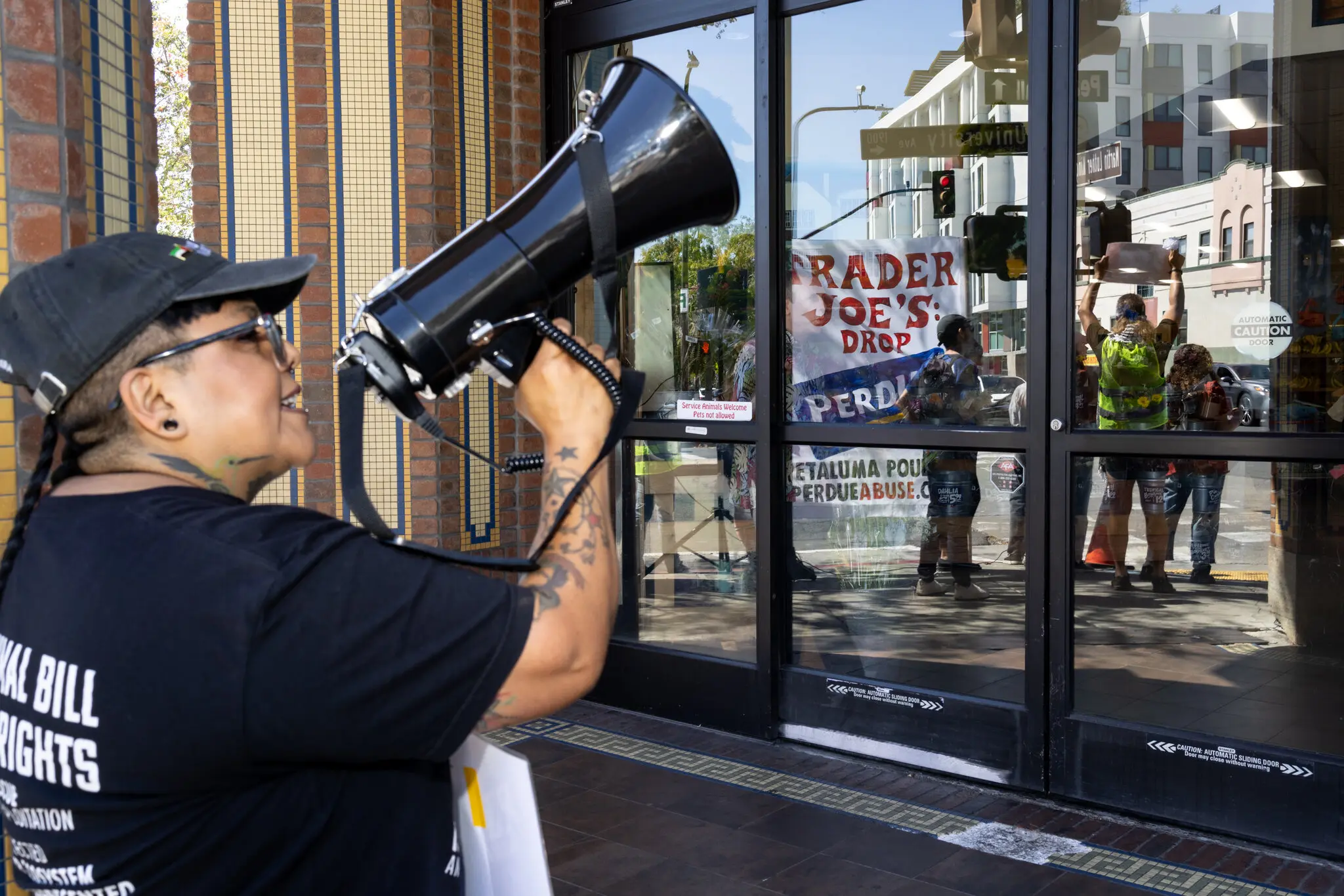
The standoff has grown increasingly tense. DxE has staged repeated protests at Sonoma farms, Costco locations, and even private homes of industry executives. In response, companies have begun to push back through the courts.
Perdue Farms, the parent company of Petaluma Poultry, has strongly denied Rosenberg’s claims and insists it maintains high animal welfare standards. Perdue sued DxE for protesting outside a Sonoma County executive’s residence, accusing the group of spreading misinformation.
Trader Joe’s also filed a lawsuit against the activists after several protests disrupted stores, where DxE members allegedly pulled chicken from customer carts and glued themselves to meat cases.
Despite these legal battles, DxE continues to argue that the shock tactics are necessary. Their strategy is less about persuading individuals to go vegan and more about drawing global attention to animal suffering through viral media campaigns.
A Political Push — and Defeat
DxE’s activism has extended beyond farms and grocery aisles into local politics. Last year, the group supported a ballot measure that would have forced at least 10 large animal farms in Sonoma County to close or drastically reduce operations. Even in a liberal stronghold, the proposal was overwhelmingly rejected, with only 15 percent of voters in favor.
Still, some analysts say DxE achieved what it wanted: visibility. “The point isn’t necessarily to win,” explained David McCuan, a political science professor at Sonoma State University. “The point is to demonstrate that there is a constituency, even in a place like Sonoma, that supports radical animal rights.”

Farmers on the Defensive
For local farmers, the constant scrutiny feels unfair. Many argue that DxE oversimplifies complex agricultural practices and ignores improvements in animal welfare.
Doug Beretta, a third-generation dairy farmer, said he spent $5,000 building a fence to block activists from filming his calves. “They don’t understand what animal agriculture really looks like,” he said. His daughter Jennifer has turned to TikTok to share videos of green pastures and family farm life in an attempt to counter DxE’s narrative.
“We can’t really reason with them,” Beretta said. “They’ve already decided we’re the enemy.”
What Comes Next
The outcome of Rosenberg’s trial could influence the future of activism in the region. California juries have sometimes sided with activists — most notably in 2023, when DxE members were acquitted after removing two chickens from a Foster Farms slaughterhouse. In that case, jurors accepted the argument that rescuing neglected animals was justified.
If Rosenberg is acquitted, farmers fear it could embolden DxE to intensify raids and protests. If convicted, the group may gain even more attention and sympathy from supporters who see her as a martyr for animal rights.
For now, the conflict in Sonoma County underscores a broader national debate: Can farming be both ethical and sustainable, or is the very act of raising animals for food inherently inhumane?
What is certain is that the rolling vineyards and organic dairies of “America’s Provence” have become an unexpected frontline in the battle over the future of food.




Leave a Reply