
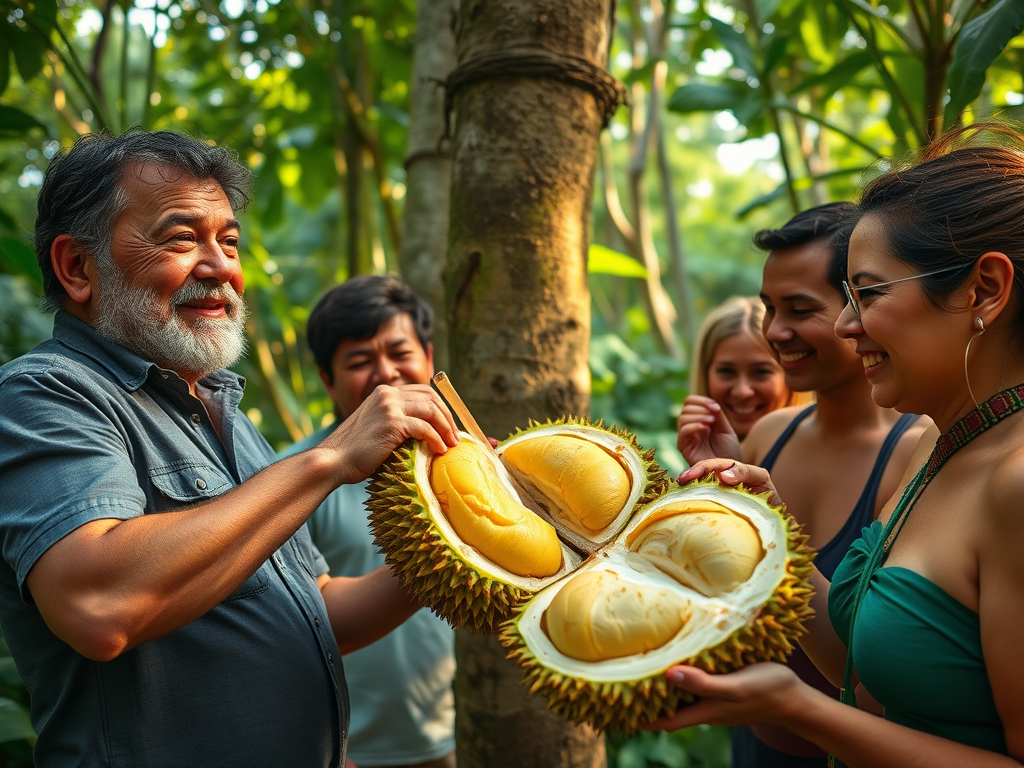

Juan Miranda Colón leaned against a tree on a humid afternoon in Puerto Rico, the rainforest buzzing with cicadas, as the spiky fruit he had been waiting for all year was finally split open. He did not call it a “smell.” For him, it was an “aroma,” rich, intoxicating, and irresistible. The farmer’s eyes lit up as the first creamy spoonful of durian flesh touched his lips.
“I believe this is the greatest fruit on Earth,” he declared with absolute conviction, watching fellow enthusiasts eagerly scoop the golden custard-like flesh into their mouths. “Once I start eating, I just can’t stop. I wish I had a second stomach.”
For Mr. Miranda, durian is not simply food. It is a passion, a ritual, and a yearly celebration. And he is not alone. Every summer, a diverse group of travelers—engineers from Tennessee, doctors from California, couples from Florida, and families from Texas—make the long trek to Panoramic Fruit, a farm perched high in the mountains above Mayagüez, Puerto Rico. Their shared mission: to taste one of the rarest fruit harvests available in North America.
A Gathering of Global Fruit Fanatics
Panoramic Fruit is owned by Ian Crown, a Massachusetts resident who spends part of each year on his 94-acre tropical orchard. To him, the farm is more than land—it is a living laboratory of rare treasures: rambutan, mangosteen, pulasan, cupuaçu, and of course, durian. “I like to call them the rare-fruit fanatics,” Crown said of his visitors. “They travel far and wide just for this experience.”
While Southeast Asia grows durian in abundance, with China alone importing over $7 billion worth in 2023, the fruit is still largely unfamiliar to most Americans. Its intimidating spikes and polarizing odor have earned it a reputation that ranges from “heavenly custard” to “rotting garbage.” The late chef Anthony Bourdain once joked it smelled like a corpse left in the sun.
Yet despite—or perhaps because of—its divisive nature, durian commands an obsession unlike any other tropical fruit.

From Southeast Asia to the Americas
In Malaysia, Thailand, and Indonesia, durian is celebrated as the “king of fruits.” Stalls line the streets during harvest season, and festivals attract crowds eager to sample its hundreds of unique varieties. But in the United States, fresh durian remains a rarity, partly because its pungent aroma complicates shipping and storage.
At H Mart in Queens, New York, a sign next to a durian display once reassured nervous shoppers: “Do not worry, it is not a gas leak.” For those who crave it, however, these challenges only fuel its allure.
Entrepreneur Lindsay Gasik, who runs a business importing frozen durian from Malaysia, believes America is on the brink of a durian boom similar to the avocado craze of the 1990s. “The U.S. is a sleeping giant,” she said. “It’s only a matter of time before people here embrace durian the way they did avocados.”
Her company began with just a few boxes in 2019. By 2023, she was shipping containers holding thousands of pounds of durian to hungry fans across the country.

A Rare Paradise in Puerto Rico
For now, one of the only places to enjoy fresh durian in the continental U.S. sphere—outside of Hawaii—is at Panoramic Fruit. Each summer, the farm transforms into a judgment-free paradise for durian lovers.
Among them are Yen Vu and Gleb Chuvpilo, a couple living in San Juan. They loaded eight medium-sized durians, about $5 per pound, into their car. While the stash could easily feed a family for days, they admitted it would probably be gone within a weekend. Their devotion to the fruit has even taken them across the world to Borneo, just to feast on its many varieties.
Durian has also shaped their relationship. Vu, originally from Vietnam, recalls asking Chuvpilo early on whether he liked the fruit. His answer was yes, and that sealed the deal. “If he had hated it, things might not have worked out,” she joked.

Fruit and Memory
For many, durian carries strong memories of childhood. Teresa Chang, a doctor from California, remembers the excitement when her family brought home durian during her upbringing in New York. “Someone would shout, ‘Get the cleaver!’ and we’d all gather around,” she recalled. The creamy fruit instantly transported them back to Taiwan summers, where durian and other tropical fruits defined family gatherings.
“It’s not just the flavor,” she said. “It’s the nostalgia—the sticky fingers, the hot air, the juice dripping down your chin.”
Tasting durian can be surprisingly complex. One fruit might offer flavors of caramelized sugar, while another suggests hints of almonds, crème brûlée, or even bubblegum. At times, the flavor profile resembles rich dairy desserts, despite growing straight from a tree. Crown himself described it as “a kick in the head followed by creamy sweetness.”

Building a Farm for the Future
Crown purchased the Puerto Rican property in 1994, determined to create an orchard that would thrive in the island’s fertile climate. Once a cattle ranch, coffee plantation, and sugar cane field, the land was reinvented as a haven for rare fruits. He first planted rambutan and mangosteen but soon realized his farm would be incomplete without durian.
“Everyone insisted—‘You have to plant durian!’” he recalled. So, before he even tasted it, he put trees in the ground. Years later, he has no regrets. “I’ve had cheese experiments in my fridge that smell worse,” he laughed.
Farm manager Roberto Luciano, however, had the opposite reaction when the fruit first ripened. “I have a weak stomach,” he admitted. “The smell was too much.” Even today, his role often involves turning away uninvited visitors desperate to buy durian. With only about 40 trees, the harvest is limited and highly coveted.
A Divisive Taste
Not everyone who comes to Panoramic Fruit leaves as a convert. Attorney Gerry Grunsfeld, who manages a popular Facebook group called “fruit 4 sale,” remembers his first taste vividly—and not in a good way. “It was like spoiled onions,” he said, recalling hours of unpleasant aftertaste.
Yet, surrounded by durian devotees who raved about its flavor, he gave it another try. With a sliver of golden flesh between his fingers, he sniffed, hesitated, then bit down. After a pause, he shook his head. “Still onions,” he muttered, spitting it out.
For some, durian remains an acquired taste they may never acquire. For others, it is nothing short of divine.

The Future of Durian in America
As demand for exotic fruits grows, Puerto Rico’s durian harvest may represent the beginning of a larger trend. With the rise of Asian supermarkets, online fruit delivery, and specialty importers, access to durian is improving. And as more Americans are exposed to its rich, custard-like flesh, its reputation may shift from curiosity to mainstream obsession.
What remains undeniable is the passion of those who love it. For people like Miranda, Vu, and countless others, durian is not simply a fruit—it is a cultural bridge, a memory trigger, and a source of joy that defies explanation.
Perhaps, as Gasik suggests, America is merely waiting for its moment of awakening. If so, the day may soon come when durian no longer hides in specialty aisles with warning signs, but proudly claims its place alongside bananas, avocados, and mangoes as a staple of tropical fruit culture in the U.S.
Until then, Panoramic Fruit remains a sanctuary where, each summer, the king of fruits reigns supreme—loved, hated, but never ignored.




Leave a Reply