
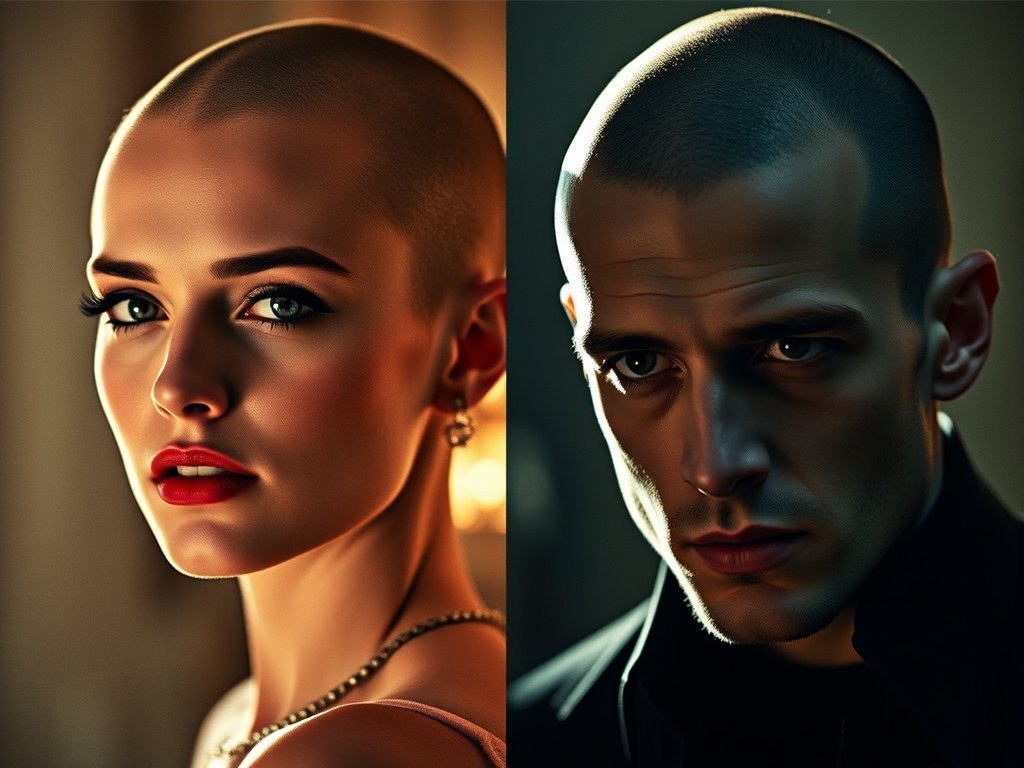

The Venice Film Festival has always been a stage for bold cinematic statements, but this year the spotlight isn’t only on films—it’s also on hair, or rather, the lack of it. A surprising trend has emerged among some of the festival’s most talked-about stars: going bald. What might sound like a simple style choice has turned into a cultural talking point, blending themes of transformation, vanity, and artistic dedication.
Scrolling through Instagram during a rare break at the festival, I noticed my friend Marco had just shaved his head. Without realizing it, he had joined the unofficial club of the season’s most striking look. This wasn’t just coincidence. On screen, Emma Stone appears with a shaved head in Yorgos Lanthimos’s new film Bugonia, while Jacob Elordi embraces the smooth, polished look as the creature in Guillermo del Toro’s Frankenstein. The bald aesthetic is suddenly everywhere, and it’s becoming a cinematic symbol with deeper resonance than mere fashion.
Emma Stone in Bugonia: A Bold Performance Choice
In Bugonia, Stone takes on the role of Michelle, a powerful executive in the pharmaceutical industry. Her character is kidnapped by Teddy, played by Jesse Plemons, who believes she is an alien plotting against humanity. As part of his twisted logic, Teddy shaves Michelle’s head, convinced her alien allies could trace her through strands of hair.
The scene could have easily been played for shock value, but Stone’s shaved look becomes a cornerstone of the performance. Known for her transformative roles in Lanthimos’s films—The Favourite and Poor Things already earned her critical acclaim—Stone once again demonstrates her willingness to commit physically and emotionally. While she admitted at the festival press conference that going bald was surprisingly easy (“you just take the razor and go”), the act carries symbolic weight. It strips away vanity and places raw vulnerability front and center, amplifying the tension between Michelle and her unstable captor.
Even if Bugonia doesn’t achieve the mainstream appeal of Poor Things, Stone’s drastic transformation ensures that her performance won’t be forgotten during awards season. Hair or no hair, her presence commands attention, and the buzz around her role proves once again that she thrives when paired with Lanthimos’s unflinching vision.

Jacob Elordi in Frankenstein: Reinventing the Monster
While Emma Stone embraced the razor for real, Jacob Elordi may have relied on makeup and prosthetics to achieve his hairless transformation in Guillermo del Toro’s Frankenstein. Regardless of technique, the result is striking. Elordi’s creature emerges pale, muscular, and bald, embodying both menace and innocence.
Del Toro explained that the design drew inspiration from 19th-century phrenology diagrams, aiming to highlight the creature’s vulnerability and childlike qualities rather than just his monstrosity. Unlike previous versions of Shelley’s iconic creation—often scarred, stitched, and grotesque—Elordi’s creature is sculptural, almost statuesque. The look captures the tension between beauty and horror, evoking Ridley Scott’s Prometheus while remaining distinctly Del Toro.
Elordi’s performance is equally transformative. Known to many for his brooding role in HBO’s Euphoria, he risks typecasting as the archetypal attractive young actor. Yet in Frankenstein, the bald look strips away the matinee-idol charm, allowing a more vulnerable and layered portrayal to shine through. He balances physical power with emotional sensitivity, offering a soulful take on a role too often reduced to a caricature of terror. Some critics at Venice even suggested that this could propel him into serious awards consideration—an impressive leap for an actor still early in his career.
Bald as a Cinematic Statement

Why is baldness suddenly everywhere on the red carpet and the big screen? The answer lies in its symbolism. A shaved head in cinema has long been associated with transformation, rebirth, or radical vulnerability. From Sigourney Weaver in Alien 3 to Charlize Theron in Mad Max: Fury Road, the decision to remove hair often signals strength, defiance, or complete reinvention.
For Stone, it emphasizes her character’s loss of control and vulnerability under captivity, while paradoxically making her appear even more commanding on screen. For Elordi, it distances him from his past roles and allows audiences to see him with fresh eyes. Both performances underscore how a simple aesthetic choice can deepen character immersion and narrative impact.
Beyond symbolism, baldness also challenges Hollywood’s obsession with surface beauty. Ironically, shaving it all off often enhances features like cheekbones or jawlines, reminding audiences that true star power doesn’t depend on flowing locks. It is no surprise that critics and fans alike are buzzing about how these actors look more striking than ever without hair.
The Broader Trend: Bald and Beautiful in Hollywood
Stone and Elordi may be the most visible examples at Venice, but they’re far from alone. In recent years, more actors have embraced the bald look on screen as a way of breaking away from traditional beauty standards. Nicholas Hoult delivered an unforgettable bald performance in Mad Max: Fury Road, while Austin Butler sported the look in Dune: Part Two, proving that hairlessness can unlock unexpected layers of charisma and intensity.
For male actors in particular, going bald early in their careers has often been seen as risky. Yet as Elordi demonstrates, the right role and the right director can turn that risk into a reinvention. If awards season takes notice, baldness may become less of a liability and more of an advantage—a sign of dedication, transformation, and fearless artistry.
The Future of the Bald Aesthetic
Will this trend continue beyond Venice? All signs point to yes. In a cultural landscape where audiences crave authenticity and transformation, the act of shaving one’s head—whether literally or through the magic of prosthetics—offers a striking visual shorthand for reinvention. Stars like Stone and Elordi are proving that embracing radical change not only captivates audiences but also elevates performances to awards-worthy status.
The bald look also resonates offscreen. Fans on social media have been quick to mimic the trend, from TikTok challenges to Instagram reveals, making hairlessness as much a lifestyle statement as a cinematic one. Whether meant as rebellion, minimalism, or just curiosity, the act of shaving one’s head continues to fascinate.
Conclusion: More Than a Haircut
What began as a surprising coincidence—Emma Stone and Jacob Elordi both debuting bald looks at Venice—has become one of the most discussed elements of the festival. Their performances in Bugonia and Frankenstein prove that transformation isn’t just about prosthetics or costumes; it’s about a willingness to shed vanity, embrace vulnerability, and take creative risks.
The bald look, far from being a gimmick, is emerging as one of the most powerful cinematic tools of the year. It underscores the idea that true artistry requires fearlessness, and sometimes the simplest changes make the boldest statements. Whether or not the Academy rewards them, Stone and Elordi have already reshaped the conversation around performance, beauty, and transformation in Hollywood.
In the end, going bald may be easier than managing any elaborate hairstyle, but as the Venice Film Festival made clear, its impact on cinema is anything but simple.




Leave a Reply