
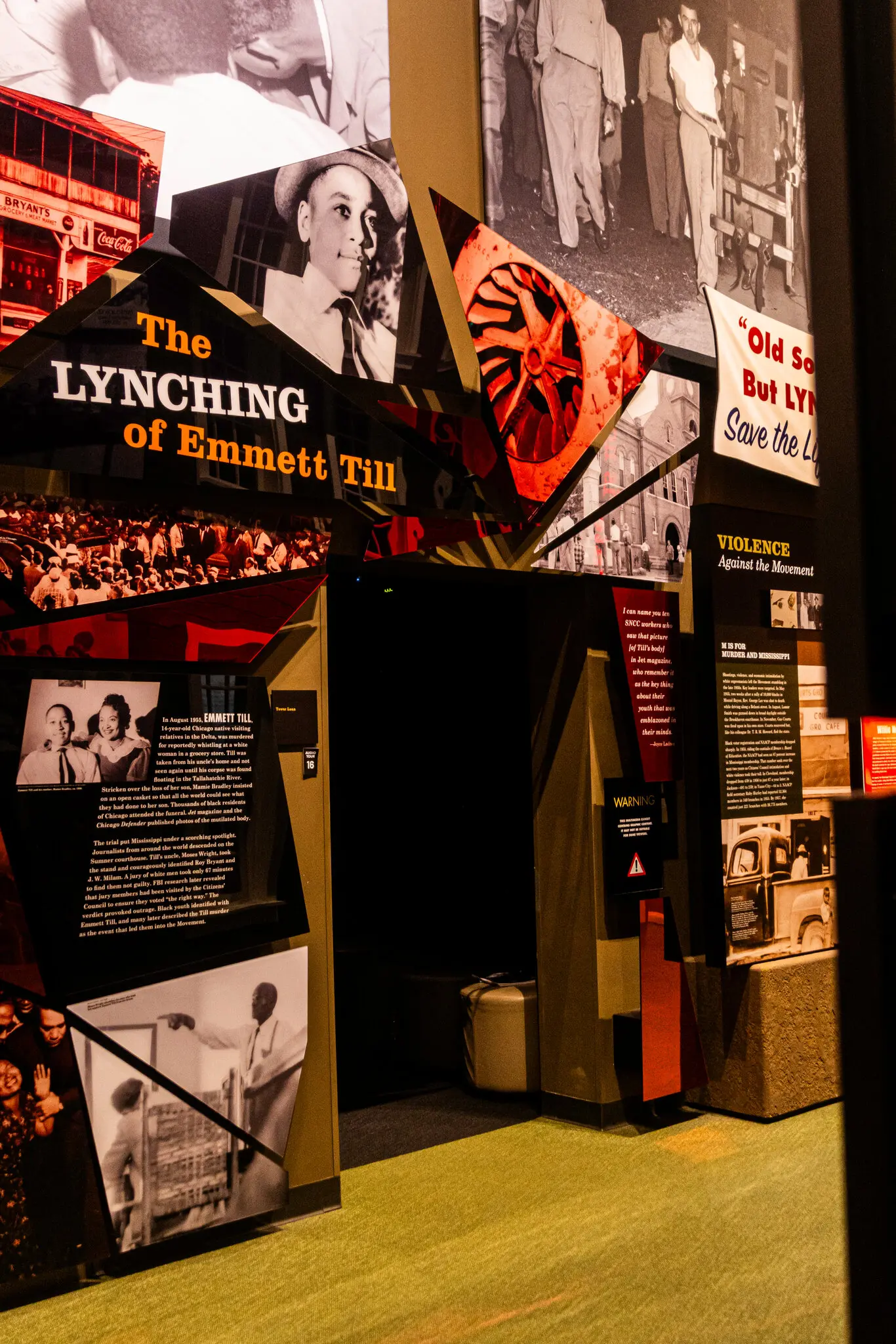

In 1955, the brutal killing of 14-year-old Emmett Till became a defining moment in American history, shocking the conscience of the nation and fueling the modern civil rights movement. For many, the memory of his open-casket funeral — where his mother insisted the world see what had been done to her son — still stands as one of the most powerful images in the fight against racial injustice.
Now, nearly seventy years later, a disturbing yet historically significant artifact has resurfaced. The gun believed to have been used in Till’s murder, an Ithaca .45-caliber pistol, is on public display at the Mississippi Civil Rights Museum in Jackson. Museum officials unveiled the weapon this week, acknowledging both the pain it symbolizes and the historical responsibility of preserving it for future generations.
A Long-Lost Weapon Returns to the Public Eye
The pistol, once thought to be lost, was reportedly used in the barn where Till was beaten and ultimately killed by two white men — Roy Bryant and J.W. Milam — after accusations that Till had whistled at Bryant’s wife, Carolyn, inside a local grocery store. The weapon has now been mounted in a secure glass case, placed alongside other artifacts connected to the Till case and the broader struggle for civil rights in the United States.
The unveiling came just days after the Civil Rights Cold Case Records Review Board released thousands of previously classified government documents related to Till’s murder. For historians, the convergence of these two events is more than coincidence. It marks a renewed effort to shed light on one of the darkest chapters in America’s past.
Civil rights scholar Daphne Chamberlain described the discovery as a significant moment in preserving truth: “Now we have an artifact that can be directly linked to what happened in that barn. If this gun exists, what else is out there, waiting to be revealed?”
The Power of Memory and the Limits of Justice
Till’s murder and the decision by his mother, Mamie Till-Mobley, to keep his casket open became catalysts for change. Photographs of Till’s mutilated body, widely circulated in Black newspapers, exposed the horrors of racial violence to the world. They also galvanized young activists, many of whom would later become leaders of the civil rights movement.
Despite the attention, justice was never delivered. Bryant and Milam were acquitted by an all-white jury after just over an hour of deliberation. Months later, they openly confessed to the killing in an interview with Look magazine, shielded from further prosecution by double jeopardy laws. Both men are now long deceased, as is Carolyn Bryant Donham, whose initial accusation set the tragedy in motion.
For Mamie Till-Mobley, who spent the rest of her life demanding accountability and telling her son’s story, the acquittal was a devastating reminder of America’s systemic racial failures. In 2023, her efforts were formally recognized when President Joe Biden established a national monument honoring both her and her son. The monument includes three historically significant sites in Illinois and Mississippi, locations repeatedly targeted by vandals in previous decades.
Tracing the Gun’s Hidden Journey
The story of how the weapon resurfaced is nearly as complex as the case itself. In 2004, filmmaker Keith Beauchamp, who directed a documentary on Till’s murder, received an anonymous email that pointed to the gun’s existence. He passed the information to the FBI, which had recently reopened the case.
Retired FBI agent Dale Killinger later confirmed that the bureau took possession of the weapon, examined it for fingerprints, and tested it against ballistic evidence from Till’s body. While the results were inconclusive, investigators strongly believed that the gun had belonged to Milam, a World War II veteran, and may indeed have been used both to strike and to shoot the teenager. After testing, the weapon was returned to its owner.
Museum officials have declined to disclose who donated the gun or under what circumstances it entered their collection. They confirmed only that it had been kept for decades by a Mississippi family with no direct ties to the Till case. Out of respect, curators consulted surviving members of Till’s family before placing the gun on display.

A Controversial but Necessary Display
The decision to exhibit the pistol has sparked mixed reactions. Some see it as a vital teaching tool, while others fear it risks sensationalizing trauma. Keith Beauchamp, the filmmaker who helped rediscover the gun, described it as “a fine line between education and spectacle.” He cautioned that the weapon itself cannot bring closure to Black America.
Nan Prince, director of collections at the Mississippi Civil Rights Museum, called the gun “a troubling and rare artifact,” noting that she was immediately struck by its gravity. For her, the display is less about morbid curiosity and more about ensuring that future generations confront history honestly.
The museum has adopted similar approaches before. Its exhibits also include the rifle used in the assassination of civil rights leader Medgar Evers, as well as artifacts tied to the Ku Klux Klan. By contextualizing these objects within broader narratives of resistance and resilience, curators aim to foster education rather than spectacle.
Michael Morris, who oversees both the Mississippi Civil Rights Museum and the Museum of Mississippi History, explained: “There are very few physical objects left that directly connect to Emmett Till’s murder. This is one more piece of history that future generations need to see and understand.”
The Ongoing Search for Truth
The newly released federal records add further depth to the Till story. Among the documents are hundreds of letters written by ordinary citizens in 1955, pleading with the FBI to intervene after the acquittal. There is also extensive correspondence showing the government’s reluctance to act, highlighting the indifference of federal authorities at the time.
Patrick Weems, executive director of the Emmett Till Interpretive Center, said the records contained no major surprises but enriched the public’s understanding of the case: “This is more about adding texture than uncovering new revelations. The documents remind us that the public demanded action, but the government was unwilling to step in.”
Still, Weems believes unanswered questions remain. Some researchers suspect that Bryant and Milam were not the only individuals involved in the crime, and future releases — expected by 2027 — may provide further clarity.

Balancing Memory, Pain, and Education
For Emmett Till’s cousin, the Rev. Wheeler Parker Jr., who was with him on the day of the grocery store encounter, the museum’s decision brings mixed emotions. “We have conflicted feelings,” Parker admitted. “But it’s important for history. It reminds us how far we’ve come, how much progress we’ve made, and how much more work lies ahead.”
As the anniversary of Till’s death continues to be marked, the presence of the pistol in a museum setting forces difficult conversations about race, memory, and justice in America. For some, the artifact is a painful reminder of violence that has not disappeared; for others, it represents an opportunity to educate new generations about the ongoing fight for equality.
What remains undeniable is that Emmett Till’s story — and the artifacts connected to it — continue to shape America’s struggle with its past. From the open casket that exposed racial violence to the gun now displayed behind glass, each piece of history ensures that the world does not forget.




Leave a Reply