
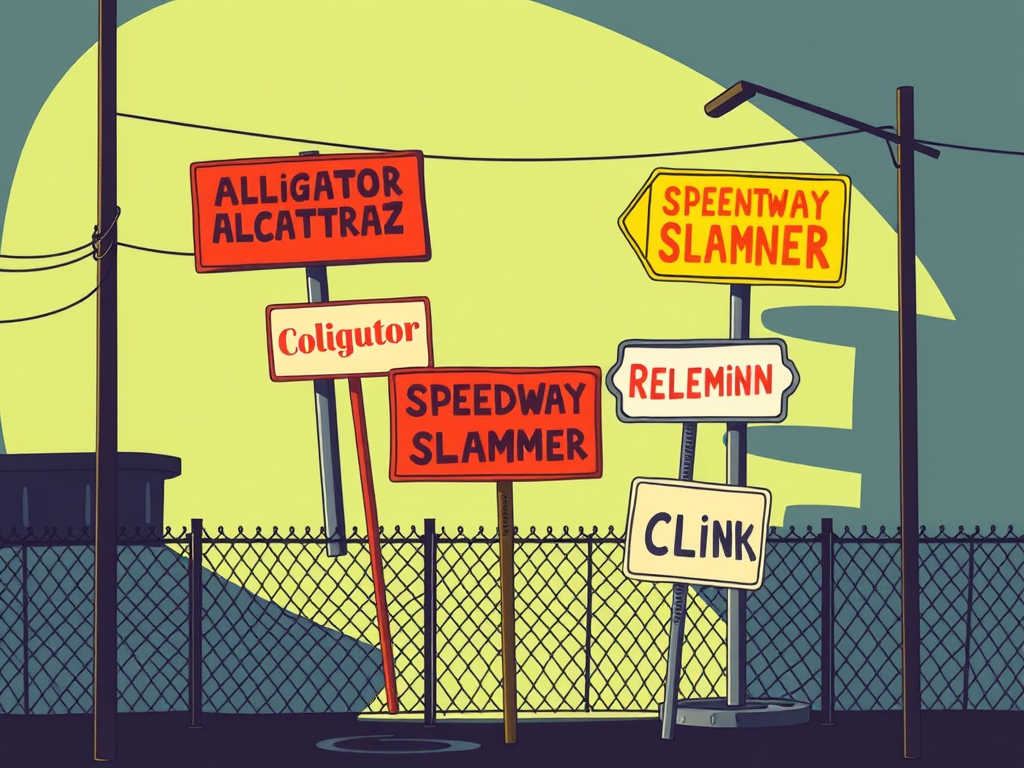

It all began in Florida with the opening of a facility nicknamed “Alligator Alcatraz.” Soon after, Indiana was introduced to the “Speedway Slammer.” Most recently, the Trump administration announced yet another detention center in Nebraska, with the controversial moniker “Cornhusker Clink.”
At first glance, these playful, alliterative names might seem harmless, even humorous. They borrow from marketing tactics designed to stick in people’s minds — the same strategies used to sell products or build viral campaigns. For some Americans, the nicknames come across as lighthearted, even clever. Memes have circulated across social media, merchandise has been printed, and the president himself joked that detainees in Florida should learn how to outrun alligators in case of an escape from the Everglades facility.
Supporters argue that the names have “a ring to them.” Ron Buschelman, a 66-year-old Nebraskan, said of the “Cornhusker Clink,” “He’s got a very good sense of humor. And we’re the Cornhusker State — I like it.” For him, the branding felt fitting, even amusing.
But for many others, this approach has been deeply offensive. Critics argue that it trivializes an expanding mass deportation system that has separated parents from children, deported immigrants to countries they were not originally from, and authorized masked officers in unmarked cars to seize people off the streets. To them, these names symbolize a government mocking human suffering.
Roxana Cortes-Mills, legal director of the Center for Immigrant and Refugee Advancement in Omaha, explained bluntly: “It’s not a reason to joke around.”

Government by Troll: A Strategy of Provocation
Observers note that the Trump administration’s use of humor, irony, and provocation is not accidental. It reflects a broader political strategy often described as “government by troll” — deliberately stoking outrage to dominate the public conversation.
The naming of detention centers is just one piece of this communication style. The White House and the Department of Homeland Security have adopted a social-media-driven tone that mirrors the online world: irreverent, meme-friendly, and unconcerned about crossing traditional boundaries of decorum.
Earlier this year, for example, the White House shared a video of shackled immigrants boarding a deportation flight and labeled it ASMR, referencing a genre of videos meant to provide relaxing soundscapes. Critics called it mocking, even dehumanizing, while supporters argued it was just a bold way of framing reality.
Some posts have gone further. A recent Homeland Security recruitment ad used the phrase “Which Way, American Man?” — widely interpreted as an echo of a white supremacist book from 1978. Homeland Security denied any connection, insisting critics were reading too much into the language.
Yet the data shows this provocative strategy has worked in terms of visibility. According to DHS, its weekly impressions on social media grew from 3.5 million in February to over 46 million by July 2025. Officials claimed this surge reflected their ability to “communicate critical information” more effectively with the American public.
Expanding Detention Infrastructure
The humorous names should not obscure the seriousness of the underlying policy. Each facility represents a state-federal partnership designed to dramatically increase detention capacity across the country. Trump’s administration has set an ambitious goal of one million deportations per year, and new detention centers are central to that plan.
“Alligator Alcatraz,” built on a former airstrip deep in the Everglades, has already faced major criticism. Detainees reported that lights remain on 24/7 and that tents leak during heavy Florida rains. A federal judge recently ordered much of the facility dismantled, though Florida is appealing. Governor Ron DeSantis vowed to open another facility, called “Deportation Depot,” in an unused prison near Jacksonville.
The Nebraska facility — “Cornhusker Clink” — will hold up to 280 detainees in the small town of McCook, between Omaha and Denver. Homeland Security even posted a cartoon of corn cobs wearing ICE baseball caps to promote the partnership, sparking immediate backlash from local officials and community members.
Historical Parallels in Political Branding
Historians see Trump’s use of catchy nicknames as part of a larger tradition of political branding. Presidential historian Douglas Brinkley noted that Trump has long relied on memorable labels for his rivals and his policies, such as dubbing his recent tax plan the “One Big Beautiful Bill.” In his view, the humorous names are a populist tactic: “It’s something where people will read it and remember it.”
Brinkley compared the practice to “Hoovervilles,” a term coined during the Great Depression to describe makeshift homeless camps and to blame President Herbert Hoover for the crisis. Similarly, Trump’s naming strategy creates imagery that sticks in the public mind — though this time, it is applied not to political opponents, but to immigration enforcement.
Rick Perlstein, a progressive historian, went further, suggesting that the jokey branding resembled the language of wartime propaganda: a deliberate effort to humiliate and dehumanize detainees.
Divided Public Reactions
Public opinion remains deeply split. Supporters praise the names as clever and effective, believing they signal toughness on immigration. Michael Alexander, a 60-year-old Floridian, said “Alligator Alcatraz” shows that the government is serious: “If you remember Alcatraz, you didn’t want to go there.” Although his wife is an immigrant, he emphasized that his support for strict enforcement did not contradict his personal respect for legal immigrants.
But others find the approach distasteful, even cruel. Alberto Lopez, 62, whose parents came from Puerto Rico, criticized the rhetoric as unpresidential: “If you’re going to be a good leader, you have to know your boundaries.”
Nebraska politicians have also weighed in. Senator Megan Hunt condemned the use of the “Cornhusker” nickname — tied to the University of Nebraska’s athletic teams — for a detention center, calling it a disgrace and urging the university to enforce its trademark. Douglas County Commissioner Roger Garcia wrote that the branding turned suffering into a joke, warning leaders not to use power “to harm instead of nurture harmony.”
Even some Republicans expressed discomfort. Bret Younkin, chairman of the Brown County GOP, admitted he admired the branding but would prefer detention centers be built “without the names.” His reasoning reflected a common theme: Americans are becoming too sensitive, he argued, but he also recognized that the branding was a deliberate masterstroke in shaping public conversation.
Everyday Nebraskans voiced more personal reactions. Beth Zacharias, a 63-year-old Omaha resident, supported strict immigration enforcement but wrinkled her nose at “Cornhusker Clink.” “It sounds harsh,” she said, adding that while illegal actions must have consequences, detainees should still be treated with dignity.
The Bigger Picture
What emerges from this debate is a portrait of a polarized America where even the names of detention centers become cultural battlegrounds. Supporters see humor, strength, and effective branding; critics see cruelty, dehumanization, and the trivialization of human suffering.
The Trump administration’s strategy of trolling — mixing irony, provocation, and spectacle — is effective in one respect: it keeps immigration front and center in public debate. Whether this helps shape lasting policy outcomes or simply deepens national division remains to be seen.
What is certain is that “Alligator Alcatraz,” “Speedway Slammer,” and “Cornhusker Clink” are far more than playful nicknames. They are political symbols — shorthand for a larger clash over immigration, identity, and the meaning of leadership in America today.




Leave a Reply