

It has been more than a decade since choreographer Kim Brandt created a work for a traditional theater. Her last theater piece, Untitled, appeared at The Kitchen in 2014 and left a lasting impression on those who witnessed it. In that work, 24 performers formed a human pile — a mountain of bodies stacked on top of one another — and held the structure for as long as possible. The audience watched in silence as the performers balanced strength, focus, and mutual awareness in an unspoken conversation. No one was in command, yet the group instinctively knew when the formation should collapse. Brandt once described it as a “hive mind,” a shared intelligence where bodies dissolve together into space.
Since then, the 46-year-old choreographer has built a reputation as a daring site-specific artist, staging works in unexpected places: cemeteries, galleries, and even the geodesic dome at MoMA PS1. While she began as a dancer in childhood and always envisioned becoming a choreographer, her artistic path was anything but linear. With a master’s degree in sculpture, Brandt approaches dance less as a sequence of steps and more as an exploration of space, form, and material. That training deeply influences how she sees movement and its environment.
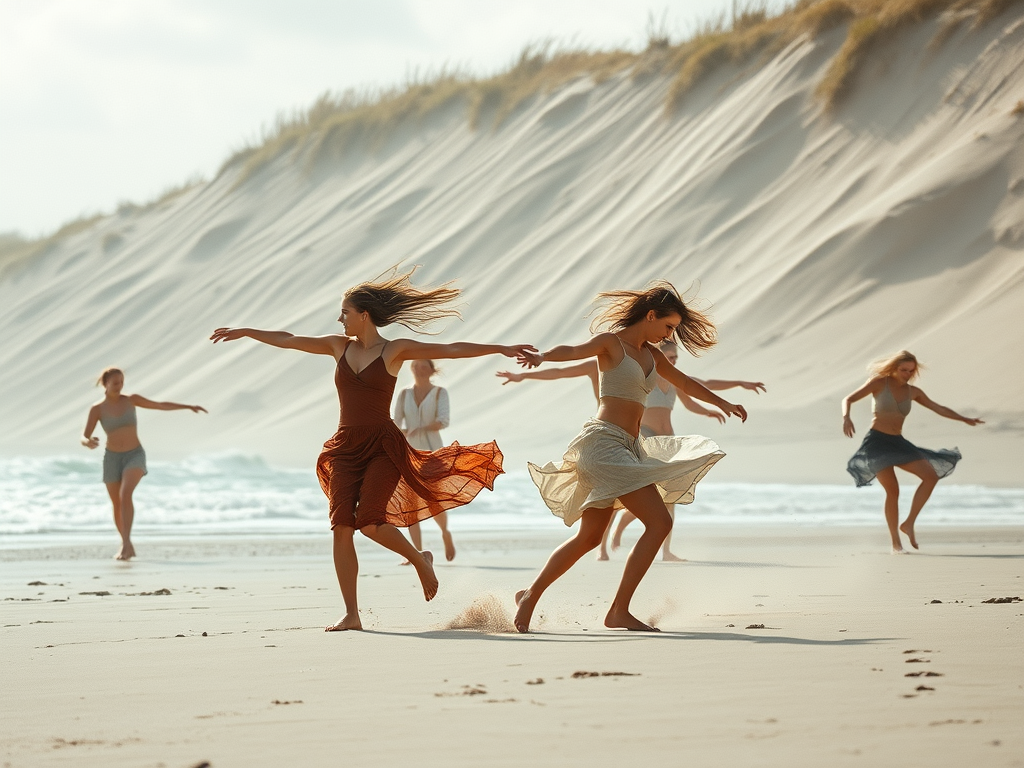
Now, Brandt is returning with her most ambitious project yet: a large-scale performance titled “Wayward”, created for Rockaway Beach as part of the annual Beach Sessions Dance Series on August 23.
Dancing with the Elements
For Brandt, Rockaway Beach presents both a challenge and an opportunity. Unlike a controlled theater environment, the beach is wild and unpredictable. “There’s so much you cannot control,” she explained with a laugh. “And I don’t want to control it. I’m not interested in that as a choreographer. But there are so many elements to contend with — wind, sand, waves, space.”
The location she chose — Beach 112 Street — is framed by tall dunes and jetties. Far from the crowded concessions, the setting feels quiet and secluded, almost like a forgotten stretch of sand. Brandt quickly became attached to the site, insisting that Wayward could only exist there. “I wanted the work to be as expansive as the beach itself,” she said.
Though open and borderless, the location still carries the energy of a stage. “It feels strangely theatrical,” Brandt admitted, acknowledging the natural proscenium created by the dunes and shoreline.

Transforming Rockaway into a Stage
Wayward features 18 dancers, as well as several children, moving across dunes, jetties, and shifting sands. Instead of the usual horizontal gaze of the ocean, Brandt incorporates verticality — dancers climb, descend, and rise against the backdrop of waves.
The environment itself becomes raw material. Brandt noted the different qualities of sand: soft and dry further inland, firm and wet near the water, and medium textures in between. “Or there’s 30-mile-an-hour winds blowing across the water,” she added. “You take a step, and five minutes later the footprints are erased. You cannot ignore that.”
At first, she experimented with incorporating surfers and other “beachy” ideas, but soon abandoned them. “I realized I didn’t want to make a piece about the beach,” she said. “I wanted to make a dance.”
The work begins near the shore and expands outward, with dancers spreading wide and tall across the dunes and moving toward the jetties. At certain moments, turning toward the dunes feels like glimpsing the unseen skyline of New York beyond the bay. The performance becomes not just about the ocean, but about Rockaway as a place — a unique intersection of city and shore.
“It’s not like Fire Island or the Jersey Shore,” Brandt explained. “It’s the city at the beach. It’s so New York. Every time I spend time here, it feels like falling in love with New York all over again — this is like the hundred-and-first time.”
The Philosophy Behind “Wayward”
The title Wayward reflects Brandt’s fascination with moving off the beaten path, embracing unpredictability, and finding beauty in disorientation. Inspired by a line from the Oxford English Dictionary quoting Thucydides — “The movement of events is often as wayward and incomprehensible as the course of human thought” — she sees her choreography as an expression of that same uncertainty.
In today’s artistic climate, with the difficulties of making dance in New York and the U.S., that concept resonates even more. “The conditions feel so wild,” she said. “Incomprehensible in many ways. But that’s part of what gives the work its urgency.”

Her choreographic scores often focus less on fixed shapes and more on processes. One score in Wayward instructs dancers to move both upward and downward at once, or in opposing directions simultaneously. This creates a meditative and shifting field of bodies, echoing the constant motion of waves and wind.
Her dancers aren’t asked to “pose” or “make shapes.” Instead, their movement is generated through awareness and response. “The form happens naturally,” Brandt explained. “I like being able to see the gears turning. I like that process being visible.”
A Collective Mind
Much like her earlier works, Wayward relies on group cohesion and unspoken communication. Dancer Courtney Cooke described Brandt’s approach as a form of hive intelligence: “She’s somehow in control even though she’s not inside the group. She holds the space and our movement together.”
That unity, particularly against the backdrop of the ocean, is what makes the work so vivid. Rather than dissolving into pure emotion, the dancers operate within a heightened state of focus, balancing inner thought with external sensation.
“She helps us find that place where we do no more or less than what’s needed,” Cooke added. “People sometimes call her work minimalist, but I disagree. It’s a very complex process to arrive at that clarity.”
Dancing as a Way of Living
Ultimately, Brandt sees Wayward as more than a performance — it is a proposition about how to move through the world. She wants her dancers to embody her choreographic ideas, but in their own ways. No one holds secret knowledge; everyone must listen and respond to one another.
“It’s about how we move through the world together,” Brandt said. “How we take care of ourselves while moving alongside others.”
She calls it “a fixing,” a way to offer another possibility of coexistence. For her, that is the true reward: dance not just as art, but as a way of being in the world.

A New Perspective on the City at the Beach
As Beach Sessions Dance Series continues to reimagine what performance can look like in outdoor environments, Brandt’s Wayward stands out for its bold engagement with the landscape. The work reframes Rockaway not only as a serene ocean setting but also as part of New York’s urban fabric — gritty, unpredictable, and alive.
For audiences, it’s a chance to see dance without walls, shaped by wind, sand, and sky. For Brandt, it’s another chapter in her lifelong project of expanding what choreography can mean.
“I’m not making a dance about the beach,” she insisted. “I’m making a dance that could only happen here.”




Leave a Reply