
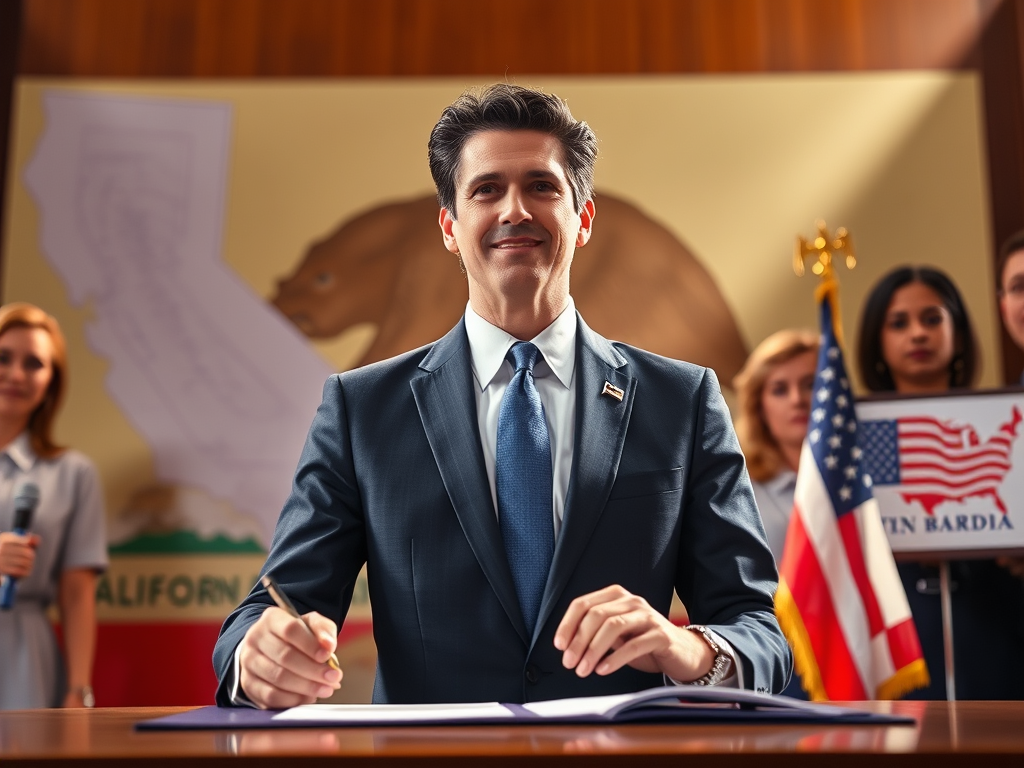

California leaders have taken a dramatic step into the center of America’s ongoing battle over political maps, voting rights, and partisan influence. On Thursday, Governor Gavin Newsom signed into law two sweeping redistricting bills aimed at reshaping congressional districts in ways that could give Democrats a stronger advantage in upcoming elections. Alongside his signature, Newsom announced a special election for November 4, asking California voters to grant final approval to these newly drawn congressional maps.
This decision comes as a direct counterpunch to Texas, where Republican lawmakers, under the encouragement of former President Donald Trump, are advancing their own mid-decade redistricting plan. The unusual timing and scale of these moves by the two largest states highlight how gerrymandering—once a behind-the-scenes process conducted quietly every ten years after the census—has become a national flashpoint in the fight for control of Congress.
Newsom Steps into a National Political Fight
Governor Newsom, widely viewed as a potential future presidential candidate, positioned the move as a defense of democracy rather than a partisan power grab. “We’re responding to what happened in Texas,” he said at the signing ceremony. “We’re neutralizing that effort and making sure the American people get a fair chance. When the rules are the same for everyone, democracy wins.”
The California governor’s rhetoric underscores the broader stakes. Democrats see capturing the House of Representatives in 2026 as essential to reining in Trump’s influence if he continues to drive Republican policy in Washington. Republicans, by contrast, argue that holding the House is vital to advancing Trump’s agenda and blocking potential Democratic investigations.
With these maps, California Democrats aim not only to flip five Republican-held seats but also to secure four competitive swing districts, potentially strengthening their already substantial majority. Currently, Democrats hold 43 of California’s 52 congressional seats, leaving Republicans with just nine.
Why This Redistricting Battle Matters

Redistricting mid-decade is rare in modern American politics. Traditionally, states redraw congressional boundaries every ten years after census data is collected. However, Trump’s push for Republicans in Texas to redraw lines early has broken that precedent, creating a ripple effect that reached California.
The showdown between Texas and California is more than a regional dispute. As the nation’s two most populous and politically influential states, their redistricting strategies symbolize the broader ideological clash dividing the country. Texas embodies the Republican vision of securing conservative dominance in the South, while California represents Democratic ambitions to preserve progressive influence on the West Coast.
“This isn’t a fight we wanted, but it’s one we can’t avoid,” said Marc Berman, a Democratic assemblyman in Sacramento. “With democracy at stake, California must step up.”

A Complicated Process in California
Unlike Texas, where partisan lawmakers directly control redistricting, California’s situation is more complex. The state created an independent redistricting commission through ballot measures passed in 2008 and 2010, designed to reduce political influence and ensure fairer representation. The commission includes five Democrats, five Republicans, and four independents.
Because of this constitutional framework, the legislature cannot unilaterally impose new maps. Instead, the proposed congressional districts must go before voters as Proposition 50 in November’s special election. If approved, the Democratic-drawn maps would be in effect for the 2026, 2028, and 2030 elections, before authority reverts back to the independent commission.
Newsom has promised an aggressive campaign in support of Proposition 50, with plans to leverage grassroots donations, liberal influencers, and endorsements from high-profile Democrats. Already, former President Barack Obama has signaled his backing, calling the measure a “pragmatic step to address a very specific challenge in this moment.”
Republican Pushback
Republicans in California have strongly opposed the move, branding it a blatant power grab that undermines the independent commission voters fought to establish. James Gallagher, the Republican leader in the State Assembly, framed the effort as pure partisanship. “This is about power. Both sides manipulate maps to achieve partisan results—that’s the definition of gerrymandering,” Gallagher said.
Although Gallagher acknowledged that Trump’s call for mid-decade maps in Texas was misguided, he warned that responding with the same tactics could erode the very principles of representation. “Fight fire with fire, and eventually you burn the whole system down,” he argued.
Former California Governor Arnold Schwarzenegger, who played a key role in creating the state’s independent redistricting commission, has also vowed to campaign against Proposition 50. Wealthy donors who supported the original commission, including Charles Munger Jr., have pledged to defend it from being weakened.
Redrawing Political Geography
Some of the proposed changes highlight just how dramatically the political map could shift. For instance, one plan would merge Shasta County, a rural conservative stronghold in Northern California, with Marin County, a liberal enclave north of San Francisco. In such a district, Democratic coastal voters would likely overwhelm Republican inland voters, virtually guaranteeing a Democratic win.
Republicans argue that such designs distort voter intent and effectively silence entire communities. “Don’t call this temporary,” said Assemblyman Carl DeMaio, a Republican. “Once Democrats seize this power, they won’t give it back to the people.”

Trump’s Role and National Tensions
The California battle cannot be separated from Trump’s broader confrontations with the state. Earlier this year, the former president took control of California’s National Guard and sent troops to Los Angeles during immigration protests—over Newsom’s objections. It was the first time since the 1960s that federal troops had been deployed in a state against its governor’s wishes.
Trump also moved to block California’s environmental regulations on electric vehicles and threatened to withhold disaster relief for wildfire recovery. These actions have heightened tensions and given Newsom additional ammunition for framing Proposition 50 as a necessary countermeasure to protect California’s interests.
What Comes Next
The fight over Proposition 50 is expected to dominate California politics in the months ahead. Democrats are betting on widespread opposition to Trump within the state to rally voters behind their plan. Republicans, meanwhile, are preparing a well-funded campaign to defend the independent commission and paint Democrats as hypocritical for criticizing gerrymandering in other states while embracing it at home.
The outcome will have implications far beyond California. If voters approve the maps, it could reshape the balance of power in Congress for years, potentially tilting control toward Democrats in 2026 and beyond. If rejected, it would reaffirm the state’s independent redistricting model and deliver a symbolic win for Republicans.
Either way, the battle over California’s congressional lines reflects a deeper struggle unfolding across the United States: whether democracy should prioritize neutral, independent representation or bend to partisan strategies in a high-stakes contest for political dominance.
As Governor Newsom put it, “The future of representation is at stake. California won’t stand by while others rig the system—we’re going to fight for fairness, even if the definition of fairness is being contested.”




Leave a Reply