
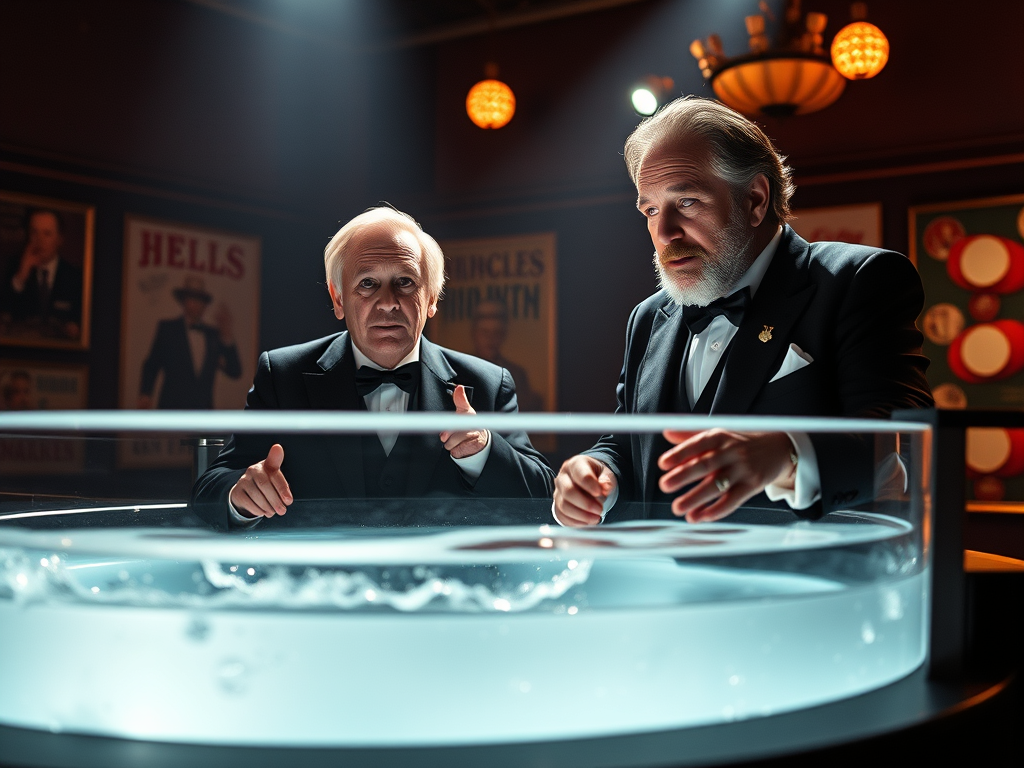

Backstage at the Penn & Teller Theater in Las Vegas, a simple but provocative question sparked debate: can a magician ever be too old to die onstage? The discussion came after Teller, the famously silent half of the legendary duo, suggested revisiting one of their most daring tricks — one that nearly flirts with death itself.
The trick, first performed in 1985 on Saturday Night Live, placed Teller inside a tank filled to the brim with water. Penn Jillette, his partner and the talkative half of the pair, locked the tank and promised not to release Teller until he correctly guessed a card chosen by a spectator. The illusion is a tense race against time, packed with misdirection, dramatic reversals, and even a staged “return from the dead.” For decades, it wowed audiences.
But today, Penn, now 70, wonders if they’ve aged out of it. “The suffering of a young man looks heroic,” he admitted. “For an older man, it can seem sad.” Teller, 77, disagreed, insisting that the trick isn’t about physical endurance but about the strength of their partnership. For him, the water tank illusion reflects a theme that has grown deeper with time: collaboration built over fifty years of performing side by side.

Penn & Teller’s Lasting Legacy
Penn & Teller are not just magicians. They are pioneers who reshaped an entire art form. Since the 1970s, they have blurred the line between deception and honesty, comedy and illusion, mystery and explanation. They made Broadway hits, redefined Las Vegas residencies, and created two long-running television successes: Penn & Teller: Bull***!* and Fool Us. The latter, now entering its 13th season, remains the most important platform for aspiring magicians worldwide.
While contemporaries like David Copperfield and Criss Angel have faded from mainstream attention, Penn & Teller continue to fill theaters and reinvent themselves. Once branded as the “bad boys of magic,” mocking cheesy showmen and debunking mysticism, they are now the elder statesmen of modern illusion — and the record holders for the longest-running headlining act in Las Vegas history.
Yet their greatest illusion may not be onstage at all. Their real trick, after five decades, is staying together in a world where artistic partnerships rarely survive.

The Secret to a Lifelong Partnership
Comedy and magic duos once dominated entertainment, from Laurel and Hardy to Nichols and May, from Martin and Lewis to the Smothers Brothers. But most eventually collapsed under the weight of ego, creative disputes, or personal conflicts. Penn & Teller, however, found a different formula.
Surprisingly, it’s not compromise or constant togetherness that fuels their longevity. Instead, it’s distance. They rarely socialize outside work. Even now, after all these years, their private lives remain mostly separate. Teller once explained that arguments are best avoided not by apologies but by simply moving on. “Apologies extend the argument,” he said. “They’re a waste of time.”
Friends confirm that their relationship can look unusually quiet. Performer Steven Banks once joined them for a meal and noted they barely spoke to each other. “I talked to Penn, then I talked to Teller. That was it.” Yet the silence is not hostility; it is trust and respect in its most distilled form.
Teller still remembers the best advice he received from director Arthur Penn during the making of their 1989 film Penn & Teller Get Killed: don’t say everything you’re thinking — let your partner unfold his ideas. To this day, Teller applies this rule, giving Penn room to develop his eccentric creativity.
Penn, in his typical provocative style, insists he doesn’t care much about his “relationship” with Teller, describing them as colleagues rather than friends. Yet this statement is its own kind of stage misdirection. The truth, visible in their shared history, tells a very different story.

From Outsiders to Icons
When they first met, magic was a fading spectacle. Performers in tuxedos were still pretending to saw women in half, while Doug Henning’s flower-power wonderland style dominated TV specials. Penn and Teller rejected both traditions. Teller, once a high school Latin teacher, and Penn, a self-taught juggler and clown school graduate, joined forces with a rebellious skepticism that would become their trademark.
Their earliest shows were scrappy and strange, featuring mismatched costumes, meta-humor, and dark comedy. They weren’t afraid to deconstruct illusions openly, showing audiences exactly how tricks worked — only to surprise them with an even bigger twist. This self-awareness, similar to what David Letterman brought to talk shows, created a new form of “meta-magic” that challenged expectations while keeping the wonder intact.
The turning point came in 1975, when Teller discovered that even a simple napkin trick could fool the mind if performed with enough misdirection. The revelation sparked their philosophy: the behind-the-scenes can be more astonishing than the trick itself.
A Life Built on Contrast
Onstage and off, Penn and Teller thrive on their differences. Penn is loud, philosophical, and sometimes deliberately provocative. He once declared he “hates magic” and often takes interviews on wild digressions. Teller, in contrast, is precise, gentle, and careful with his words. His silence onstage has become one of the most powerful tools in modern performance.
This balance of extremes reflects a deeper truth: they are not just partners but two contrasting elements fused into a greater whole. Teller once invoked Socrates, noting that love is defined as different elements coming together to create something beautiful. “We always claim we are not friends,” he admitted, his eyes welling with emotion, “but of course we are.”
Changing with the Times
Over the decades, Penn & Teller’s act has evolved with society. They abandoned their signature “bullet catch” trick out of respect for the tragedies of mass shootings. They stopped performing a controversial flag-burning routine when the American flag became politically charged.
Penn himself has shifted the most. Once a fierce libertarian, he softened his views after the pandemic and parenthood, rejecting requests to speak at anti-mask rallies and even regretting his time on The Celebrity Apprentice. Teller, meanwhile, followed his father’s advice never to marry or have children, devoting his life entirely to art.
Despite these personal changes, their partnership remains constant. When Teller underwent bypass surgery, Penn visited daily. When Penn had children, Teller was the first non-family member to hold his babies. Teller has been equally clear in interviews: while many assume he creates most of the magic, he insists that “Penn and I are two people but one thing.”

Facing Mortality
The water tank trick represents something deeper now than it did in 1985. Back then, it was youthful bravado — the comedy of risking death without consequence. Today, it symbolizes the reality of aging performers confronting their own limits.
Penn may resist reviving it, but the act reveals the core of their relationship. Even when Teller appears to be drowning, he refuses Penn’s help because the illusion — the work — must come first. It’s a philosophy that has defined them since their earliest show, which ended with Teller’s “death” and Penn shrugging: “No use crying over a dead magician.”
As they debated whether to bring the trick back, Penn predicted the argument’s outcome. They would talk it through, consider their vast repertoire, and ultimately decide to move on to something new. And that’s exactly what they did — because for Penn & Teller, the show always goes on.
The Real Illusion
For fifty years, Penn & Teller have defied expectations, not only by revolutionizing magic but by proving that artistic partnerships can last. They have lived through cultural shifts, personal transformations, and even mortality scares, yet their collaboration remains unshakable.
Their true magic is not sleight of hand or dramatic escapes. It is trust, resilience, and the rare alchemy of two very different men who built a single identity — one that continues to surprise, provoke, and inspire.
And perhaps that is the answer to the backstage debate. Can magicians be too old to die? Maybe. But Penn & Teller’s greatest act has been showing the world that even in the face of age, change, and mortality, magic can endure forever.




Leave a Reply