
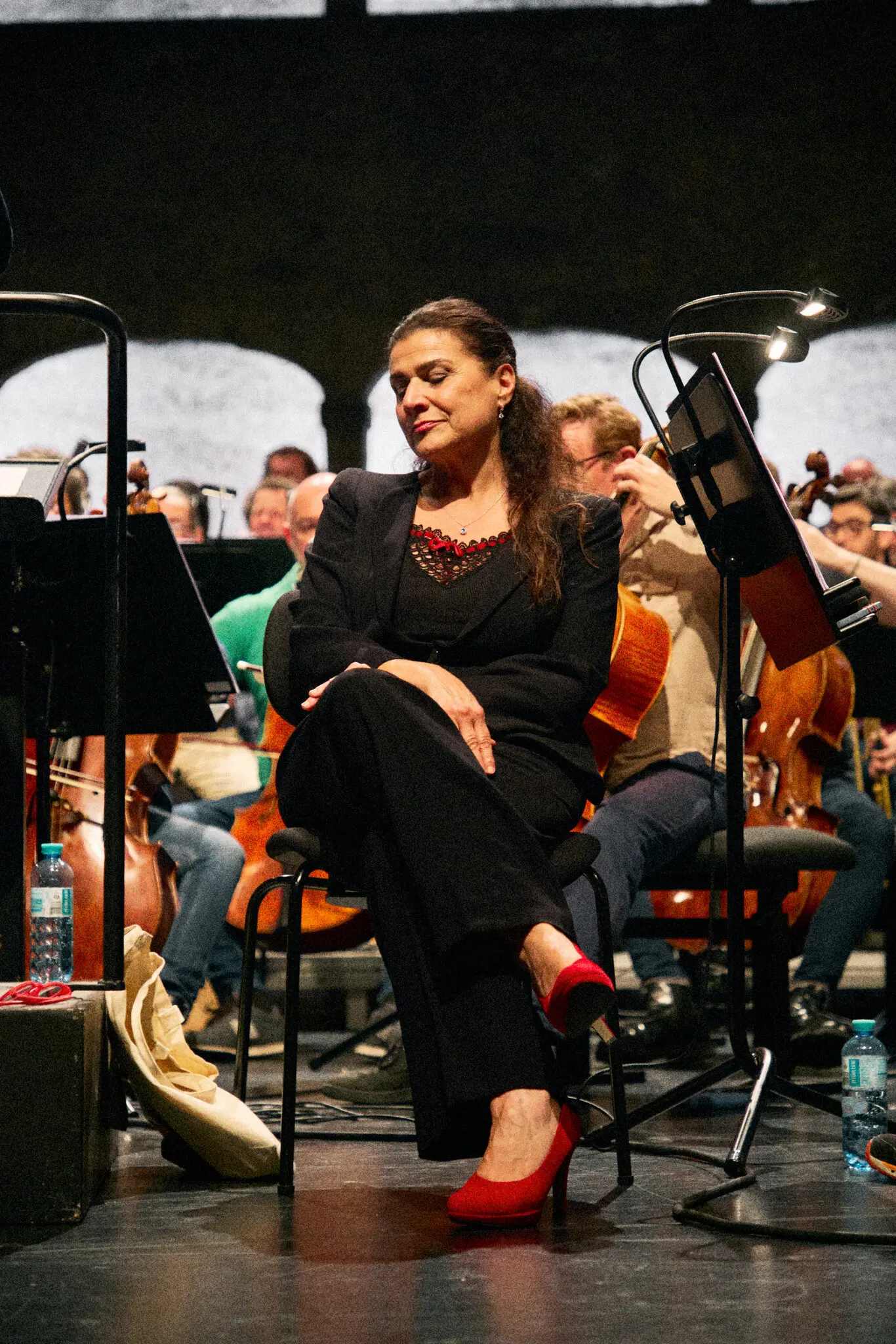

Cecilia Bartoli’s schedule at the Salzburg Whitsun Festival would make most people dizzy. One moment she’s seated in the audience at a ballet, the next she’s stepping into character for an operatic death scene. On this early June afternoon, she had been enjoying John Neumeier’s ballet Death in Venice at the Grosses Festspielhaus. As soon as the curtain fell for intermission, she quietly slipped away, crossed a courtyard, and entered the historic Felsenreitschule theatre — a venue carved into the side of a mountain.
The instant she walked in, Bartoli switched roles. She was no longer the festival’s artistic director but the acclaimed mezzo-soprano known to audiences worldwide. On stage, members of Les Musiciens du Prince-Monaco orchestra were waiting, under the baton of conductor Gianluca Capuano. Bartoli greeted friends warmly, exchanged cheek kisses, and then took her seat. Closing her eyes, she pretended to sleep, embodying Desdemona from Rossini’s Otello moments before her on-stage death.
After a brief wink to assure everyone she was acting, she rose to sing alongside tenor Sergey Romanovsky, dramatically collapsing when his character stabbed her with a stage dagger. The scene was rehearsed, refined, and completed in 20 minutes — just enough time for Bartoli to hurry back to her ballet seat for the second act.

This rapid shift between roles — performer, director, supporter — has defined Bartoli’s tenure at the Whitsun Festival since 2012. She is its heart and soul, simultaneously shaping the artistic program and starring in its most high-profile productions. Beyond Salzburg, she runs the Opéra de Monte-Carlo in Monaco, maintains a busy international singing career, and even founded her own orchestra.
At 59, an age when many opera stars slow down, Bartoli shows no sign of stopping. Her voice retains the richness, control, and agility that first made her famous, and her artistic ambitions continue to grow. Her current Whitsun Festival contract has been extended until 2031, which will make her the longest-serving leader in its history, surpassing even founder Herbert von Karajan.
“I’ll stay as long as I feel I have something to say,” Bartoli remarked, her enthusiasm undimmed.
The Secret Behind Her Longevity
Bartoli’s sustained success is no accident. She treats her voice with extraordinary care, selecting her repertoire carefully and never compromising on preparation. She compares her approach to cooking a proper Italian ragù — a process that demands patience and time.
“You can’t make a good ragù in five minutes,” she said with a laugh, mimicking the slow bubbling of a sauce. “It’s the same in music. Your voice, your muscles, everything needs time to adapt. Rush it, and you’ll end up with something thin and weak.”
Born in Rome to two professional singers, Bartoli seemed destined for a musical life. Yet as a child, she was more drawn to flamenco dancing than opera. Her parents allowed her to keep dancing — on the condition that she also study at a conservatory.
“It turned out I was faster with my vocal cords than with my feet,” she joked.
Though she still enjoys flamenco, it’s her vocal artistry that has defined her career. Mentors like conductor Daniel Barenboim encouraged her to explore Mozart’s repertoire early on, honing her ability to deliver both purity and precision. This meticulous control, even in the softest passages, is now a hallmark of her style.

A Career Built on Artistic Freedom
Bartoli’s recordings are renowned for their ornamentation and historical range, particularly her interpretations of Baroque and bel canto music. Her 1999 release The Vivaldi Album sold over a million copies, sparking a renewed interest in Vivaldi’s lesser-known operatic works.
“It was crossover in the sense that audiences came to us, rather than us going to them,” she said.
While she achieved major successes, including her Metropolitan Opera debut at age 29, Bartoli’s fear of flying has limited her U.S. appearances. When she does travel to America, she prefers to cross the Atlantic by ship — a journey she describes as magical, with views of the aurora borealis and a slow, dramatic approach to New York Harbor.
In 2016, Bartoli co-founded Les Musiciens du Prince-Monaco with Jean-Louis Grinda, aiming to create a period ensemble evocative of Baroque royal courts. Capuano, now its chief conductor, praises her artistry and the “special alchemy” they share.
Transforming the Whitsun Festival
When Bartoli took over the Whitsun Festival, it lacked the identity and sparkle it enjoys today. Her vision was clear: each year would have a central theme, anchored by a new opera production in which she would star. Themes have ranged from Handel’s heroic dramas to playful reinterpretations like a West Side Story framed as an older woman’s memories.
Markus Hinterhäuser, artistic director of the broader Salzburg Festival, describes her impact simply: “If the Whitsun Festival has a heartbeat, and that heartbeat has a name, it’s Cecilia Bartoli.”
Her approach extends beyond her performances. She is known for being the first to arrive at rehearsals, the last to leave, and a constant source of encouragement for colleagues. Lea Desandre, a rising mezzo-soprano, notes Bartoli’s ability to focus instantly and create a sense of community among performers.
Off stage, she moves through festival spaces like a burst of energy — greeting friends, attending other performances, and even distributing flowers to fellow artists during curtain calls. At one recent ballet, she rushed backstage to embrace choreographer John Neumeier, whispering, “I’m so proud of you” in his ear.

A Legacy Still in the Making
Bartoli’s festival performances often end with exuberance. In her closing gala of Rossini arias, she shifted effortlessly between costumes, comedic flourishes, and vocal fireworks. In one encore, she incorporated a touch of flamenco, grinning as she explained, “I had to — we’re in Spain!”
Even after such evenings, her schedule rarely lets up. Following that performance, she headed to a gala dinner before preparing for a drive to Cremona, Italy, where she would sing Gluck’s Orfeo ed Euridice the next night.
Her life is a balance of discipline and joy — qualities that keep her voice vibrant and her leadership effective. As she looks toward another decade at the Whitsun Festival, Bartoli continues to blend the roles of performer, curator, and cultural ambassador with the same boundless energy that first brought her to the world’s attention.
For opera lovers and festivalgoers alike, Cecilia Bartoli is more than just a voice — she is a living example of how passion, precision, and perseverance can create a legacy that resonates far beyond the stage.




Leave a Reply