
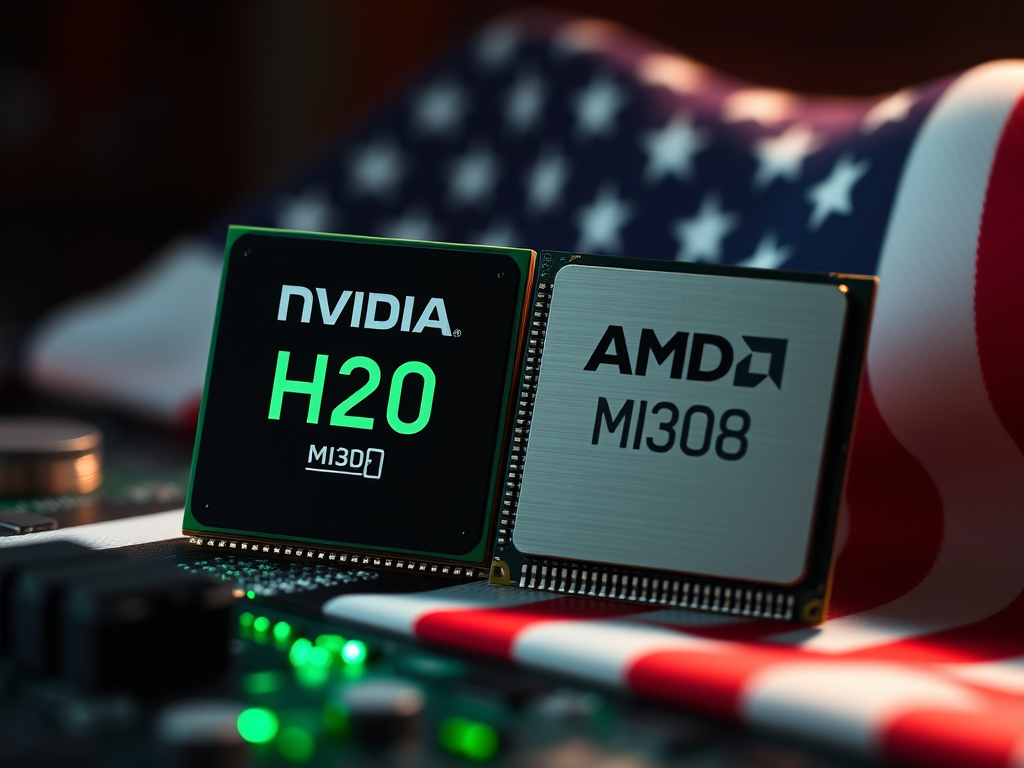

U.S. Government to Take Cut of Nvidia and AMD A.I. Chip Sales to China

In a move that is both financially unconventional and politically charged, Nvidia and Advanced Micro Devices (AMD) have agreed to hand over 15 percent of revenue from their artificial intelligence (AI) chip sales to China directly to the U.S. government. The arrangement, negotiated with the Trump administration, reflects an increasingly interventionist approach to global tech trade and could inject billions into federal coffers — while igniting debate over national security and economic strategy.
According to three individuals familiar with the matter, who spoke on condition of anonymity because they were not authorized to comment publicly, the agreement was finalized just weeks after Nvidia was granted conditional approval to sell a specially designed AI chip, the H20, in China.
While the Trump administration publicly announced last month that Nvidia could sell the H20 to Chinese customers, actual export licenses had not been issued at the time. That changed after Nvidia’s CEO Jensen Huang met with President Trump at the White House last Wednesday. The two reportedly struck a deal granting the U.S. government a 15 percent share of the revenue from those sales. Two days later, the Commerce Department began processing licenses, clearing the path for shipments.
A Rare Precedent in U.S. Trade Policy
Such revenue-sharing arrangements tied to export approvals are virtually unheard of in U.S. trade history. The deal effectively makes Washington a direct beneficiary of AI hardware sales to China — a country that has been the subject of sweeping American technology restrictions in recent years.
The model mirrors other unusual interventions by the Trump administration. In June, it approved Japanese steelmaker Nippon Steel’s investment in U.S. Steel, which included a “golden share” arrangement granting the government a stake — a mechanism rarely seen in modern American business.
The administration has also wielded tariffs aggressively to encourage domestic manufacturing. Just last week, Trump warned that foreign-made semiconductors would face a 100 percent tariff unless tech firms invested in U.S. production.
Potential Billions at Stake

The stakes are enormous. Analysts at Bernstein Research estimate Nvidia could sell over $15 billion worth of H20 chips in China by year-end, while AMD’s AI chip, the MI308 — also recently barred from sale to China before the current arrangement — could generate $800 million. This would translate to more than $2 billion flowing directly to the U.S. Treasury under the new agreement.
The White House, Commerce Department, and AMD declined to comment on Sunday. Nvidia spokesperson Ken Brown reiterated that the company adheres to U.S. export regulations:
“While we haven’t shipped H20 to China for months, we hope export control rules will let America compete in China and worldwide,” he said.
National Security Backlash
The deal has stirred immediate criticism from national security experts who have long opposed AI chip exports to China. Their concern: monetizing export licenses could set a dangerous precedent, incentivizing Beijing to pressure other firms into similar arrangements to ease restrictions on sensitive technologies, from semiconductor fabrication tools to advanced memory chips.
“This is essentially selling our national security for corporate profits,” said Liza Tobin, a former China director at the National Security Council under both the Trump and Biden administrations. “It rewards China’s persistence in pushing for concessions, and it sends the wrong signal about U.S. priorities.”
The Financial Times first reported on the revenue-sharing element of the agreement.
A Policy Reversal with Global Stakes
The decision marks a sharp reversal from April, when the Trump administration banned sales of these AI chips to China over fears they could accelerate Beijing’s progress in AI development — a domain with strategic military and economic implications.
Nvidia’s chips, considered among the best for running large-scale AI computations, outperform those of Chinese competitor Huawei. U.S. officials maintain that China is still barred from acquiring Nvidia’s most advanced processors, and that the H20 is a less powerful, export-compliant version specifically designed for the Chinese market.
“We don’t sell them our best stuff, not our second-best, not even our third-best,” Commerce Secretary Howard Lutnick told CNBC last month. He framed the policy as a strategy to keep the U.S. one step ahead technologically while still securing market share in China.
Nvidia’s Strategic Argument
Jensen Huang reportedly convinced President Trump that a total ban would only help Huawei dominate the Chinese AI chip market. Such dominance, he warned, could fuel Huawei’s R&D efforts and close the competitive gap with U.S. companies.
Instead, Huang argued, letting Nvidia and AMD compete for sales in China — under strict performance limits — would ensure American companies retained a foothold in the world’s largest semiconductor market, using the revenue to fund further innovation.
“The American tech stack should be the global standard, just as the U.S. dollar underpins the world’s financial system,” Huang said in a July podcast for the Special Competitive Studies Project, a Washington think tank.
Experts Warn of Strategic Risks
Not everyone agrees. In July, 20 former national security and economic policy officials — including Matt Pottinger and David Feith, both veterans of the Trump administration — signed a letter calling the policy shift “a strategic misstep.” They argued that the H20 chip is far from obsolete and could serve as “a potent accelerator” for China’s AI capabilities.
Diplomatic and Commercial Complications
The approval has also created friction in China. Late last month, the Cyberspace Administration of China summoned Huang over concerns that the H20 chip might contain “backdoor security risks.” Chinese state media subsequently discouraged domestic companies from purchasing it.
In response, Nvidia published a blog post flatly denying any backdoor vulnerabilities and criticizing a proposed U.S. law, the Chip Security Act, which would require chipmakers to track their products to prevent smuggling into China.
“There is no such thing as a ‘good’ secret backdoor — only dangerous vulnerabilities that need to be eliminated,” the company stated.
The Bigger Picture: U.S.-China AI Rivalry
The Nvidia-AMD deal underscores the delicate balance Washington faces in managing the U.S.-China tech rivalry. On one hand, AI hardware represents a lucrative industry in which American companies hold a clear performance edge. On the other, national security concerns dictate keeping China at least one technological generation behind.
This new revenue-sharing model, unprecedented in the AI sector, signals that the Trump administration is willing to experiment with hybrid policies — part trade restriction, part financial partnership — to navigate this tension.
Yet whether this approach safeguards U.S. interests or compromises them remains hotly debated. If the policy fuels U.S. innovation while limiting China’s access to cutting-edge chips, it could be seen as a pragmatic middle ground. If, however, it accelerates China’s AI progress, critics may point to this as a costly miscalculation in the technology arms race.



Leave a Reply