

Trump’s Rooftop Tour: A White House Makeover Unveiled

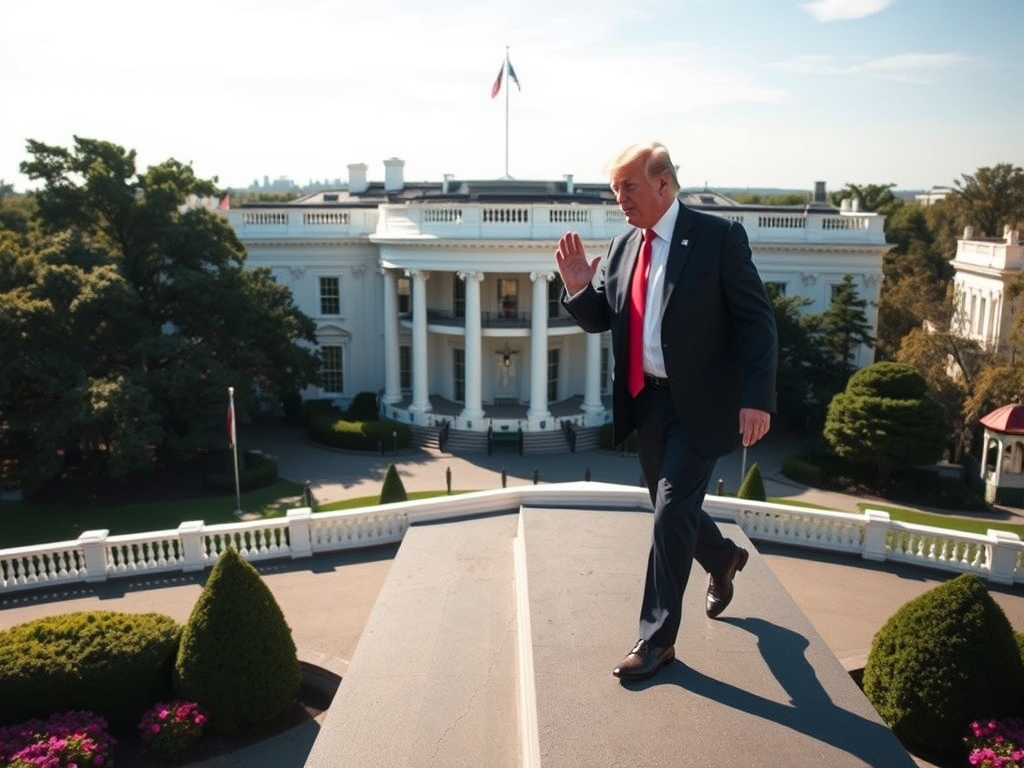
In an unexpected spectacle Tuesday morning, former President Donald Trump was spotted walking atop the White House, casually surveying the grounds as reporters below scrambled for answers. “Just taking a little walk,” he called out from the roof, gesturing vaguely over the James S. Brady Press Briefing Room. But this was no ordinary stroll — it was, as Trump explained, part of his “home improvement” project: a proposed $200 million White House ballroom.
With Secret Service agents and counter-sniper teams securing the area, what appeared to be an impromptu tour was in fact a tightly orchestrated operation. Mr. Trump moved from rooftop to rooftop, pausing above the Oval Office and overlooking the newly paved Rose Garden — now notably missing some of its historically significant features.

According to White House aides, the former president was envisioning the future site of the massive 90,000-square-foot ballroom, a structure nearly twice the size of the current presidential residence. Speaking to reporters, Trump claimed the project was a personal contribution: “Everything I do, I pay for myself,” he said. “It’s just another way to give back to the country.”
A Presidential Distraction or Redecoration on Steroids?
As tensions rise within the Republican Party and backlash brews over various policy decisions, the ballroom plans have become an unlikely focus — a spectacle that conveniently shifts attention away from legislative discontent. While some GOP lawmakers face intense criticism from constituents during the August recess, Trump has chosen instead to reshape the nation’s most iconic residence, converting it from a public symbol into something resembling a gilded property from his personal portfolio.
His affinity for opulence is no secret. During his presidency, he repeatedly infused Trumpian design elements into the White House — from gold-trimmed coasters in the Oval Office to massive American flags planted on the South Lawn. Now, with his Trump International Hotel in Washington shuttered, the White House seems to be filling that void, serving as a stage for donors, dignitaries, and political allies.
On social media, Trump has labeled these efforts as his “fun projects” — a juxtaposition to his usual posts about global politics, economic policy, and U.S.-China relations. But critics argue that these “improvements” reflect more about Trump’s personal tastes than national interests.

The Rose Garden Redesign — Reversed?
Trump’s current reimagining of the White House includes substantial alterations to the Rose Garden, once renovated under the direction of former First Lady Melania Trump. Her version, praised for its nod to historic preservation, featured newly planted roses, limestone walkways, and the removal of aging crab apple trees.
That version of the garden also made history by featuring the first piece of artwork by an Asian American artist in the White House collection. However, that statue has now mysteriously disappeared. A White House official, speaking anonymously, claimed the artwork is “being polished,” but no timeline has been offered for its return.
Whether Melania supports the new changes remains unclear. The East Wing declined to comment on the matter, and questions about the fate of nearby East Wing offices that could be displaced by the proposed ballroom were redirected to the West Wing.
Who’s Paying for the White House Ballroom?
While Trump insists that he — and a select group of “patriot donors” — will fund the construction, details about financing remain vague. In past fundraising efforts, Trump has hosted dinners and events for donors at the White House, particularly those involved in his cryptocurrency ventures. This has led to concerns among ethics experts.
Noah Bookbinder, president of Citizens for Responsibility and Ethics in Washington (CREW), called the donor funding structure “highly unusual.” He warned that contributors might view the project as a backdoor channel to influence the Trump administration or his political return.
“This isn’t a private golf club or resort,” Bookbinder remarked. “The White House belongs to the American people. Turning it into a venue for privately funded construction — especially one resembling Mar-a-Lago — is deeply problematic.”
Indeed, the proposed ballroom bears a striking resemblance to the event hall at Trump’s Mar-a-Lago estate in Palm Beach, Florida. That venue has hosted everything from weddings and campaign fundraisers to lavish dinners where Trump plays host, often receiving standing ovations before sitting down to eat.

Trump’s Love Affair With Gilded Spaces
Trump’s desire to remake government spaces in his image isn’t new. When he moved into the White House in 2017, he overruled many of Melania Trump’s design choices, opting instead for gold-accented furnishings and traditional symbols of power.
Now, with the ballroom project underway — at least in theory — he appears determined to leave behind a legacy not just in policy, but in architecture and design. Whether that legacy aligns with the values of democracy and public ownership remains a hot topic of debate.
While some view his efforts as harmless eccentricity, others see a troubling pattern: a transformation of the nation’s house into a private mansion, stylized after his own commercial ventures.
The Truth About Trump’s “Donated” Salary
During his rooftop remarks, Trump reiterated a common talking point — that he contributes his presidential salary back to the government. “Nobody mentions that,” he said. “Just like my salary is contributed.”
However, a closer look reveals the picture is more complicated. While the Trump White House initially announced partial donations to agencies like the Department of Education, federal tax returns show a sharp decline in charitable giving over time. In 2020, he reported no donations at all. The current White House has not responded to inquiries about whether Trump intends to make similar donations this year.
Final Thoughts: Public Office or Personal Palace?
Whether or not the White House ballroom becomes a reality, Trump’s vision for America’s most recognized residence reveals much about his governing philosophy. Blending the personal with the presidential, the commercial with the ceremonial, Trump continues to reshape public symbols into reflections of his private identity.
To his supporters, it’s a bold display of patriotism and self-funded nationalism. To critics, it’s an ethical minefield and a symbolic takeover of public space for private gratification.
As always with Trump, the line between showmanship and substance remains deliberately blurred.




Leave a Reply