
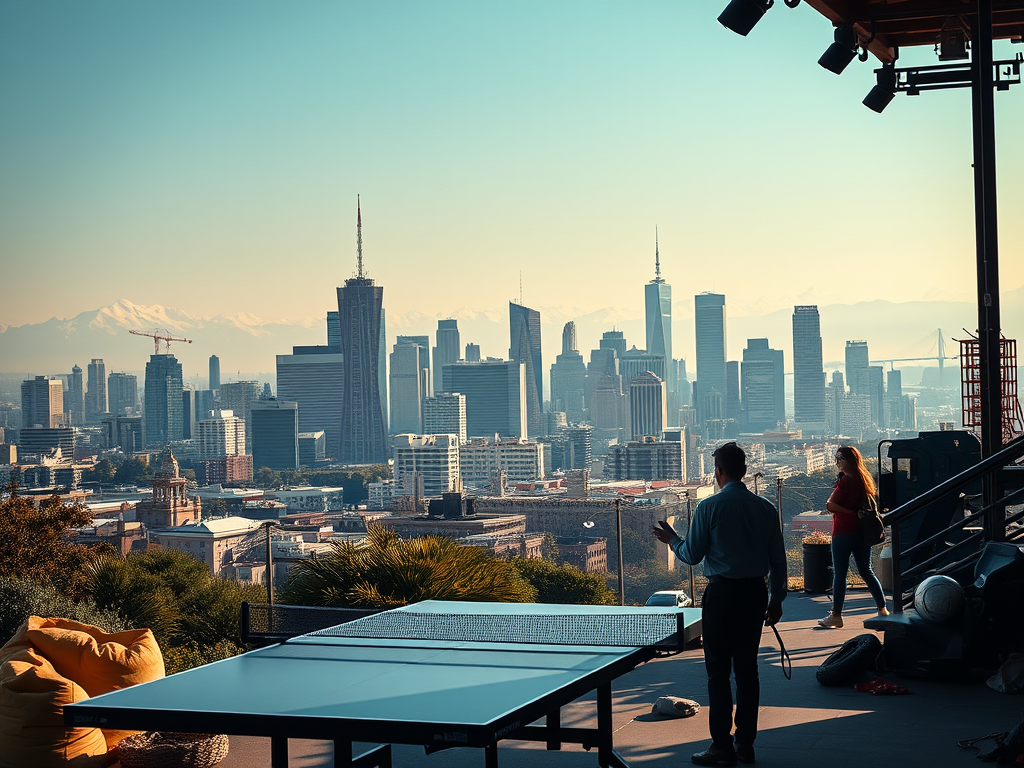

In HBO’s satirical tech comedy Silicon Valley, there’s a scene that now feels like a relic from a different era. A character, fresh off selling his start-up, finds colleagues lounging on a rooftop with beers in hand. They’re not stressed about deadlines — they’re “resting and vesting,” coasting through their stock grants with little pressure to produce.
Silicon Valley Is in Its ‘Hard Tech’ Era

That lighthearted depiction of early 2010s Silicon Valley — where free lunches, nap pods, and ping pong matches reigned supreme — wasn’t far off from reality. At the time, tech giants like Google, Facebook, Apple, and Netflix were ushering in the Web 2.0 age. Engineers built social networks, music apps, and photo-sharing platforms. The consumer internet exploded in scale and value, changing the way we lived, worked, and socialized.

But fast forward to today, and that version of Silicon Valley has all but disappeared. In its place is a grittier, more intense ecosystem driven not by snack bars and stock options, but by a singular focus: artificial intelligence.
Goodbye Perks, Hello Neural Nets
Silicon Valley is no longer dominated by developers building dating apps or photo filters. Instead, the power centers of the industry are now filled with conversations about LLMs (large language models), GPUs, and neural networks. Knowing how to scale an AI model or train it on petabytes of data has become the new entry ticket.
Compare Instagram’s filter technology to OpenAI’s ability to turn text into film-quality animation or realistic dialogue, and it’s clear: the tech stakes have risen dramatically. We’ve entered the “hard tech” era, where deeper computing knowledge and access to scarce resources — like Nvidia’s coveted H100 GPUs — separate the frontrunners from the rest.
The cultural transformation is visible, too. Gone are the days of rainbow beanbags and free dry cleaning. Many of the legendary perks that made Big Tech feel like paradise have been stripped back. Instead, today’s start-up offices and hacker houses are laser-focused on productivity and innovation.

San Francisco: The New Tech Capital
Once, the beating heart of Silicon Valley was spread across Menlo Park, Mountain View, and Palo Alto. Today, San Francisco has reclaimed its crown, largely thanks to the explosive rise of AI start-ups.
OpenAI, the creator of ChatGPT, calls the city home, as does Anthropic, another fast-growing AI firm. This migration of talent and capital has shifted the gravitational pull away from traditional Big Tech campuses and toward the urban density of San Francisco — especially neighborhoods like Mission, Potrero Hill, and Hayes Valley.
This revitalization has even brought new names to these areas. The stretch between Mission and Potrero Hill is now informally known as “The Arena,” where AI-focused start-ups battle for dominance. Hayes Valley, nicknamed “Cerebral Valley,” has become a cultural hub where engineers and founders discuss models over Mediterranean salads and wine.
Even the city’s Financial District — once left quiet by pandemic-era remote work — is humming again, thanks to companies like Scale AI and OpenAI expanding their footprints.
From Free Spirits to Fierce Competitors
The vibe of the modern tech workforce has also shifted. Where developers once enjoyed the luxury of working on passion projects thanks to “20 percent time,” today’s tech employees are under greater scrutiny. Hiring has slowed, performance expectations have intensified, and job security is no longer a given.
Meta, Google, and other former talent hoarders have gone through rounds of layoffs. Mark Zuckerberg’s “year of efficiency” saw thousands of jobs slashed, while Elon Musk famously reduced Twitter’s workforce by nearly 75% after his acquisition.
The cushy, sometimes excessive job roles of the Web 2.0 boom — diversity officers, “innovation evangelists,” and content moderators — have largely disappeared. In their place are deep learning specialists, reinforcement learning engineers, and infrastructure architects who can train AI at scale.

A Political and Cultural Shift
Beyond the office walls, Silicon Valley is undergoing a philosophical realignment. The region’s historically left-leaning politics have given way to a new class of self-described “Liberaltarians” — a blend of social liberalism and libertarian economics.
This shift has fueled investment in sectors once shunned by tech elites, such as defense technology and military-grade AI. Start-ups developing autonomous drones, AI-guided missiles, and other “dual-use” applications are now finding themselves darlings of venture capital.
It’s a stark contrast to the last decade, where the biggest innovations came in the form of a new social network or messaging app. Today, the focus is not on tapping your phone to order coffee, but on building the infrastructure for a new era of intelligence — one where machines may not just serve humans, but eventually outthink them.
The AI Gold Rush
The transformation accelerated in late 2022 with the debut of ChatGPT. Overnight, artificial intelligence became the hottest topic in global tech. Funding flooded into the sector. VCs, burned by failures in crypto and metaverse projects, redirected capital toward any start-up with “AI” in its pitch deck.
The result? A mass migration of talent and ambition back to the Bay Area. Miami’s “Silicon Beach” and Austin’s “Silicon Hills” lost their shine. AI, it turns out, is an industry best built face-to-face — in meetups, late-night hackathons, and serendipitous conversations at coffee shops.
San Francisco is once again the meeting ground. Start-up founders and engineers mingle at private clubs like Shack15 near the Ferry Building, or discuss model tuning strategies over beers in converted Victorian homes turned hacker houses.
What Comes Next?
For those who have observed the tech industry’s cycles over the past two decades, the rise of hard tech signals more than just a change in tools — it’s a fundamental reshaping of values.
No longer is success measured in daily active users or app store rankings. Today’s prestige comes from developing general-purpose models, scaling distributed computing, and pushing the boundaries of machine cognition.
And while the start-up scene retains its celebratory flair — AI parties at museums, late-night rooftop coding sessions, and million-dollar funding celebrations — there’s a renewed seriousness under the surface. Engineers and entrepreneurs now talk not just about building tools for fun, but about creating the foundation for the future of civilization.

Silicon Valley’s Second Act
The reinvention of Silicon Valley as the global AI epicenter is not just a passing trend — it’s a rebirth. The region’s ability to adapt, reimagine itself, and bet big on unproven technologies has long been its greatest strength.
If the Web 2.0 boom was about digitizing communication and consumer experiences, the AI era is about redefining intelligence itself. Founders are no longer playing gods on laptops — they’re building machines that might soon rival the gods.
“We are so back,” said Roon, a well-known tech commentator, summing up the mood in San Francisco after OpenAI secured a major lease and Scale AI took over Zynga’s old headquarters.
And perhaps that’s the biggest takeaway of all. Silicon Valley isn’t fading — it’s evolving. The hype may look different, the logos may change, and the perks may be fewer, but the hunger to change the world is stronger than ever.




Leave a Reply