
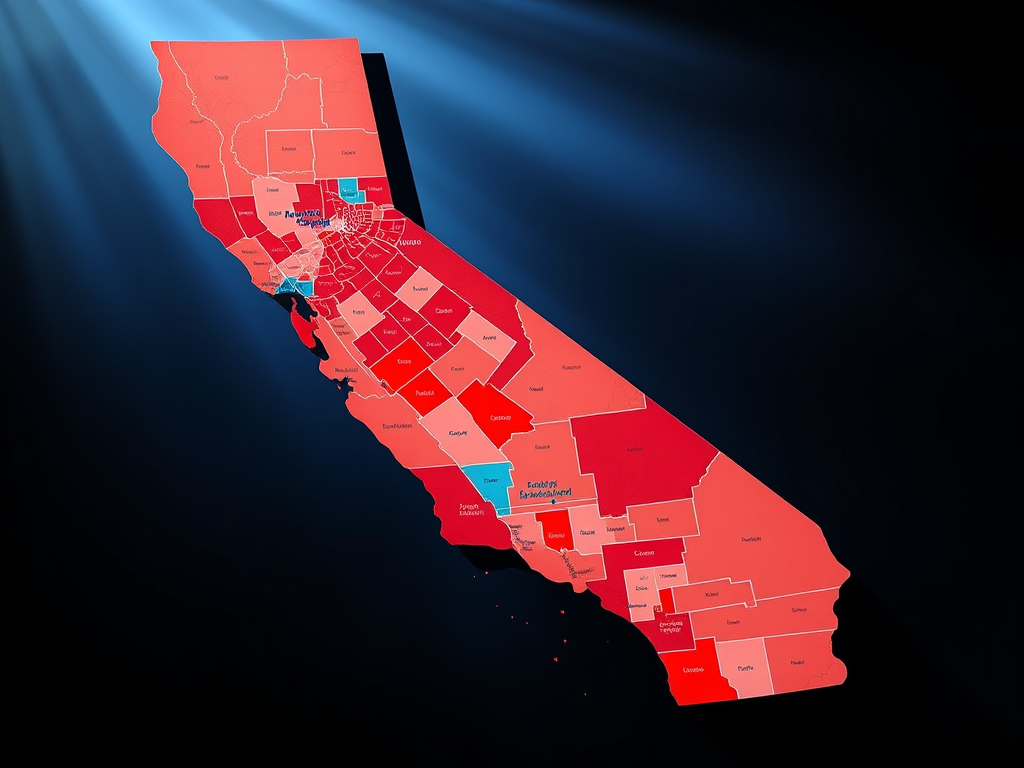

California Democrats Look to Redraw House Map to Counter Texas G.O.P.

In a rapidly escalating political showdown, California Democrats are mobilizing efforts to redraw congressional maps that could significantly reshape the balance of power in the U.S. House of Representatives. This strategic move comes in direct response to aggressive redistricting efforts by Republicans in Texas, which aim to secure an advantage in the 2026 midterm elections.
California’s proposed initiative could shift up to five Republican-held House seats to Democratic control—potentially neutralizing the GOP’s attempt to flip an equivalent number of Democratic seats in Texas. While the idea initially seemed unlikely, momentum is building across California’s political leadership, with Democratic lawmakers and Governor Gavin Newsom taking urgent steps to advance the plan.
A Coordinated Democratic Response to Republican Gerrymandering
Representative Robert Garcia of Long Beach voiced the growing sentiment among his colleagues: “If Republicans are going to play this game, California can fight and push back harder. We’re not going to allow national congressional Republicans and Donald Trump to rig the map unopposed.”
Newsom is proposing a ballot measure that would allow the state to suspend its current redistricting rules—managed by an independent commission—for the next three election cycles. If approved, the governor hopes to put the measure before voters in a special election scheduled for November 4, 2025. The state legislature is expected to vote on the proposal the week of August 18, with a hard deadline of August 22 to place it on the ballot.
The move could mark a pivotal turning point in what is increasingly being described as a national “redistricting arms race,” with both parties leveraging map manipulation to cement long-term political control.
National Implications: A Coast-to-Coast Redistricting War

What began as a political maneuver in Texas is now spreading nationwide. Former President Donald Trump and other GOP leaders have aggressively supported mid-decade redistricting in Republican-led states like Texas, Missouri, Indiana, and Ohio. Vice President JD Vance is scheduled to visit Indiana to rally support for the GOP’s plan.
But Democratic leaders in states like California, New York, Illinois, and Maryland are now contemplating their own countermeasures. Illinois Governor JB Pritzker made it clear: “If they’re going to cheat, then all of us have to take a hard look at the effect of that cheating on democracy. Everything is on the table.”
Still, Democrats face a more complex path in many of their strongholds. In states like Illinois and New York, congressional maps are already heavily tilted in Democrats’ favor, leaving little room for new pickups. Furthermore, redistricting procedures in these states involve independent commissions or legal obstacles that make rapid changes more difficult.
California’s High-Stakes Proposal
Despite the complexities, California may offer Democrats the best opportunity to counter Republican redistricting offensives. A new map under discussion could remove as many as five of the nine Republican House members currently serving California. Potentially affected Republicans include Reps. Kevin Kiley, Ken Calvert, David Valadao, Darrell Issa, and Doug LaMalfa.
In some versions of the proposed map, Republican voters would be shifted to already-safe GOP districts, allowing nearby swing districts to tilt more Democratic. One potential adjustment involves consolidating more Republican voters into Rep. Young Kim’s Orange County district, freeing up neighboring districts to be more favorable to Democrats.
This strategic remapping not only aims to capture GOP-held seats but also to reinforce the positions of several Democratic incumbents whose districts are considered vulnerable in upcoming elections.
Independent Redistricting System at Risk
However, California’s situation is unique due to its long-standing independent redistricting commission, which was created to remove partisanship from the process. Newsom’s proposal would temporarily override this system, triggering fierce debate from transparency advocates and former officials.
Former Governor Arnold Schwarzenegger, a vocal proponent of the nonpartisan redistricting model, has signaled strong opposition to the potential rollback. His former chief of staff, Daniel Ketchell, stated, “His position is clear: gerrymandering is wrong no matter who does it. Power should rest with the people, not politicians.”
Advocacy groups that once campaigned to establish California’s independent redistricting commission are now organizing to defeat the ballot measure. They argue that returning to a partisan system undermines years of progress in ensuring fair representation.
Still, powerful groups like the Service Employees International Union (SEIU) California have endorsed the plan, adding significant political momentum behind the measure.
Republican Pushback and Federal Tensions
Meanwhile, Texas has become ground zero for redistricting conflict. GOP Senator John Cornyn recently requested that the FBI locate and detain dozens of Democratic state legislators who fled Texas to prevent a quorum for redistricting votes. Many of them have taken refuge in states like New York, Illinois, and Massachusetts.
This extreme tactic sparked outrage from Democrats, raising constitutional and jurisdictional questions. Governor Greg Abbott and Attorney General Ken Paxton have also threatened legal action, including seeking to vacate the seats of absent legislators and issue arrest warrants.
In response, Democratic lawmakers like Rep. Gene Wu of Houston have condemned the moves as politically motivated and dangerous. “This office doesn’t belong to Greg Abbott or me. It belongs to the voters of District 137,” Wu stated.
The Texas House has already begun fining absent lawmakers $500 per day. Paxton and Abbott, both facing competitive re-election battles, appear to be using the redistricting standoff to rally support among the conservative base.

The Broader Battle for Congressional Control
Redistricting has become the key battleground in the fight for congressional dominance in 2026 and beyond. With fewer swing districts, the stakes for each redrawn map are increasingly high. Analysts warn that these battles could further polarize Congress and discourage bipartisan cooperation.
Illinois, for example, already leans heavily Democratic. Redrawing maps there could be legally and politically complicated, especially as the primary election calendar looms and candidates begin gathering petition signatures. Any change would likely require a special legislative session and face legal scrutiny.
New York Governor Kathy Hochul noted that legal constraints in her state likely prevent any redistricting changes until 2027. Maryland Governor Wes Moore is keeping options open, though his state has just one GOP-held seat left.
Conclusion: A High-Risk, High-Reward Strategy
The redistricting war is no longer a slow-moving process confined to once-a-decade changes. Instead, it is evolving into a fast-paced, high-stakes power struggle with national consequences.
California Democrats’ bold proposal marks a critical escalation in the fight against Republican-led gerrymandering efforts. While the plan still faces legal and political hurdles, it represents a shift in Democratic strategy—from defense to offense.
If passed, California’s new map could alter the trajectory of the 2026 midterm elections and reframe the national debate on who controls the redistricting process: independent commissions or partisan legislatures.
The answer to that question may well shape American politics for the next decade.




Leave a Reply