
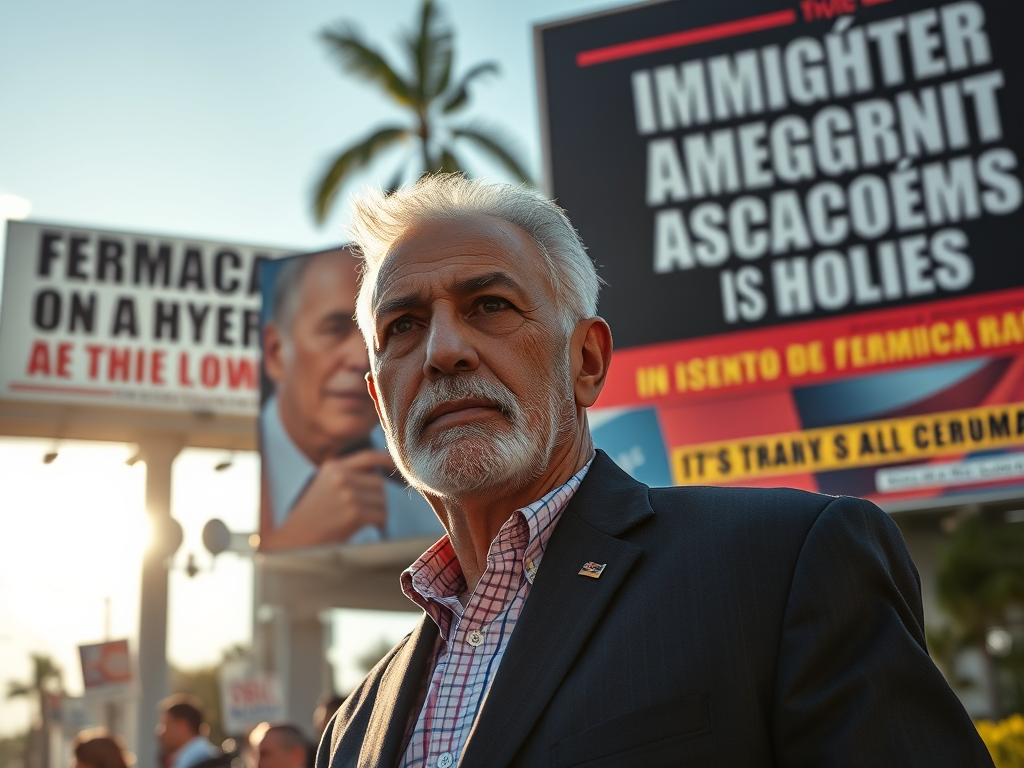

The Billionaire Behind Mysterious Immigration Ads Targeting Miami Republicans

In the spring of this year, Miami residents were greeted by a barrage of provocative billboards and digital ads that quickly became impossible to ignore. These messages didn’t promote a brand or upcoming event—instead, they took sharp aim at Cuban American Republican lawmakers, accusing them of supporting cruel immigration policies. One particularly bold ad read, “Deporting immigrants is cruel,” featuring the faces of well-known Republican figures representing Florida in Congress. Additional ads soon followed, including criticisms of a newly proposed immigration detention facility in the Florida Everglades ominously dubbed “Alligator Alcatraz.”
After months of speculation over who was behind the campaign, billionaire investor and philanthropist Michael B. Fernández has stepped forward to claim responsibility. In an exclusive interview with The New York Times, Fernández—who chairs MBF Healthcare Partners, a private equity firm based in Coral Gables—shared his motivations for pouring millions of dollars into the campaign, revealing a deep sense of personal urgency and civic duty.
“I’m trying to awaken the conscience of this city,” said the 73-year-old Fernández. “Especially among Cuban Americans who, like me, fled authoritarianism. What we’re seeing now in America—especially in Florida—is all too familiar. And it’s frightening.”

Fernández’s campaign is operating under a political group he founded called Keep Them Honest. With Florida veering sharply to the political right in recent years, especially in Miami-Dade County—home to one of the largest foreign-born populations in the U.S.—his efforts stand out. The region, dominated by Hispanic voters, has become a stronghold for Republican candidates, many of whom have aligned closely with former President Donald Trump’s hardline stance on immigration.
But Fernández, once a registered Republican himself, left the party over a decade ago. He now describes himself as politically unaffiliated and deeply concerned about what he sees as the erosion of democratic norms. His ultimate goal: to unseat at least one of the three Cuban American Republicans currently representing Florida in Congress—Mario Diaz-Balart, Carlos Gimenez, and Maria Elvira Salazar—in the upcoming midterm elections.
“Do I expect to win? Maybe not,” Fernández admitted. “These incumbents are well-known, well-funded, and face little competition. But that’s not the point. This is about accountability.”
Interestingly, all three lawmakers have shown some independence from Trump’s immigration agenda. They opposed stripping deportation protections from Venezuelan migrants and, in Salazar’s case, even proposed legislation to offer undocumented immigrants a pathway to legal residency. But for Fernández, these gestures have been insufficient and politically calculated.
“This isn’t about one vote or one bill,” Fernández said. “It’s about moral clarity. And too many of our elected officials have lost it.”
When a local Spanish-language television station recently asked Rep. Diaz-Balart about the ads, he dismissed them as “a badge of honor” and a sign that the “extreme left” opposes him. Fernández was quick to respond: “Congressman, it’s not them. It’s us.”
Though Fernández’s role in the campaign was previously unknown, he has been an outspoken critic of these representatives for years. In May, he publicly urged them to take a stand against Trump’s immigration policies, publishing full-page ads in The New York Times and The Wall Street Journal denouncing what he called their “complicity and cowardice.”
Yet Fernández acknowledges that his financial investment alone may not be enough to tip the political scales. “Throwing money at the problem won’t fix it,” he noted. “This needs to be a movement—a coalition of donors, activists, and voters who are ready to speak up.”
To that end, he has reportedly convinced over 30 contributors—about one-third of whom are Republicans—to support Keep Them Honest. As a 501(c)(4) organization, the group is not legally required to disclose its donors, though Fernández said he hopes more supporters will go public. He also admitted that many are hesitant due to fears of political and financial retaliation.

Fernández himself has already paid a price for his advocacy. He revealed that he’s received multiple threats, lost investors in his ventures, and become estranged from some friends and family members. “This is the cost of conviction,” he said. “But I’m not backing down.”
Despite his current opposition to the Republican establishment, Fernández has a long history of supporting the party. Over the years, he donated more than $30 million to Republican candidates and causes, including contributions to Maria Elvira Salazar before she took office. He was also a key fundraiser for former Governor Rick Scott’s 2014 re-election campaign and gave generously to Jeb Bush’s 2016 presidential bid. But when Donald Trump secured the Republican nomination, Fernández crossed party lines and endorsed Hillary Clinton.
His political transformation, he said, was born from a sense of betrayal. “I believed in the Republican Party’s ideals—fiscal responsibility, free markets, limited government,” he explained. “But what we have now is something entirely different. It’s fear-driven, anti-immigrant, and anti-democratic.”
His experiences as an immigrant deeply inform his perspective. Fernández came to the United States from Cuba at age 12 and arrived in New York in 1965. He vividly recalls how newly arrived immigrants from Mexico and Ireland gave him winter clothes—snow boots and a coat—to help him through his first harsh American winter. Later, he served in the U.S. Army as a paratrooper, further cementing his belief in the values of opportunity and inclusion.
Fernández’s philanthropic efforts have also come under the spotlight. Recently, he rescinded a $10 million donation to Miami Dade College and a $1 million pledge to Florida International University. His decision came in response to a move by Governor Ron DeSantis and state legislators to repeal a 2014 law allowing undocumented students who were brought to the U.S. as children to qualify for in-state tuition. Fernández had strongly advocated for the original bill, which he now displays framed in his office.
Instead of funding public institutions, he’s redirecting those resources toward a nonprofit that awards scholarships to undocumented students at private schools. “I want my legacy to be about action,” he said. “Something my children and grandchildren can look back on and understand.”
For Fernández, this campaign is more than political—it’s personal. It’s about setting an example and preserving a country that gave him everything. “This is my responsibility,” he said. “To stand up. To speak out. And to act—before it’s too late.”




Leave a Reply