
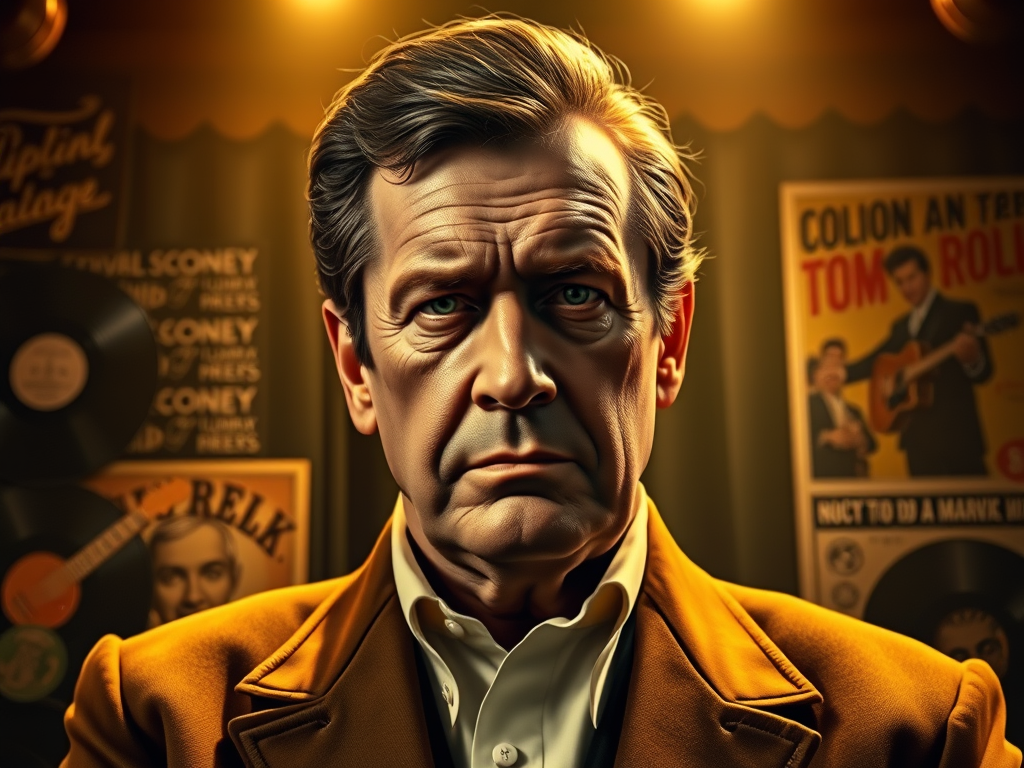

Was Elvis Presley’s Manager the Colonel a Villain? It’s Complicated.

In the annals of rock ‘n’ roll, few figures operating behind the scenes have been as harshly judged—or as poorly understood—as Colonel Tom Parker.
Known primarily as the longtime manager of Elvis Presley, Parker was the architect behind much of the commercial success that helped Presley become the first global icon of rock music. Thanks to Parker’s business acumen, Elvis signed lucrative contracts, landed major television appearances, and earned millions. In many ways, Parker was the mastermind who transformed a gifted Southern singer into a worldwide cultural phenomenon.
Yet despite—or perhaps because of—his central role in Presley’s career, Parker has long been vilified. Critics have frequently portrayed him as a manipulative opportunist who prioritized profit over Presley’s artistic growth. Stories of his alleged greed abound, especially in the 1970s, when he was reportedly taking an astonishing 50 percent cut of Presley’s earnings. Adding to the mystique was Parker’s own murky past: born Andreas Cornelis van Kuijk in the Netherlands, he concealed his foreign origins for most of his life, fabricating a new identity in the United States and pretending to be a native of West Virginia.
Now, a new book by renowned music historian Peter Guralnick aims to offer a more nuanced and evidence-based view of Parker’s legacy. Titled The Colonel and the King, the book—set for release on August 5—draws from a trove of private correspondence, memos, and records left behind by Parker. Elvis Presley Enterprises, which holds rights to Parker’s personal files, granted Guralnick exclusive access to these materials, providing the author with the opportunity to present a version of history grounded in first-hand documentation.

Guralnick is no stranger to Elvis scholarship. His two-volume biography of Presley from the 1990s—Last Train to Memphis and Careless Love—are considered definitive works, deeply researched and widely respected in both music and academic circles. For fans and historians alike, a new entry from Guralnick carries the weight and anticipation of a major historical update—akin to a fresh installment in Robert Caro’s monumental biography of Lyndon B. Johnson.
Sean Wilentz, a history professor at Princeton University, emphasized Guralnick’s unique contribution. “Peter Guralnick is not only meticulous in his research, uncovering obscure details no one else finds, but he also approaches his subjects with the sensibility of a true historian,” Wilentz noted. “He doesn’t write from hindsight; he allows the story to unfold with the uncertainty that real life contains.”
Speaking in a video interview from his home near Boston, the 81-year-old Guralnick emphasized that his goal was not to rewrite history to cast Parker as a hero, nor to defend his controversial decisions. Rather, he hoped to present a full, complex picture of the man behind the legend. “I wasn’t writing to change anyone’s mind if they’ve already made up their mind,” Guralnick said. “My intention was simply to move past the myths and tell the story as truthfully and completely as possible.”
Guralnick’s interest in Parker’s personal records stretches back decades. “When I first encountered the letters over 30 years ago, I was struck by how different they were from the caricature that had formed around Parker,” he explained. In Careless Love, Guralnick had previously depicted Parker as a kind of larger-than-life, almost Shakespearean figure—part rogue, part showman. But the letters revealed a different side: a man with strategic foresight, deep involvement in Elvis’s career, and at times, genuine concern for the artist’s creative agency.

For example, during the early negotiations for Elvis to appear on The Ed Sullivan Show, Parker held firm on key demands. Sullivan had initially refused to feature Presley, deeming him too controversial. But when Presley appeared on The Steve Allen Show and crushed Sullivan in the ratings, Sullivan reconsidered. Even then, Parker insisted on full creative control for Elvis: the selection of songs, the style of performance, and the choice of backing musicians were all non-negotiable. According to Guralnick, this was not the behavior of a cynical profiteer, but rather a shrewd manager advocating fiercely for his client’s autonomy.
Parker’s own backstory is as mysterious as any in the entertainment industry. After leaving the Netherlands as a young man, he reinvented himself in the United States, fabricating a colorful past involving carnivals and showbiz. “He crafted a life of self-invention,” Guralnick observed. “What’s fascinating is how closely the American version of his story mirrored the real life he left behind in Holland—it’s like he transposed one narrative onto another.”

Despite the compelling mythology around Parker’s controlling nature, Guralnick argues that during the first decade of their collaboration, he was widely admired. “Until the late 1960s, Parker wasn’t seen as an antagonist,” Guralnick said. “He was viewed as a savvy businessman, which is exactly why Beatles manager Brian Epstein sought him out.”
The popular image of Parker as a puppet master gained traction only after Presley’s death, most recently reinforced by Baz Luhrmann’s 2022 film Elvis. The portrayal in that film painted Parker as a domineering force who steered Presley toward mediocrity and burnout. Guralnick, however, offers a more layered interpretation. He points out that both Presley and Parker were underestimated when they arrived in Hollywood, often dismissed as country bumpkins. But they soon defied expectations—Presley with his talent, and Parker with his ability to strike formidable deals.
When asked if he considers himself a defender of Parker, Guralnick was clear: “No more than I am of Elvis or Sam Cooke. My aim is to discard the myths and see the person beneath them. Parker was complicated, often inscrutable, but not without fault. I wanted to show the entire man, not a one-dimensional caricature.”
Many critics argue that Parker stifled Presley’s creativity by funneling him into formulaic movies and keeping him off the concert stage for much of the 1960s. Guralnick agrees, to an extent—but insists there’s more to the story. After Presley returned from military service in 1960, he starred in two serious dramas, Wild in the Country and Flaming Star, which failed commercially. The box office triumph of Blue Hawaii that followed led to a series of similar musical films. At the same time, Presley became increasingly absorbed in spiritual study, questioning his life’s purpose and withdrawing from performance altogether. His creative retreat, Guralnick argues, was as much personal as it was professional.
In 1965, Parker renegotiated Presley’s RCA contract. At a time when Presley’s record sales had dropped by 40% compared to five years prior, Parker secured a $2.1 million deal over seven years, contingent on new recordings. One of these was a gospel album—How Great Thou Art—which reinvigorated Presley’s interest in music and set the stage for his late-career resurgence: the 1968 comeback special, the 1969 Memphis sessions, and his famous Las Vegas shows.

The controversial 50 percent commission Parker took on Presley’s earnings is often cited as evidence of exploitation. But Guralnick offers a different perspective. By the mid-1960s, Presley’s spending had spiraled out of control. “Elvis was making over $3 million a year, yet he was teetering on bankruptcy,” Guralnick said. “Parker believed that, given the enormous effort he put into generating income opportunities, a 50-50 partnership was justified.”
So why, then, has Parker been cast so clearly as the villain?
“From the beginning, Parker believed the artist must always wear the white hat,” Guralnick explained. “When criticism of Elvis mounted in the late ’60s and especially in the ’70s, Parker never allowed the blame to fall on Elvis. He absorbed it himself. That’s how he ended up wearing the black hat in the public imagination.”
Parker never published the memoir he long promised—tentatively titled How Much Does It Cost If It’s Free? Guralnick believes this was deliberate. “Even after Elvis’s death, he held onto that principle. He would not betray the artist he believed in.”
Ultimately, The Colonel and the King doesn’t seek to exonerate Parker—but it does strive to humanize him. By peeling back the layers of myth and speculation, Guralnick delivers a more complete picture of a man who was neither saint nor scoundrel, but something far more intriguing: deeply flawed, profoundly influential, and still misunderstood.




Leave a Reply