

Amy Sherald Cancels Her Smithsonian Show, Citing Censorship

Amy Sherald, the acclaimed painter who gained national attention after her 2018 portrait of former First Lady Michelle Obama, has made the decision to withdraw her upcoming solo exhibition, American Sublime, from the Smithsonian’s National Portrait Gallery. Her choice, she explained, was prompted by the museum’s alleged hesitation to feature one of her works — a powerful painting portraying a transgender person as the Statue of Liberty — due to concerns it might draw criticism from President Trump.
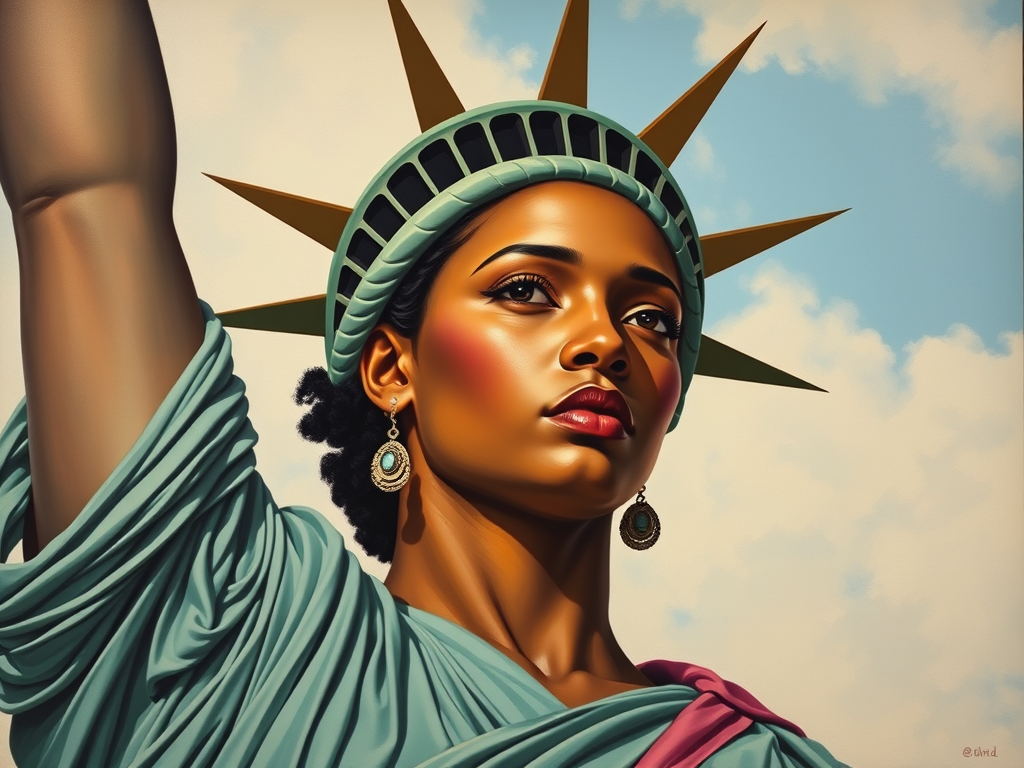
Originally scheduled to open at the Portrait Gallery in September, American Sublime was set to be a landmark exhibition. Not only would it have showcased approximately 50 of Sherald’s significant pieces, but it also marked a historic first: a solo show at the Portrait Gallery by a contemporary Black artist. Sherald has become known for her poignant, quiet, and dignified portraits that challenge traditional ideas of identity and visibility — themes that deeply resonated with the nation during her portrayal of Michelle Obama. One such work, Trans Forming Liberty, reflects Sherald’s commitment to social commentary, portraying a transgender woman in the iconic pose of Lady Liberty, holding a torch aloft.
In a letter addressed to Lonnie G. Bunch III, Secretary of the Smithsonian Institution, Sherald explained her reasons for backing out. “I entered into this collaboration in good faith, believing the institution shared my vision for presenting art that reflects the full complexity of the American experience,” she wrote. “Regrettably, it has become clear that the environment no longer protects the integrity of this vision.”

The source of contention stems from internal discussions within the Portrait Gallery surrounding Trans Forming Liberty. Sherald said she was notified that concerns had been raised over the inclusion of the painting, ultimately leading to conversations about its potential removal. According to her, the worry was that the piece — which boldly reinterprets one of America’s most revered symbols — might attract negative attention from the Trump administration.
In a public statement, Sherald expressed disappointment and frustration. “These internal apprehensions appear to be the result of a larger political climate marked by increasing hostility toward trans lives,” she said. “When fear takes precedence over artistic truth, the work and its message are inevitably compromised.”
According to Sherald, on July 22, Bunch proposed a compromise: instead of showing the painting, the museum would display a video in which individuals discussed their reactions to the artwork and transgender issues more broadly. But Sherald rejected this option, saying that it would have opened the door to anti-trans viewpoints and diluted the message of her work. “Replacing the painting with a video would, in effect, transform the meaning of the exhibition,” she said. “Rather than a celebration of trans visibility, it would have invited public debate over whether that visibility should even exist. I could not be a part of that.”
The Smithsonian responded by suggesting there had been a misunderstanding. In an official statement, a spokesperson clarified, “The video was never intended to replace Ms. Sherald’s painting but to provide additional context for it. It was meant to deepen public engagement with the piece, not remove it.”
Despite this clarification, the institution acknowledged Sherald’s decision. “While we respect Ms. Sherald’s choice to withdraw her exhibition, we are disheartened that our visitors will miss the opportunity to engage with American Sublime,” the museum stated. “The Smithsonian is committed to fostering understanding through the arts. Though we were unable to reach a mutual agreement in this case, we remain inspired by Ms. Sherald and her unwavering dedication to portraiture.”
Sherald’s withdrawal comes amid growing scrutiny of cultural institutions by President Trump and his administration. In March, Trump signed an executive order accusing the Smithsonian of promoting what he characterized as “divisive, race-centered ideologies” and “attempts to rewrite America’s history.” The order, widely seen as a political effort to influence the content of federally funded museums, has caused significant concern within the arts community.

A White House official, commenting on Sherald’s painting, said the decision to exclude it was necessary. “The reinterpretation of a cherished national symbol like the Statue of Liberty through a politically charged lens undermines the mission of national museums,” said Lindsey Halligan, a special assistant to the President. “This symbol is sacred, representing freedom and unity, not a canvas for ideological experimentation.”
The controversy has also resulted in administrative changes. In May, Trump publicly dismissed Kim Sajet, the director of the National Portrait Gallery, via social media, accusing her of promoting partisan narratives and strongly supporting diversity, equity, and inclusion (D.E.I.) initiatives. The Smithsonian responded by reaffirming its independence regarding personnel decisions. However, the Institution’s Board of Regents also directed museum leaders to review exhibitions for potential bias.
Kim Sajet resigned weeks later, stating that her tenure had been about “telling a more complete American story — one rooted in connection, reflection, and understanding.”
Sherald, who has long used her art as a means of asserting visibility for historically marginalized communities, emphasized the importance of artistic integrity. “Portraiture is how I assert existence,” she wrote. “When that visibility is even subtly undermined, it alters not just the piece, but the meaning it carries. I can’t allow that to happen.”
American Sublime had already debuted at the San Francisco Museum of Modern Art before traveling to the Whitney Museum of American Art in New York, where it will remain on view until August 10. The show was to open at the Portrait Gallery on September 19.

Sherald has never shied away from activism in her art. Her portrait of Breonna Taylor — a Black woman killed during a police raid — is one of her most recognized works in recent years and is jointly held by the Smithsonian’s National Museum of African American History and Culture and the Speed Art Museum in Louisville. Another notable piece, For Love, and For Country, portrays two men sharing an embrace in the style of the famous World War II photo of a sailor kissing a nurse on V-J Day, reimagining it to engage with themes of military service and sexuality.
Both of these paintings are part of the American Sublime show, further highlighting Sherald’s ongoing efforts to bring underrepresented narratives into public view.
In her final remarks, Sherald firmly positioned her choice as a moral one. “I cannot in good conscience participate in a system of censorship, especially when it targets vulnerable communities,” she said. “With trans individuals facing discrimination, legislative attacks, and physical danger across this country, silence is complicity. I refuse to be silent.”
This incident underscores a broader tension between artists and institutions navigating political pressure, especially when public funding is involved. As cultural spaces become battlegrounds for ideological control, Sherald’s decision will likely reverberate throughout the museum world — a bold act of protest that affirms the essential role of art in telling difficult, necessary truths.




Leave a Reply