
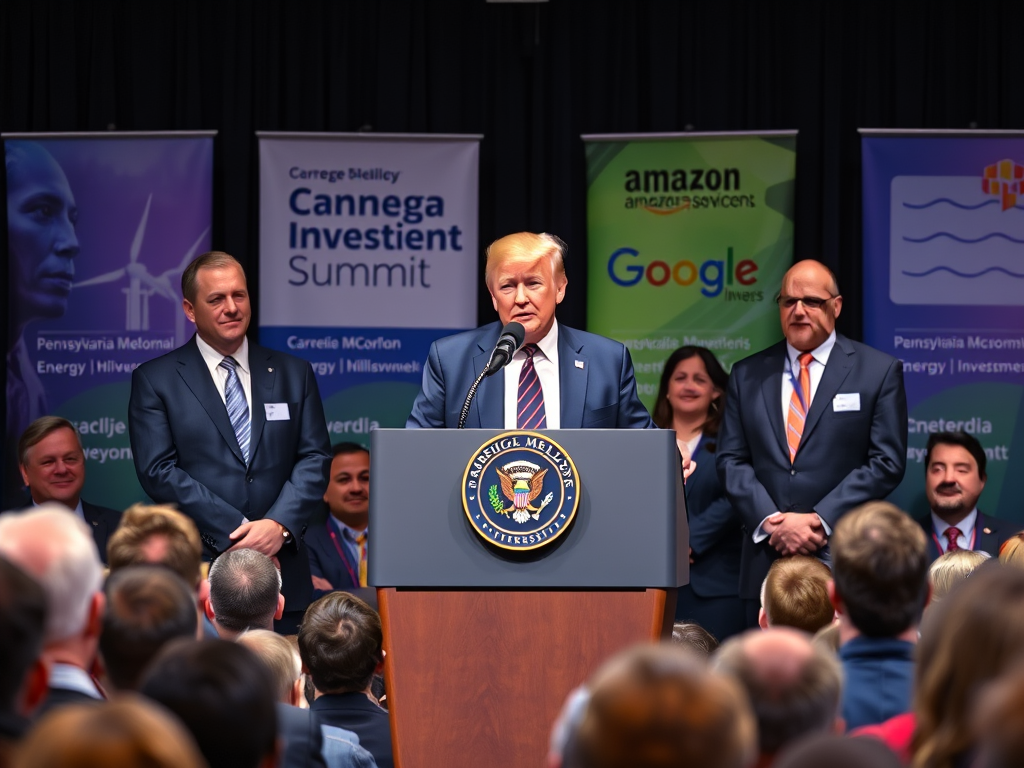

Trump Highlights $90B AI and Energy Investment in Pennsylvania

On Tuesday, former President Donald Trump made a prominent appearance in Pittsburgh to commend an influx of private-sector investments totaling more than $90 billion into data centers and energy infrastructure throughout Pennsylvania. These efforts are intended to fuel the rapid growth of artificial intelligence technologies and bolster America’s energy capacity.
Speaking at the Pennsylvania Energy and Innovation Summit, held at Carnegie Mellon University, Trump lauded the strategic significance of these investments. He emphasized that such projects are critical for positioning the United States—and Pennsylvania in particular—at the forefront of the global AI race.
“The commitments we’re seeing today are laying the foundation for the future to be conceived, developed, and produced not just in Pennsylvania and Pittsburgh,” Trump stated during his keynote address, “but across the United States of America.”
The summit was spearheaded by Republican Senator David McCormick of Pennsylvania, who coordinated the event to bring together high-ranking Trump administration officials and top executives from both the technology and fossil fuel sectors. Attendees included major players such as Amazon Web Services, Anthropic, Google, ExxonMobil, and Westinghouse, demonstrating the broad industry support behind this large-scale investment push.
One of the most noteworthy announcements came from Blackstone, a leading private equity firm, which revealed plans to allocate $25 billion toward the construction of new data centers and energy infrastructure projects. This includes the development of natural gas-powered electricity plants, a key component in supporting the energy-intensive demands of modern AI computing systems.

Similarly, Google declared it would inject another $25 billion into expanding its data center operations. The tech giant also introduced a separate initiative to invest $3 billion into upgrading two existing hydroelectric dams in Pennsylvania, aiming to increase their energy output and sustainability.
Another significant development came from CoreWeave, a cloud computing firm focused on AI services, which disclosed its intention to invest $6 billion in building a massive data center near Lancaster, Pennsylvania. These substantial financial commitments reflect the growing consensus that Pennsylvania, with its vast energy resources, is well-positioned to become a national AI and data infrastructure hub.
The Trump administration has long emphasized the strategic importance of staying ahead of geopolitical rivals—particularly China—in the development of artificial intelligence. Senior officials have reiterated that dominating the AI frontier is an essential element of national security. As part of this broader goal, the administration has prioritized streamlining the approval process for new natural gas and nuclear energy plants, which are essential for meeting the high electricity demands of AI data centers.

On his first day back in office, Trump issued a declaration of a “national energy emergency,” arguing that the nation’s current power infrastructure was inadequate for its escalating energy requirements. He instructed federal agencies to begin rolling back environmental regulations that he claimed were obstructing growth and technological progress.
However, this aggressive strategy has not been without controversy. Critics argue that the Trump administration’s decision to cut scientific research funding and weaken regulatory institutions has inadvertently given China more room to catch up in the AI race. Just a day before the summit, Nvidia, a leading chip manufacturer, announced that the administration had relaxed restrictions on certain types of AI chip exports to China—a move that has drawn criticism from national security experts and environmental groups alike.
Despite the concerns, business leaders at the summit offered strong endorsements of Pennsylvania as a strategic location for AI development. Many pointed to the state’s abundant natural gas reserves, largely obtained through hydraulic fracturing (fracking), as a key advantage. Pennsylvania’s vast underground shale formations have enabled energy companies to extract large quantities of gas, although the lack of sufficient pipeline infrastructure continues to be a logistical bottleneck in transporting fuel to other regions.
Jon Gray, president of Blackstone, spoke optimistically about the potential to directly link data center development with local energy production. “What excites us most about this area is the opportunity to co-locate data centers next to the power source,” Gray explained. “It creates operational efficiency, reduces costs, and ensures a more stable energy supply.”
Environmental advocates, however, have sharply criticized the administration’s approach, warning that its focus on expanding fossil fuel use—particularly oil, gas, and coal—could exacerbate air pollution and accelerate the effects of climate change. They have expressed alarm over the administration’s push to circumvent environmental impact assessments in favor of fast-tracking energy projects.
In response to these concerns, Interior Secretary Doug Burgum, who also spoke at the summit, dismissed climate change as a primary threat. “This administration has clearly identified two existential threats to our nation, and neither of them is climate change,” Burgum said. “Number one is the risk of Iran acquiring nuclear weapons, and number two is the danger of falling behind in the AI arms race.”
Burgum’s remarks highlighted the administration’s belief that AI supremacy is as critical to national defense as military hardware or nuclear deterrence. By focusing national resources on building infrastructure to support AI systems, Trump and his allies hope to ensure that the U.S. remains a technological leader well into the 21st century.
While opinions remain divided, the summit in Pittsburgh underscored a unified effort among corporate leaders, politicians, and administration officials to channel substantial investments into Pennsylvania’s infrastructure. These developments signal a decisive shift in both economic and technological policy, one that positions energy and artificial intelligence as twin pillars of America’s future.
For many supporters, this approach represents an opportunity to reinvigorate domestic industry, create high-paying tech jobs, and solidify the nation’s leadership in a competitive global landscape. For opponents, it raises troubling questions about environmental sustainability and the potential consequences of prioritizing short-term technological dominance over long-term ecological health.
Nevertheless, the wave of announcements at the summit points to a clear direction: the merging of AI and energy development is set to redefine not only Pennsylvania’s economy but also the trajectory of national innovation policy.




Leave a Reply