
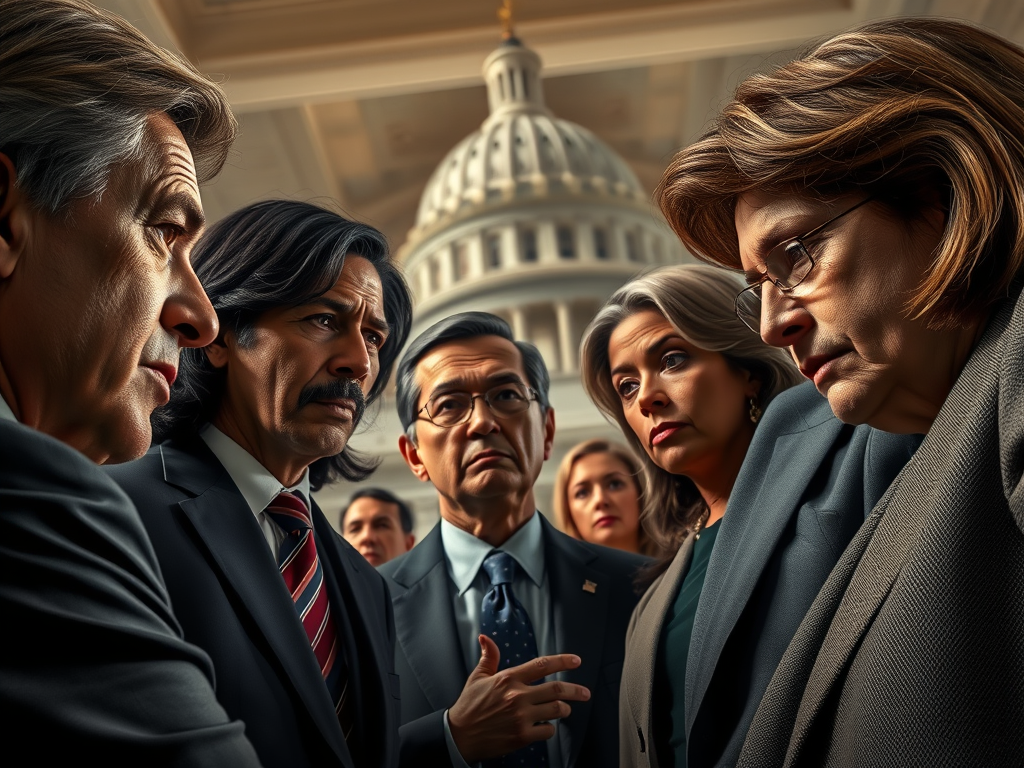

Democrats Broach Potential Walkout to Block Texas Redistricting

Prominent figures within the national Democratic Party are actively encouraging their colleagues in the Texas House to seriously consider taking drastic action—specifically, a walkout from an upcoming special legislative session. This move is being weighed as a potential strategy to prevent the Republican Party from implementing a controversial redistricting of the state’s congressional boundaries, a move that would take place ahead of the 2026 midterm elections.
The redistricting effort has ignited a political storm, with national leaders from both parties getting involved. While Democrats are discussing measures to block the plan, former President Donald Trump is doubling down on his push for Republican lawmakers in Texas to use the redistricting opportunity to reshape the state’s political map in the GOP’s favor.
According to an individual familiar with the conversation, Trump held a private call on Tuesday with Republican members of Congress from Texas. During this call—first disclosed by Punchbowl News—he reportedly urged them to create five additional Republican-leaning districts by redrawing areas currently held by Democrats.
Following the call, Trump took to social media to share his perspective, writing, “Just spoke to our Great Congressmen and women of Texas.” He continued, “I keep hearing about Texas ‘going Blue,’ but it is just another Democrat LIE.”
Redistricting typically occurs once every ten years, based on data from the U.S. Census, to account for shifts in population that impact congressional representation. Conducting a redistricting effort in the middle of the decade, however, is highly unusual and almost always provokes legal and political battles. These efforts are often seen as overtly partisan, lacking the demographic justification that normally accompanies redistricting.

In this particular case, Trump appears to be pushing for a new map that would reinforce Republican control in the U.S. House of Representatives, where the party currently holds only a slim majority. By increasing the number of Republican-friendly districts in Texas, the GOP could potentially secure its position heading into the midterms, undermining Democratic chances of regaining control.
“This is a moment that calls for resistance,” said Representative Lizzie Fletcher, a Democrat from Houston whose district could be significantly affected by the new maps. “What’s being proposed represents a fundamental betrayal of the people of Texas.”
On Monday evening, Democratic members of the Texas House participated in a private virtual meeting lasting more than two hours. The call included key Democratic figures such as Hakeem Jeffries, the U.S. House Minority Leader from New York, and Ken Martin, Chair of the Democratic National Committee. Around 40 Democratic lawmakers from the Texas House were in attendance.
According to a person with knowledge of the conversation, Jeffries described the impending special session as an urgent and pivotal moment that would require bold, coordinated action to stand against Trump and Texas Republicans.
Eric Holder, the former U.S. Attorney General who served under President Obama and has since led national initiatives to combat partisan gerrymandering, also participated in the call. A copy of the agenda reviewed by The New York Times confirmed his presence.
Although none of the Democratic leaders on the call directly instructed Texas lawmakers to stage a walkout, several participants said that the tone and content of the discussion strongly implied that such a tactic should be on the table.
The following day, the Texas House Democratic Caucus issued a public statement declaring that their members were prepared to use “whatever means necessary” to resist the proposed redistricting plan.
Republican Governor Greg Abbott has scheduled the special session to begin on July 21 and last for 30 days. In addition to redistricting, the session will also address legislative responses to recent deadly floods in the Texas Hill Country and possibly other issues.
Speaking at a press conference on Tuesday, Jeffries sharply criticized the Republican-led redistricting efforts, alleging that they were part of a broader strategy to marginalize and silence voters across Texas.
“Republicans are trying to rig the map to suppress the voices of millions,” Jeffries stated. He went on to accuse Trump of effectively dictating the creation of five new Republican districts and warned that the state’s GOP lawmakers appeared ready to comply.
Democrats currently hold 12 of Texas’ 38 congressional seats. With a vacancy in Houston’s 18th District—an area with strong Democratic support—they were anticipating a likely win in a special election scheduled for November.
A walkout, however, would not come without serious risks for Democrats. Procedural rules require that at least 100 of the 150 members of the Texas House be present to conduct official business. This means Democrats would need at least 51 of their 62 members to participate in a walkout to prevent a quorum.
Under rules implemented by the Republican-controlled House after a similar incident in 2021, any legislator who participates in a walkout would face a $500 daily fine. Over the course of the 30-day session, this would amount to $15,000 per lawmaker. Moreover, these fines must be paid personally; campaign funds cannot be used to cover the penalties.

The idea of a walkout is not new for Texas Democrats. In 2003, Democratic lawmakers famously fled the state in an attempt to block a mid-decade redistricting championed by Republican Congressman Tom DeLay. That effort failed, as did their more recent 2021 walkout over voting restrictions.
If Democrats choose to walk out again, they may face even more aggressive opposition. On Tuesday, Texas Attorney General Ken Paxton declared that his office would assist law enforcement in locating and arresting any Democratic lawmakers who refused to show up for the special session.
“Texans didn’t elect them to run away from their responsibilities,” Paxton said in a statement. “They need to stay, do their jobs, and stop acting like cowards.”
Neither Jeffries nor Martin responded immediately to requests for comment on their private call with Texas lawmakers. However, Representative Fletcher made clear that any action would ultimately be determined by the Democratic members of the Texas Legislature.
Some Democrats expressed reluctance to pursue another walkout. State Representative Jon Rosenthal, who represents parts of Houston and participated in the 2021 walkout, voiced concerns about the feasibility of repeating the tactic under the current rules.
“Those of us who went through this last time are going to be cautious,” Rosenthal said. “These new financial penalties put an unreasonable burden on members. For many of us, it’s just not sustainable.”
While the debate continues among Democrats, Trump’s demand for redistricting appears to be gaining traction within his party. Senator John Cornyn, currently facing a tough primary challenge from Paxton and seeking Trump’s endorsement, expressed strong support for the initiative.
“A mid-decade redistricting could yield major advantages for Republicans in Texas,” Cornyn posted online, signaling alignment with Trump’s aggressive push for political gains.
As the special session approaches, the stakes continue to rise. With high financial costs, the threat of arrest, and an increasingly polarized atmosphere, Texas Democrats must soon decide whether to take a historic stand—or risk seeing their districts reshaped before the 2026 election season begins.




Leave a Reply