
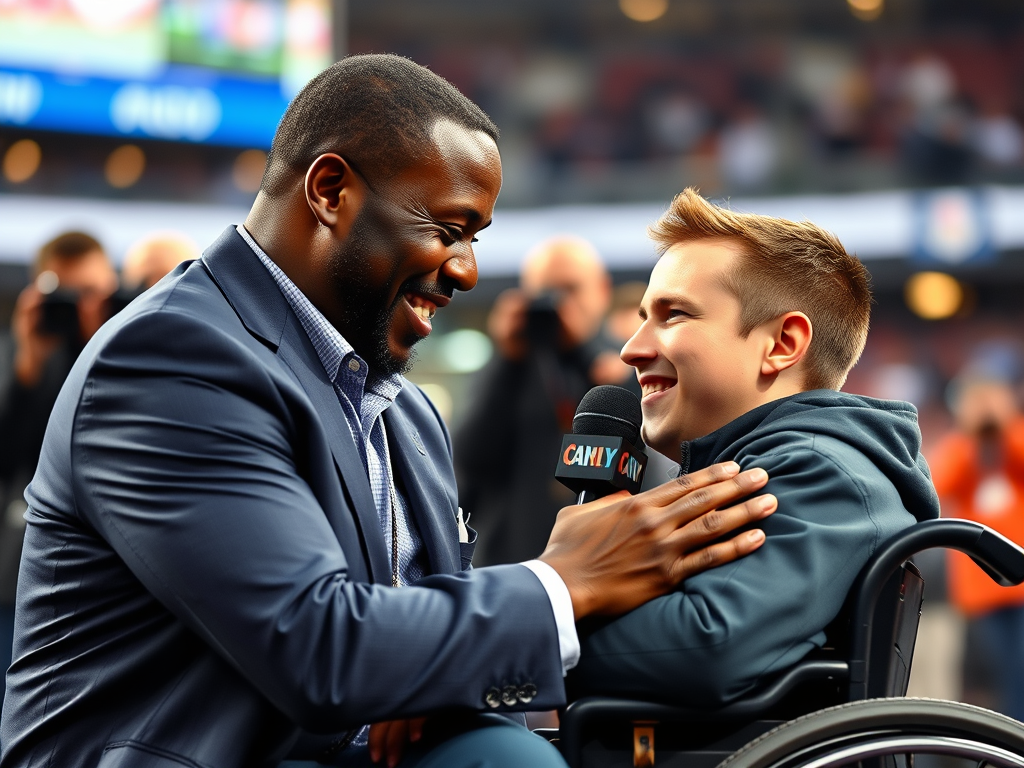

Life-Changing Moment for UCF Student Journalist: Deion Sanders’ Impact

Throughout his career, Deion Sanders has generated countless viral moments. But one particular interaction stands out—not for its flash or flair, but for the quiet, deeply personal connection it created.
On September 28 of last year, the University of Colorado’s football team, led by Sanders, had just crushed the previously undefeated University of Central Florida (UCF) 48-21 in Orlando. Among the press gathered for the postgame conference was a 21-year-old student journalist named Andrew Cherico. He had been covering the UCF Knights for a small independent media site called Sons of UCF, where he was interning. That day, though, turned out to be more than just another assignment—it became a transformative moment in his life.

Cherico arrived at the stadium early in the morning and stayed on through the long, sweltering Florida day. By the time the press conference began around 8 p.m., he was exhausted. He had spent nearly 12 straight hours on his feet—or rather, in his motorized wheelchair, which he has relied on since he was nine years old. Andrew lives with spinal muscular atrophy (SMA), a progressive neuromuscular disorder that weakens muscles over time. He was able to walk in early childhood but gradually transitioned from a manual wheelchair to the power wheelchair he uses today.
“It must’ve been 1,000 degrees that day,” Cherico recalled. “By the time I asked my question, I was running on fumes.” The long hours had taken such a toll that, on his way out of the stadium that night, he vomited from sheer exhaustion—though he didn’t let his internship supervisors know just how wiped out he was.

Still, despite everything, Cherico was determined to make the most of the moment. Before the press conference began, he carefully positioned himself so he might be seen and chosen to ask a question. He had been rehearsing it in his head even before the game ended: he wanted to ask Sanders how Colorado managed to stop R.J. Harvey and UCF’s powerful rushing offense.
When Cherico finally got his chance, Sanders initially responded with tactical insight—but then stopped mid-answer. His focus shifted from football to the young reporter in front of him.
“I’m proud of you,” Sanders said, looking directly at Cherico. “I’m proud of your resilience and everything you go through each day. You have no idea how proud I am. I was in a wheelchair once too, after having some of my toes amputated. I know what that’s like. I had to remodel my bathroom with grab bars just to use the toilet. I truly understand, and I’m proud of you, man.”
Cherico sat stunned. “I felt every butterfly in my stomach wake up at once,” he later said. “And then everyone in the room started turning around to look at me. That’s when I realized—he’s really talking about me.”
Born with SMA Type 3, a condition that affects nearly every muscle group, Cherico has faced physical limitations since childhood. Thanks to advancements in modern medicine, the disease’s progression has slowed. But the road has still been steep. His early love of sports came from sitting on the couch with his dad, watching games while wearing a New York Jets jersey. Even then, he knew he wouldn’t be the one playing on the field—but maybe, just maybe, he could be the one talking about it.
When he was six, his aunt heard him reciting sports stats and told him he should be a sports broadcaster. He was already listening religiously to announcers like Gary Cohen, Kevin Harlan, and Ian Eagle. By age 10, he was dreaming of becoming one himself. His biggest inspiration, though, has always been his parents—his father, a retired NYPD detective, and his mother, a nurse’s assistant. Their unwavering support instilled in him the belief that, no matter what physical challenges he faced, he still belonged.

He graduated from a specialized high school in New York for students with disabilities—his class had just 15 people. College life at UCF, with its 70,000 students, was a huge leap. But the warm weather and the excitement around the UCF football program, especially after their undefeated 2017 season, drew him to Orlando. He and his family moved to Florida in 2023, after Andrew took a gap year.
Breaking into sports media wasn’t easy. In April 2023, he created a Twitter account to begin sharing his analysis and commentary—at first to no one. “For the first few months, it felt like I was tweeting into the void,” he said. But he stuck with it. Slowly, people began to notice.
Eventually, the team at Sons of UCF, a small site focused entirely on UCF sports, reached out. They offered him a paid internship, complete with a monthly stipend and college credit. Adam Eaton, the site’s founder, admired Cherico’s initiative. “He’s been counted out his whole life,” Eaton said. “But we never say no to him. If he’s got an idea, we ask him to come up with a plan—and he always does. We’re here to support him.”
Cherico’s passion and charisma helped him connect with players, coaches, and fans alike. His father often drove him to games and practices, and the UCF community embraced him.
That work paid off when, in summer 2024, he landed a bigger opportunity: a job with Knights247, the UCF-focused platform under 247Sports. This new position also meant new challenges, including his first out-of-state reporting trip—to the Big 12 Media Days in Frisco, Texas.
Air travel is daunting for most people. For someone in a $30,000 power wheelchair, it’s a logistical puzzle. Cherico arrives three hours early, meets with the ramp supervisor, and hands over printed instructions about his chair’s care. “This chair is my life,” he said. “Without it, I’m stuck.”
The hassles don’t end at the airport. Accessible taxis can be nearly impossible to find. In Dallas, he called 20 different companies before finally getting a lead on a driver in Fort Worth. One short ride cost him $75. “I always come with a Plan A, B, and C,” he said. “But this time, Plan A and B both failed. I didn’t even know if I was going to make it.”
Despite the obstacles, Cherico has grown increasingly aware that his journey isn’t just about him. A few weeks before Texas, he spoke at a Disneyland conference for people living with SMA. Afterward, several parents came up to him, thanking him for being a role model and asking if he could talk to their children.

“There are so many people like me who don’t feel like they have a voice,” he said. “I didn’t know what my future would be. I can’t get out of bed without help, can’t use the bathroom alone—but I still chase my dream. I want others to know that with some hope and determination, they can do the same.”
Cherico’s ultimate goal is to reach the professional level in sports media—not just for himself, but so others with disabilities can see what’s possible. “It’s not always fair,” he admits. “You have to work harder, plan more, adapt. But you can do it.”
Even when life feels overwhelming—when his arms can’t move as quickly as others’, or he struggles to set up equipment—he remembers moments like the one with Deion Sanders.
“I was probably the youngest person in that room,” he said. “And definitely the only one with a physical disability. But I was there. And Coach Sanders looked at me and reminded me that I belong.”
On the second day of the Big 12 Media Days, Sanders and Colorado arrived in Frisco. Cherico got the chance to reconnect with the Hall of Famer and thank him in person. Sanders told The Athletic he was glad to see Cherico there: “It takes a lot to get here. We take it for granted. My hat’s off to him.”
For Andrew, that moment was more than validation—it was fuel. “When the world makes me doubt myself, I go back to that moment,” he said. “It reminds me that I can do this. That with grit, planning, and a little faith, I’ll find a way.”




Leave a Reply