
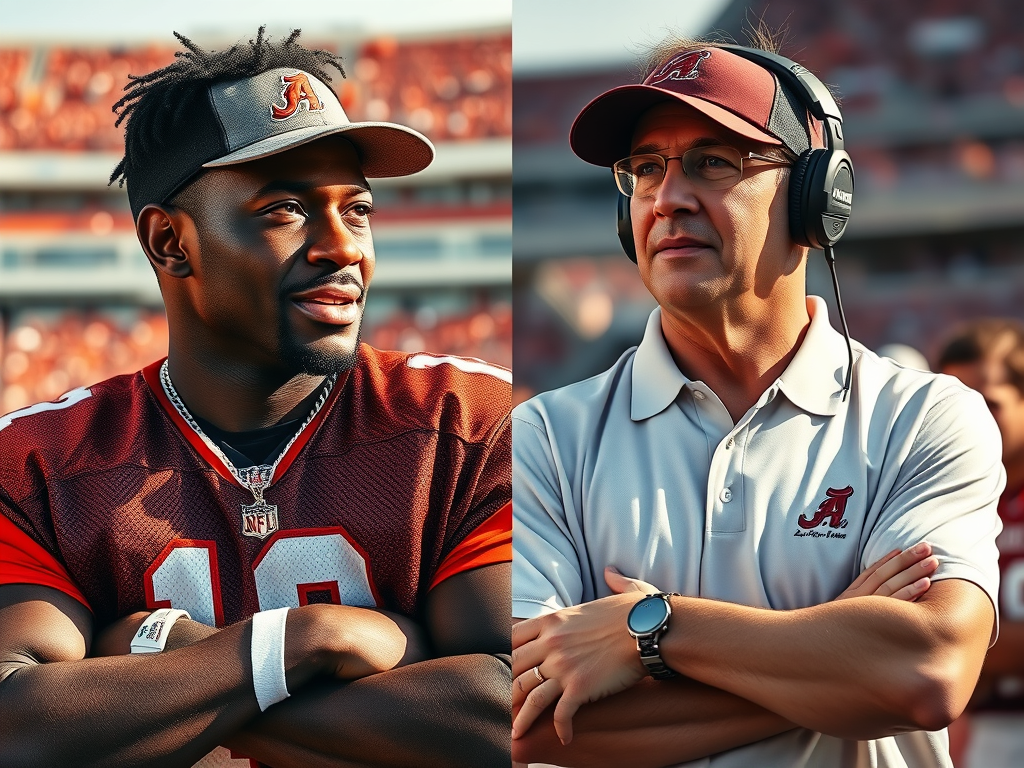

Deion Sanders went from NFL star to successful college coach. Did his teammates see it coming?

Thirty-five years ago, a new Atlanta Falcon named Deion Sanders arrived in Suwanee, Georgia, with a carefully cultivated image.
During his time at Florida State, he famously drove to games in a white stretch limousine and stepped out in a tuxedo. Known for his flamboyant style, Sanders swaggered into end zones in ways that few dared to at the time. He even told reporters that Florida receivers “must think I’m God.”https://wordpress.com/
“Deion was famous for his bold suits, alligator shoes, gold chains, and a signature diamond-studded dollar sign pendant, not to mention his silk pork pie hats,” recalled his Falcons teammate, Tim Green, in an email.
Naturally, Green had his doubts.
But then he met Sanders.
“The first time I saw him in person was in training camp, in the lobby of the Falcon Inn. I did a double take,” Green wrote. “Prime Time was just Deion, wearing Falcons shorts and a plain T-shirt.”
Green asked why Sanders wasn’t sporting his usual flashy accessories.
“That’s just for show, Tim,” Sanders explained.
Like many, Green was initially struck by Sanders’ image, but over time, he saw the depth beneath it. This season, Sanders has led the University of Colorado to a 9-3 record, earning praise that could attract interest from NFL teams in need of a head coach.
The Athletic interviewed 10 people who worked with Sanders during his NFL career. None of them could have predicted that Sanders would evolve into a coach capable of transforming a major college football program, but their stories offer insight into how the flashy “Neon Deion” became the more reflective “Coach Prime.”
Sanders’ journey to the Alamo Bowl this weekend was shaped by eight years of high school coaching and three seasons at Jackson State. But it all began when he was making his signature moves on the field.
Though Sanders was often seen as self-promotional, many who knew him saw another side—a unifier.
“Players just gravitated toward him,” said Jerry Glanville, who coached Sanders for four years in Atlanta. “They loved him.”
Glanville fondly remembers the times Sanders brought celebrity friends, like MC Hammer and Mr. T, to visit the team.
Quarterback Bobby Hebert, who faced Sanders as a member of the Saints, initially saw Sanders as arrogant. But when Hebert joined the Falcons in 1993, his perspective changed.
“As a teammate, you saw he got along with everyone,” Hebert said. “We’re both from the South, so we’d go fishing together. His greatest strength was communication—he connected with players from all backgrounds and generations.”
Hebert believes Sanders’ ability to relate will make him a great coach.
“When he’s 70 or 80, he’ll still be able to connect with 20-year-olds,” Hebert said. “I’d bet he’s an incredible recruiter.”
Green, too, believes Sanders’ Christian faith contributes to his leadership style.
“It’s the foundation of his leadership,” Green said. “Jesus said that to lead is to serve. As the star player, Deion used his position to serve others, and that made him a natural leader. He was humble and kind to everyone in that locker room.”
In 1992, Sanders filmed a Nike ad as “Sanderclause,” and when asked to select five teammates for the commercial, he chose three Black players and two White players, including Green. When the director expressed surprise, Sanders simply said, “I brought three of my Black brothers and two of my White brothers.”
After the 1993 season, Sanders signed with the 49ers, and while some teammates were uncertain about his arrival, Sanders quickly put their concerns to rest.
Quarterback Steve Young remembers Sanders pulling him aside on his first day.

“I want you to know that all the marketing stuff is my genius,” Sanders told Young. “But don’t let it confuse you. I’m a great teammate, and I’ll always be there for game day. You don’t need to worry about that. As for the rest, just grab some popcorn and enjoy the show.”
Young soon realized Sanders was genuine.
“There’s a sophistication to him,” Young said. “That conversation was so direct and mature. And then, on the field, he was the best teammate and locker room presence you could ask for.”
In 1994, Sanders helped the 49ers win the NFC Championship and Super Bowl, with key interceptions in both games.
“He brought a new energy,” said Merton Hanks, who played safety for the 49ers at the time. “He blended seamlessly into the team’s culture, even though we had superstars like Jerry Rice and Steve Young. He didn’t disrupt our dynamic, but he did tweak it in positive ways.”
In 1995, Sanders joined the Cowboys, a team struggling under new coach Barry Switzer. Despite the team’s previous successes, Sanders quickly earned his place as a leader.
“Deion had a unique ability to connect with everyone,” said Jason Garrett, a backup quarterback on that team. “He developed strong relationships with the defensive backs, but he also got along with everyone else.”
Even in training camp, where most players used regular golf carts, Sanders rolled up in a Mercedes golf cart with air conditioning and luxury features. Yet, according to Garrett, no one resented him for it.
Sanders also bought an ergonomic chair for himself during meetings, but then allowed everyone else to use it, making a statement about the quality of the team’s facilities.

“He was always willing to share his knowledge,” said Cowboys linebacker Jim Schwantz. “He helped younger players, especially defensive backs.”
During one of his pregame rituals, Sanders would lay his uniform out on the floor, from his neckband to his socks. Charles Haley, a volatile teammate, would deliberately mess it up—at least three times before every game. Instead of reacting negatively, Sanders would laugh it off, gaining Haley’s respect.
In his second season with the Cowboys, Sanders helped them reclaim their spot as the league’s best, earning his second Super Bowl ring. Later, he moved to Washington, where he faced a tense situation as part of a crowded cornerback group. Even so, he handled it professionally, never demanding to be the primary starter.
Despite some criticisms about his work ethic, Sanders’ presence had a positive impact on the team’s competitive spirit. Garrett recalls the fierce one-on-one practices between Sanders and Michael Irvin, which added a new level of intensity to the team.
In Washington, Sanders served as a mentor to younger players, offering candid advice about his own past mistakes. After retiring from the NFL at 33, Sanders made a brief comeback with the Ravens, where he took on a lesser role but continued to influence the team’s culture.
“He understood his place,” said Brian Billick, the Ravens’ coach at the time. “He knew when to step back and let others lead, but he was still a valuable part of the team.”
Even in his final years in the NFL, Sanders’ passion for the game was undeniable. His colleagues admired his commitment to studying tape and his dedication to finding any edge he could on the field.
As Green recalls, “I’ve never seen a player so serious about the game. I remember when he was dropped off by helicopter while playing both football and baseball. He raced into the locker room, got into practice, and started making calls for the secondary.”
Sanders’ keen eye for talent made him an invaluable asset to his coaches. Ken Herock, who drafted him, often consulted Sanders about cornerbacks and wide receivers, noting his sharp understanding of the game.
After retiring, Sanders didn’t just disappear from the football world. He continued to inspire as a coach, demonstrating the same leadership qualities that made him a beloved teammate. His coaching career mirrors the discipline, dedication, and connection he demonstrated throughout his playing days.
Seven years ago, Garrett, now head coach of the Cowboys, found himself on an airplane with Sanders. Sanders suggested speaking to the Cowboys’ defensive backs, and Garrett was so impressed by Sanders’ coaching clinic that he called it one of the best he’d ever seen.
“He demonstrated everything,” Garrett said. “How a cornerback should stand, where to place your eyes, how to adjust to the game. It was phenomenal.”
Looking back, Sanders’ flamboyant persona may have overshadowed his leadership and football IQ, but as Coach Prime, those qualities are front and center, helping him shape the future of college football.




Leave a Reply