
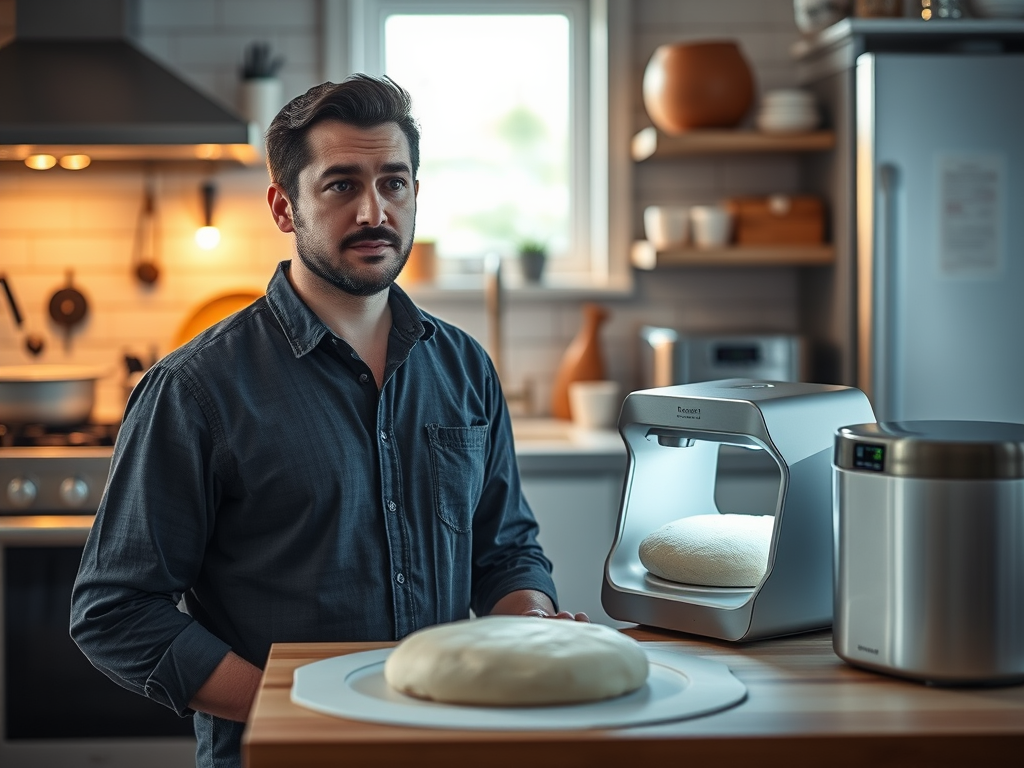

Navigating Tariffs: The Challenge of Launching DoughBed

Erik Fabian had envisioned a very different 2024. By now, he had hoped his innovative kitchen product—the DoughBed—would be sitting proudly in American homes, helping aspiring bakers nurture their sourdough starters. Instead of seeing satisfied customers posting rave reviews online and sales rolling in to fund future product development, he finds himself anxiously watching shipping updates and crunching numbers to stay afloat.
The DoughBed, a specially designed warming platform for sourdough starter dough, was supposed to be the next big step for his company, Sourhouse. It’s the natural successor to his first hit product, Goldie, a warming pad for jars of starter. But three months after the scheduled arrival date, the DoughBed still hasn’t made it to the Port of Houston. The delay has not only disrupted his launch plans—it has also thrown his entire business into survival mode.

The root of Fabian’s dilemma lies in a larger geopolitical conflict: the ongoing trade tensions between the United States and China, championed by former President Donald Trump. The uncertainty caused by constantly shifting tariffs—announced, delayed, revised—has left many small business owners, including Fabian, in a state of confusion and vulnerability. With no clear guidance or consistency, they are left with a painful choice: either pay steep taxes to get products in quickly or wait it out and face prolonged shipping timelines and cash flow challenges.
Fabian had initially intended to ship the first batch of DoughBeds from his manufacturer in China in early April. At that time, tariffs had spiked as high as 145%. Hoping to minimize costs, he delayed the shipment until late May, when the tariffs dropped to 30%. While that move saved money, it came at the expense of time. Instead of launching in the spring—a peak season for new kitchen products—he was now staring down a summer launch, when few people want to bake bread in the heat. His advertising and promotional efforts had to be pushed to fall, further stalling potential sales.

This delay is especially damaging because the DoughBed had already generated strong anticipation through a successful Kickstarter campaign. The crowdfunding platform had helped him raise initial funds and build early customer enthusiasm. But rather than fulfilling preorders and riding the wave of excitement, Fabian was forced to slap a “Sold Out” sign on his website. Curious potential buyers turned away disappointed, and the brand began to lose momentum.
“You spend more than a year preparing for your product’s big debut,” Fabian lamented. “When that moment finally arrives, and you can’t meet demand, you lose a window that you may never get back.”
At the moment, Fabian is frantically trying to find $150,000 to cover upcoming tariff payments through the fall. His confusion over the rationale for these tariffs grows daily. Most of his products are not manufactured in the U.S. at all, or if they are, they cost three to four times more than what he pays abroad. From his perspective, the trade war is not forcing production back to American soil—it’s simply choking small businesses like his.
Rather than thinking creatively about what to invent next—whether it’s a new spatula, timer, or other baking accessory—Fabian finds himself obsessing over trade policy. “My energy should be going toward product innovation,” he said, “but instead, I’m constantly reacting to changes that I can’t control. I’m stuck responding to Trump’s economic whims.”
This isn’t the first time Fabian has had to weather unpredictable circumstances. Sourhouse was born out of the uncertainty of the COVID-19 pandemic. In 2020, as the world locked down, Fabian—a seasoned branding professional who had previously worked with Moleskine—became a full-time dad. With his newborn daughter and five-year-old son underfoot, he and his wife left their Brooklyn apartment and relocated to Jacksonville, Florida, to live with her parents in a larger home.


During that time, he observed a trend: people were turning to baking as a source of comfort and creativity. Sourdough, in particular, had surged in popularity. As an experienced sourdough hobbyist, Fabian recognized a common frustration among home bakers: keeping their starter at the right temperature. Especially during the winter months in Brooklyn, he had faced the same issue.
Bakers were using a patchwork of homemade methods—tucking jars into microwaves or finding warm kitchen corners—but nothing worked consistently. So, he started experimenting and developed a small heating device that could keep a sourdough starter in what he termed the “Goldilocks zone”—between 75°F and 82°F.
He collaborated with industrial designer Jennifer Yoko Olson, a friend from Brooklyn who had previously worked on furniture and tech products. The two spent evenings and weekends refining a prototype. By May 2022, they had a functional model. By this time, the Fabian family had relocated to Asheville, North Carolina, and his wife—who had professional experience with Kickstarter—guided them through a campaign that raised over $100,000. A second crowdfunding effort on Indiegogo brought in an additional $30,000.
They partnered with Platform88, a network of Chinese factories that specialize in working with start-ups. This system was created by Jacob Rothman, an American entrepreneur based in Shanghai who had spent decades helping companies manufacture products in China.
Their first product, Goldie, shipped to backers in December 2022. Encouraged by the response, Fabian and Olson began work on their next innovation—the DoughBed. However, Fabian still hoped to produce parts of his products domestically. He looked for American suppliers of glass jars and muslin fabric, but the prices were prohibitive—sometimes four times higher than the costs in China. Local sourcing just wasn’t financially viable.
For large corporations, the combination of pandemic disruptions and trade tensions has led to a global reorganization of supply chains. Companies like Walmart have shifted some production to Mexico, and Apple has moved a portion of iPhone assembly to India. But small businesses lack the capital, scale, and flexibility to make such dramatic changes. They remain reliant on manufacturers like Platform88.
While Rothman has expanded operations to India and even launched a facility in Cambodia, these locations still can’t handle the complex electronics required for Sourhouse’s products. So, for now, Fabian remains bound to Chinese production lines.

This reflects what many economists argue is a flaw in the U.S. trade war strategy: the belief that American industry can simply rebuild overnight. According to Susan Helper, a supply chain specialist at Case Western Reserve University and former economic adviser to Presidents Biden and Obama, “The U.S. won’t be able to restore its industrial base quickly. Constant tariff changes make it hard to plan long-term, which is essential for rebuilding manufacturing.”
Fabian recently met Kelly Loeffler, a former U.S. senator now leading the Small Business Administration, at an event in North Carolina. He shared his frustrations and asked whether any relief was possible for small businesses struggling with tariffs. While she seemed empathetic, Fabian said, her only suggestion was to revisit domestic sourcing, pointing him to a list of suppliers on the SBA’s website—resources he had already tried.
Maggie Clemmons, a spokesperson for the SBA, stated that the Trump administration is committed to revitalizing American manufacturing. She emphasized recent policy initiatives and encouraged entrepreneurs to reduce their reliance on the “Chinese Communist Party.”
Caught in the crosshairs, Fabian has recently raised prices across his product line by 30% to offset increased costs. He’s nervous that he may soon hit a ceiling with consumers. If tariffs rise again under another Trump administration, he might be forced to abandon the DoughBed altogether.
“Our business model could collapse,” he admitted. “If selling the DoughBed becomes too expensive, it may not survive the year.”




Leave a Reply