
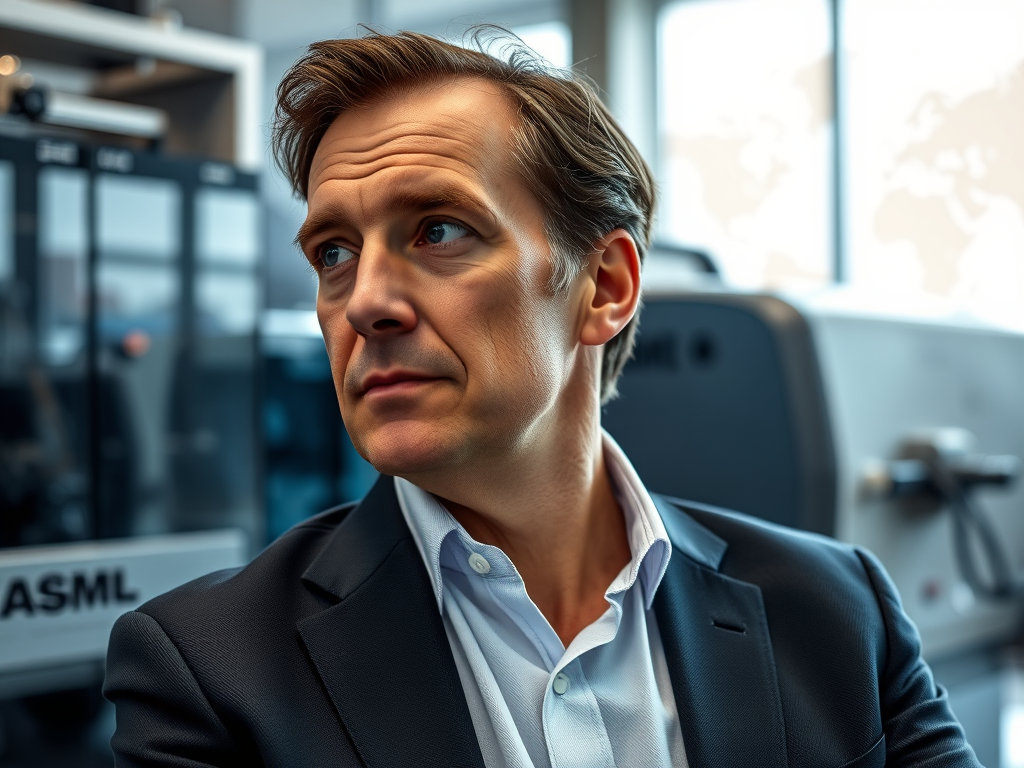

ASML’s CEO Navigates Geopolitical Challenges in Semiconductors

Almost every week, Christophe Fouquet, the CEO of ASML, a major Dutch technology firm, finds himself navigating complex political challenges that could affect his company’s operations.
Just last month, former U.S. President Donald Trump declared 50 percent tariffs on goods imported from Europe, a move that could significantly increase the cost of ASML’s lithography systems in the American market. These machines are crucial for manufacturing advanced semiconductors. However, within two days, Trump unexpectedly suspended the tariffs, adding another layer of unpredictability to the situation.
Simultaneously, the Dutch foreign minister visited Beijing to discuss various issues, including the possibility of relaxing the export restrictions that currently prevent Chinese firms from purchasing ASML’s advanced chip-making tools. As if that weren’t enough, the Dutch government recently collapsed, creating even more uncertainty around international trade discussions.
Each of these developments has the potential to significantly impact ASML’s business. The company holds a unique position as the world’s sole manufacturer of high-end lithography machines—tools that are essential in producing state-of-the-art microchips. These machines, which can be as large as a train car and cost up to $400 million, are highly sought after by both China and the United States. As a result, ASML has effectively become a pawn in a much larger geopolitical conflict over technological supremacy, with restrictions being placed on where and how its products can be sold.
For Mr. Fouquet, a 52-year-old French engineer who stepped into the CEO role last year, this environment presents a formidable challenge. Speaking from ASML’s headquarters in Veldhoven, a small town situated about 80 miles from Amsterdam, he acknowledged the limited control the company has over many of these broader forces. “A lot of what’s happening is beyond our control,” he admitted during a recent interview.

At the start of his tenure, Fouquet took a quiet approach to the growing political pressures. However, as these tensions have intensified, he’s become more vocal. He has expressed serious concerns that government policies aimed at controlling technology exports could disrupt long-established global supply chains, hinder innovation in artificial intelligence and related fields, and even motivate China to accelerate the development of its own semiconductor capabilities. In the long run, such developments could threaten ASML’s market leadership and negatively impact the technological advantage of Western countries.
Fouquet pointed out that China has already begun creating its own lithography technology, which is vital for printing intricate circuit patterns onto silicon wafers. Although Chinese companies still lag behind ASML in terms of technological sophistication, he warned that “those you try to stop will work harder to succeed.” In his view, barriers may only serve to accelerate their determination.
“No matter how many roadblocks you put up,” he emphasized, “people will find ways around them.”
Fouquet is among a small but growing group of semiconductor industry leaders openly criticizing the United States’ trade and export control policies. For instance, Jensen Huang, CEO of Nvidia—a major producer of AI chips—recently called these restrictions not only questionable but now “clearly wrong.” He argued that keeping Chinese firms isolated from American competitors may actually empower them globally, while weakening the U.S.’s own tech sector.
Amid these shifting political dynamics, Fouquet is working to secure ASML’s future. Beyond publicly addressing the implications of international trade measures, he has overseen the expansion of ASML’s government affairs teams in key locations including Washington, Brussels, and The Hague. Fouquet believes both the Netherlands and the European Union should take stronger action to shield ASML and the wider semiconductor sector from the fallout of geopolitical disputes, especially those between the U.S. and China.
“We always hope for more support, that’s clear,” he said. “For Europe, and particularly for the Netherlands, the attention on ASML presents a significant opportunity.”

The Dutch Ministry of Economic Affairs chose not to comment on the matter, and officials from both the European Commission and the U.S. Department of Commerce did not respond to inquiries.
ASML has been at the forefront of lithography technology since the 1980s, developing machines that enable the manufacture of microchips—the foundational components powering modern electronics. The company’s most advanced systems use extreme ultraviolet (EUV) light to etch increasingly tiny transistors onto silicon chips. This sophisticated process involves advanced optics and physics, such as using lasers to blast minuscule tin droplets, creating the necessary light waves.
These machines are extraordinarily complex and require collaboration with hundreds of suppliers worldwide. Delivering just one of them often requires multiple Boeing 747 cargo planes. As Chris Miller, a professor at Tufts University and author of Chip War, noted, “It’s the most complex machine humans have ever created,” involving contributions from disciplines like materials science, manufacturing, and optical engineering across continents.

ASML has grown rapidly, thanks in part to the increasing presence of semiconductors in everything from mobile phones and vehicles to home appliances. In recent years, the AI revolution has driven even greater demand, with companies like Microsoft, Google, and OpenAI constructing massive data centers packed with AI chips built using ASML equipment. In 2023, the company recorded a record revenue of €28.3 billion (approximately $32.3 billion). Looking ahead, ASML projects its annual revenue could rise to between €44 billion and €60 billion by the end of the decade.
Despite this growth, several clouds hang over ASML’s future. The sustainability of AI-driven chip demand remains uncertain, and some question whether its latest €400 million machines will deliver sufficient return on investment. Reflecting these doubts, the company’s stock has fallen around 25 percent over the past 12 months.
The recently proposed U.S. tariffs have only added to the list of concerns. Fouquet believes such measures undermine American efforts to build domestic chip production capacity. “If you want to produce chips locally, then the cost has to be viable,” he explained. “Tariffs just make everything more expensive.”
Fouquet began his ASML career in 2008, eventually rising to lead the division responsible for EUV systems. Roughly six years ago, as debates intensified over whether Western countries should continue selling critical technology to China, he gained firsthand experience in the intersection of global politics and high-tech manufacturing.
In 2019, the Trump administration successfully persuaded the Dutch government to prevent ASML from shipping its EUV systems to China. Under President Biden, those restrictions expanded to include older generations of lithography machines. As a result of these rules, ASML anticipates that sales to China—previously nearly half of its business in the second quarter of 2023—will fall to around 25 percent, with Taiwan and South Korea emerging as its primary markets.


Today, Fouquet and his team are in regular discussions with policymakers across Washington, Brussels, and The Hague. He aims to communicate the importance of a globally interconnected semiconductor supply chain. He warns that policies designed to target one country often have unintended consequences, slowing progress and increasing costs across the entire industry.
Using national security as a rationale for trade restrictions can backfire, he said. Rather than focusing solely on restraining geopolitical rivals, he urged a stronger emphasis on innovation and long-term competitiveness.
Some experts, however, believe the restrictions are justified. Gregory C. Allen, a researcher at the Center for Strategic and International Studies and former U.S. defense official, argued that slowing China’s progress in chipmaking is a necessary objective. China is deploying substantial financial and structural support—such as subsidies, tax incentives, and free land—to accelerate its technological independence. He also mentioned that Huawei has hired former ASML employees to help build Chinese lithography machines, though they still lag far behind.

Chinese firms have reportedly stockpiled older ASML machines ahead of the export restrictions, which allows them to maintain a foothold in less advanced chip production. Still, Allen noted that lithography remains an area where China trails furthest and may take the longest to catch up.
Back in Veldhoven, signs of ASML’s growth are visible everywhere. Construction cranes loom over an expanding headquarters, and inside, engineers clad in sterile suits diligently test the newest lithography systems.
From a conference room overlooking the buzzing activity, Fouquet remains cautiously hopeful. He believes the AI revolution is only beginning, promising strong long-term demand for ASML’s technologies. Yet he also recognizes that geopolitical tensions are unlikely to fade anytime soon.
“We have to remain realistic,” he said. “This industry has become strategic for every nation on Earth.”




Leave a Reply