

In Des Moines, Big Operas and Big Ambitions Fill a Tiny Theater

When people think of Richard Wagner, they often imagine sprawling productions filled with thunderous orchestras and dramatic, oversized sets—performances that demand vast stages and even vaster budgets. So it’s surprising, even unthinkable, to experience one of his operas in an environment so intimate that you’re practically within arm’s reach of the singers.
Yet that’s exactly what happens at the Des Moines Metro Opera, a remarkable four-week summer opera festival based in Iowa. Since its founding in 1973, the company has carved out a unique niche by presenting grand works—usually reserved for massive opera houses—in a much smaller, immersive venue. This year’s season runs through July 20, continuing the tradition of bringing operatic spectacles to a space that holds just 467 people.
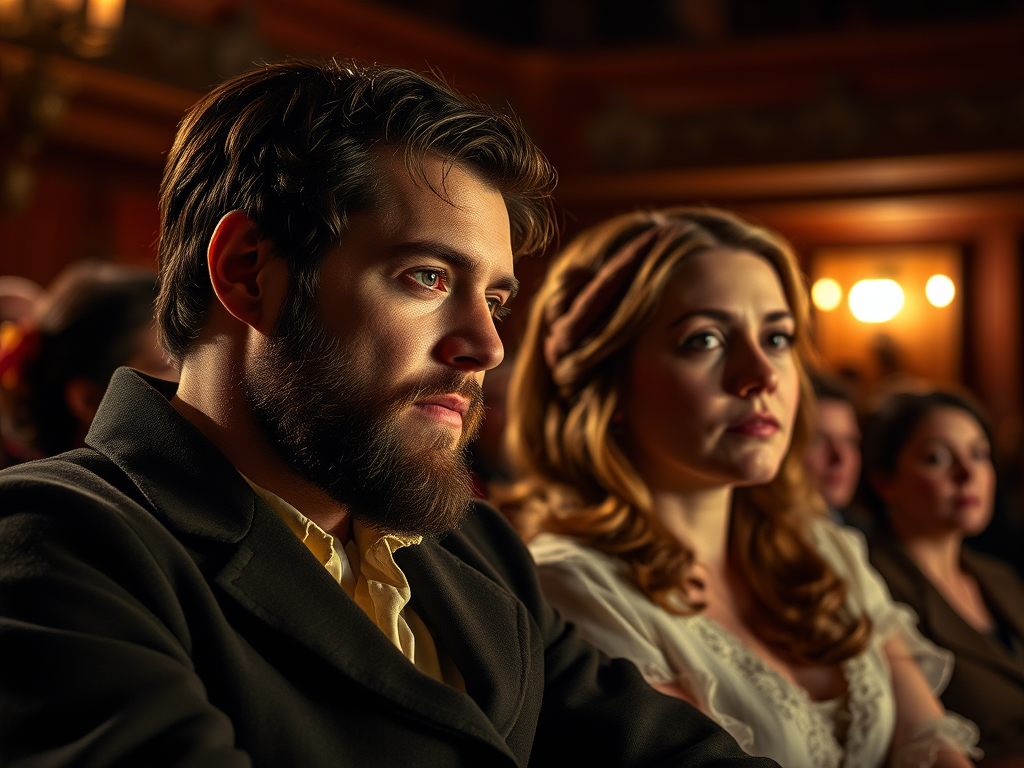
This cozy theater, designed to embrace the audience, positions the stage to surround the orchestra pit and extend deep into the seating area. This layout ensures that even the audience members in the furthest row feel directly involved in the action unfolding just feet away.

During a late-June performance of Wagner’s The Flying Dutchman, bass-baritone Ryan McKinny embodied the cursed seafarer with a voice that carried both power and vulnerability. His quieter moments—whispers of despair and longing—were just as impactful as the thunderous sailor choruses that followed. Julie Adams, playing Senta, portrayed her character’s obsessive devotion with nuanced facial expressions so subtle they would be lost in a larger venue. Here, however, the smallest gestures carried profound emotional weight—something difficult to achieve in cavernous opera houses like the Met.
“There’s no escape here,” explained mezzo-soprano Sun-Ly Pierce, a familiar face at Des Moines. “The audience sees everything—every expression, every breath. It’s like performing under a microscope, but that’s what makes it so compelling.”

While the intimate atmosphere would enhance any chamber piece, Des Moines Metro Opera has gained a reputation for taking on monumental, complex productions that would be considered ambitious even in larger spaces. The list includes heavyweights such as Salome, Elektra, Wozzeck, Peter Grimes, Billy Budd, and Pelléas et Mélisande. These works, often avoided by other regional companies, are performed here with slightly scaled-down orchestrations to suit the pit, which accommodates around 65 musicians.
Michael Egel, the general and artistic director of the company, doesn’t let the venue’s size dictate the artistic vision. “If we can fit it in the pit,” he said, “we’re not going to back down. In fact, these works often gain something in an intimate setting. In Salome, when she’s dancing with Jochanaan’s severed head just a few feet away from you—it’s electrifying in a way that’s impossible from the balcony of a big hall.”

While many opera companies across the country are retreating from challenging works due to financial pressure and risk-averse programming, Des Moines is boldly moving in the opposite direction. Alongside The Flying Dutchman, this summer’s lineup includes Janáček’s The Cunning Little Vixen and Stravinsky’s The Rake’s Progress. These are not safe choices, but Des Moines makes them work—artistically and financially.
Since Egel took the reins about 15 years ago, the company’s operating budget has more than doubled to approximately $5.4 million, and its endowment has nearly tripled, now surpassing $20 million. The orchestra features musicians from across the United States, and the caliber of vocal talent has risen impressively. Approximately 25% of the audience now comes from out of state, and the company boasts strong ticket sales even for its most daring productions—15 of the 17 performances last summer were sellouts.
Egel credits much of the success to the tastes of the local audience. “People often underestimate them,” he said. “It’s too simplistic to assume that only visitors from major cities want to see Lulu, while local residents just want familiar works like Carmen. That’s not how it works here.”
Located on the campus of Simpson College in Indianola, just 17 miles south of Des Moines, the company was originally founded by Robert L. Larsen, a Simpson music professor. His vision wasn’t just to bring opera to Iowa’s cornfields but to present adventurous repertoire right from the start. The very first season in 1973 included Puccini’s La Rondine, Britten’s Albert Herring, and a double bill featuring Menotti’s The Medium and the U.S. premiere of Arthur Benjamin’s Prima Donna. This early commitment to artistic risk became a hallmark of the company.

Over the decades, however, Des Moines Metro Opera began to settle into more routine territory. Larsen reused singers and repeated titles, and productions became more predictable. When health concerns forced his retirement in 2009—he passed away in 2021—Egel, a former student of Simpson and a longtime staff member of the company, stepped in to revitalize its direction.
Egel’s relationship with the opera began modestly. As a student in the early 1990s, he worked summer jobs with the company, handling everything from airport pickups to bar tending and janitorial work. He eventually moved into roles in props and marketing before transitioning to the artistic administrator position.
His passion for behind-the-scenes work ultimately led him to leadership. As the new artistic director, and later general director, he made a clear promise: every season would include at least one opera the company had never produced before. He also instituted a 15-year gap before repeating any title.
Music director David Neely recalled how pivotal the 2013 season was, when they presented both Elektra and Peter Grimes. “After that first orchestra rehearsal of Elektra, we looked around and said, ‘Wow—we can actually do this.’ That was the moment we realized we were capable of tackling anything.”

Egel also opened the door for more directorial experimentation. “If we’re going to work in the round,” he said, “let’s fully embrace it.” This philosophy informed this year’s production of The Cunning Little Vixen, directed by Kristine McIntyre. The staging featured charming folk-inspired costumes by Vita Tzykun alongside striking high-definition video art by Oyoram, creating a rich visual experience.
Despite a technical hiccup that required a restart on opening night, the performance was magical. Under Neely’s baton, the orchestra captured both the intricate angularity and the lush lyricism of Janáček’s music. And though The Flying Dutchman was perhaps too restrained in its interpretation, it still featured standout performances, including tenor Demetrious Sampson Jr., a former apprentice who showed the company’s knack for discovering emerging talent.
Recently, the company also ventured into original commissions, including A Thousand Acres, based on Jane Smiley’s novel, and American Apollo, which explores the relationship between painter John Singer Sargent and his model. These ambitious works were part of the company’s 50th anniversary celebrations, though they also strained resources, prompting a temporary suspension of the Second Stages Series, which brought chamber operas to unconventional venues across Des Moines.

Board chair Darren Jirsa hopes to revive that initiative. “It’s a great way to connect with the broader community outside Indianola,” he said. But reviving it will require additional funding, particularly as the company begins planning much-needed renovations to its outdated backstage facilities. Enhanced technical resources would allow for more productions and possibly more performances—a rare prospect in today’s struggling opera landscape.
Next season promises more boundary-pushing programming, including Szymanowski’s King Roger and Floyd’s Of Mice and Men, alongside Puccini’s Tosca—a classic that, in this context, feels almost like a novelty. But Egel’s sights remain firmly set on more unusual fare, from Lulu to the company’s first Handel opera and even works by contemporary Finnish composer Kaija Saariaho.
“I feel a deep sense of purpose doing this here,” Egel said. “I’m from Iowa. Being part of this community means the success of the opera is personal to me. I want to build something that lasts—a company that thrives in my home state, and brings the world’s greatest operas to the heart of the Midwest.”




Leave a Reply