

Peter Sellars Is Still Living His Life Through Art

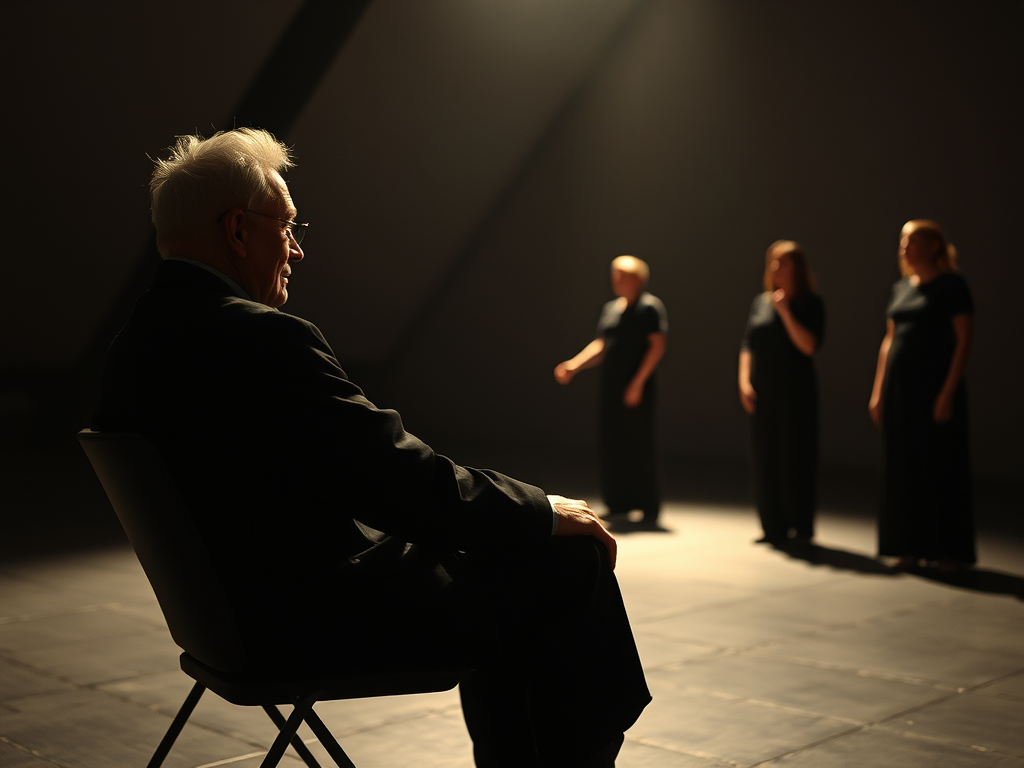
One quiet afternoon at Purchase College, nestled just north of New York City, a deeply moving moment unfolded. As a group of singers rehearsed a scene from Matthew Aucoin’s opera Music for New Bodies, director Peter Sellars sat quietly in the darkened space, tears silently streaming down his cheeks.
The section they were working on was delicate yet devastating. The vocalists intoned the word “down” repeatedly, almost like a chant, as the accompanying music created a slow, haunting atmosphere that seemed to stretch time itself. The passage — rooted in Jorie Graham’s poetry about illness and environmental catastrophe — pierced the air with raw honesty, evoking dread and sorrow in equal measure. For Sellars, a towering presence in the world of performing arts, the emotional force of the music was simply overwhelming.
Those who know Sellars best speak of his remarkable emotional transparency. His collaborators describe a man who greets everyone with warm embraces, whose laugh erupts in sudden, joyful bursts — and who never hides his tears.

“He lets himself feel everything,” soprano Julia Bullock reflected. “He doesn’t hesitate to release those emotions.”
This Thursday, Music for New Bodies opens at David Geffen Hall, part of the American Modern Opera Company’s summer residency at Lincoln Center. Sellars’s staging embodies his signature minimalist, ritualistic aesthetic. There is almost no scenery or props — just the performers, positioned in fluid, painterly formations under evocative lighting, channeling a visual intensity reminiscent of Baroque art.
“I designed the staging,” Sellars explained in an interview, “but even calling it ‘staging’ feels too formal. Really, you’re just seeing the music come to life.”
This moment is part of a packed season for the 67-year-old director. Just days ago, his latest work, The Nine Jewelled Deer — an adaptation of a folk tale that examines sexual violence through the lens of Indian classical music and electronics — premiered at the Aix-en-Provence Festival in France. Later this summer, at the Salzburg Festival in Austria, he will present a dark pairing of Mahler’s Abschied from Das Lied von der Erde and Schoenberg’s Erwartung.

“Music allows us to engage with subjects that are too painful for ordinary language,” Sellars said. “You have to find a way to explore them with honesty — but also with care, without turning it into spectacle or exploitation. Music gives you a space to exist in those unspeakable places.”
It was nearly four decades ago that Sellars first arrived at Purchase to stage a groundbreaking series of Mozart operas. At a time when updating the classics was a controversial practice in the U.S., Sellars dared to place The Marriage of Figaro in Trump Tower, Don Giovanni in Harlem, and Così Fan Tutte in a roadside diner. Together, these bold reinterpretations offered a scathing critique of the Reagan-era cultural and political climate.
Sellars was in his twenties then, but the productions — later turned into widely viewed films — established his reputation as a fearless young visionary. Critic Peter G. Davis famously wrote that Sellars’s Così Fan Tutte “will haunt me for the rest of my life.”
During a recent break from Music for New Bodies rehearsals, Sellars walked through the lobby to the Pepsico Theater, where those Mozart stagings had first come to life. It was the first time he had stepped inside in decades.
Peering into the theater, where children danced among oversized floral props for a local festival, he smiled. “It looks the same,” he said. “That’s wonderful.”

But while the space remained familiar, Sellars himself has continued to evolve. Though he occasionally revisits canonical works, his artistic voice has grown leaner, more introspective, and less tethered to narrative conventions. His more recent focus has been on forging collaborations with composers like Kaija Saariaho and John Adams — creative partnerships that have resulted in some of the most significant contributions to contemporary opera, according to conductor Esa-Pekka Salonen.
The turning point came with his Mozart productions and the debut of Nixon in China, created with Adams and librettist Alice Goodman in 1987. These works not only launched his international career but also helped redefine the boundaries of opera itself. In many ways, Sellars has spent his life ahead of the curve, shaping artistic trends before they catch on — from intercultural collaborations to streamlined stagings dictated by limited funding.
“In today’s arts landscape, where financial support is disappearing,” he noted, “we have to be smarter with the resources we do have. But that can actually push us toward more daring, essential decisions.”
Sellars rarely shies away from weighty themes. When working with conductor Teodor Currentzis on a version of Purcell’s The Indian Queen, he incorporated modern texts by Nicaraguan novelist Rosario Aguilar, transforming the opera into a visceral exploration of colonial violence.
Though not every experiment has landed — and some have drawn criticism for leaning into liberal sentimentality — his most successful productions cut through politics and philosophy to reach something more primal. They are about people, stripped bare and seen with empathy.
Markus Hinterhäuser, artistic director of the Salzburg Festival, said it best: “Peter returns to the most fundamental questions — why theater exists, and what it means for humans to express themselves through it.”
Sellars’s love for theater began in childhood. Growing up in Pittsburgh during the 1960s, he found a mentor in puppeteer Margo Lovelace. Her puppet theater transported stories across cultures: Rumpelstiltskin set in Egypt with regional music, Beauty and the Beast relocated to Japan, accompanied by koto.

This early exposure to global storytelling and avant-garde performance gave Sellars a broader artistic lens — and offered him solace during turbulent years at home.
“I think that’s why I’ve always been drawn to opera plots,” he said. “I recognize those emotional stakes. But more than that, I’m interested in healing. Most of my work is about accompanying people through suffering — and bringing them to the other side.”
By high school, he had transitioned from puppets to actors, finding it easier to stage full plays than teach others the intricacies of marionette manipulation. He directed numerous productions as a teenager, and even more as an undergraduate at Harvard, where his unconventional staging of Antony and Cleopatra in a swimming pool began to draw widespread attention. Immersed in Boston’s early music scene, he delved into the works of Bach and Handel.
The films of his radical Mozart trilogy cemented his reputation — and sparked both awe and outrage. “When I was a student in Greece,” said conductor Currentzis, “our teachers warned us: ‘Watch anything you want, just not Peter Sellars.’ So naturally, that’s the first thing we watched.”
Sellars went on to create revelatory productions of complex 20th-century works, such as Messiaen’s Saint François d’Assise and Ligeti’s Le Grand Macabre. His video-recorded staging of Handel’s Theodora, with powerful performances by Dawn Upshaw and Lorraine Hunt Lieberson, remains iconic. His interpretations of Bach’s Passions with the Berlin Philharmonic distilled their spiritual and emotional essence into simple, resonant theatricality.
Beyond directing, he has also served as a curator and catalyst, organizing cross-genre festivals in cities like Los Angeles, Vienna, and Adelaide. His home in Los Angeles — filled with books and sunlight — reflects that spirit of intellectual abundance and artistic collaboration.
“I spend a lot of my life supporting other artists,” he said. “That’s a joy. It’s not just about my voice — it’s about being changed by the people you work with, and realizing that Western music is itself a hybrid. Nothing is pure. Everything is a blend.”

For younger artists like Matthew Aucoin, Sellars represents more than just a director. “He’s a model for how to live through your work,” said Aucoin. “He radiates a kind of spiritual intensity.”
That intensity can be demanding. “Peter digs deep into the psyche of performers during rehearsal,” said Salonen. “Tears are not uncommon — not from anguish, but from sheer emotional release.”
According to Currentzis, Sellars’s vulnerability unlocks something profound. “He’s completely unguarded. And when he opens up like that, others do too. Most people start crying. That’s how the real work begins.”
Back at Purchase, Sellars gave the ensemble specific, poetic notes: make the opening words crystal clear, imbue them with intimacy, ground them with subtle movement. And then, he stopped.
Although plenty of details still needed attention, he announced a full day off.
“With Peter, even though he pushes hard,” said Bullock, “he also knows when to step back.”
Sellars explained it simply: “If you’ve reached the edge of something beautiful, you don’t need to force it. Let the next step belong to them.”




Leave a Reply