
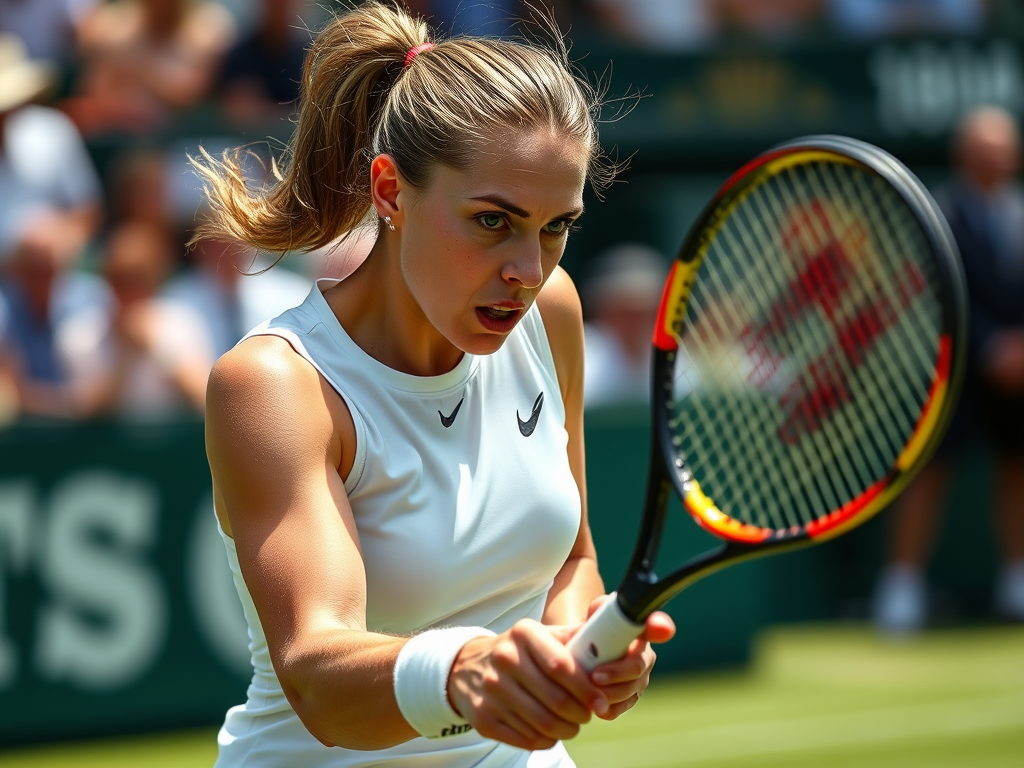

Tennis gamesmanship and dark arts: MTOs, bathroom breaks and the serve clock

Every sport contains areas of ambiguity—spaces where the rules aren’t so much broken as they are bent. Within these margins, some athletes thrive. These individuals are often seen as practitioners of what many call the “dark arts” of competition: strategies that flirt with the boundaries of legality, often without technically stepping beyond them.
Across every major sport, there are figures who come to symbolize this philosophy. In soccer, there’s Sergio Busquets, known for his theatrical falls and psychological warfare. In baseball, the Houston Astros became infamous for their sign-stealing scandal. In the WNBA, Diana Taurasi has built a legacy not only on talent but also on mental games. And in tennis, this legacy continues—with Laura Siegemund proudly taking on that mantle at this year’s Wimbledon.

Currently, Siegemund finds herself in the Wimbledon quarterfinals, preparing to take on Aryna Sabalenka, the tournament’s top seed and widely seen as the player to beat. The match will serve as a test not only of Sabalenka’s athletic prowess but also of her psychological resilience, especially after her emotionally charged defeat to Coco Gauff in the French Open final just weeks earlier.
Siegemund is not your conventional opponent. At 37, she brings an unconventional style to the court—loaded with slicing, sudden changes in pace, and an array of drop shots. But more notably, she has earned a reputation as one of the most challenging and frustrating opponents on the WTA Tour.
This reputation was on full display in her fourth-round match against Solana Sierra, a young Argentine newcomer making her debut in a Grand Slam last-16 round. Siegemund arrived at the match a few minutes late, leaving her inexperienced rival standing uneasily by herself on court—a subtle psychological tactic. Once play began, Siegemund demonstrated why she is considered one of the slowest players in the game. She milked every second between points, paused noticeably during her service motion, and frequently changed rackets mid-game. These tactics, while not against the rules, served to disrupt Sierra’s rhythm and unsettle her focus.
Back in 2018, Naomi Osaka commented that part of Siegemund’s strategy seemed to involve finding small ways to irritate her opponent. It’s a sentiment echoed by many on the tour. When Siegemund wins an important point, she doesn’t shy away from celebrating with intensity—asserting her presence and shaking the composure of those across the net.
Perhaps unsurprisingly, Siegemund holds a degree in psychology—a detail that many insiders believe contributes to her keen ability to read opponents and identify their emotional vulnerabilities. She denies that her behavior is calculated, however.
“These things just happen,” Siegemund explained during a press conference. “I’m not out there trying to cause problems. That’s not my aim. But I know I have certain habits that can be seen as controversial.”
She went on to explain that her routines—especially the time she takes between points—have been part of her game for years. “This isn’t something new. I’ve always played this way. I’m consistent with my odd routines, and I do them for myself, not to bother others. But yes, sometimes that does lead to friction. Still, I’m not going to change who I am—not even for Sabalenka.”
To some, this kind of behavior is simply a refusal to be intimidated by more prominent players. In a sport that often elevates its stars to almost untouchable status, Siegemund represents a willingness to stand her ground and assert her presence, regardless of who’s on the other side of the net.

Historically, some of the few players who managed to overcome legends like Rafael Nadal did so by challenging them in both play and presence. Robin Söderling famously unsettled Nadal during a 2007 Wimbledon match by mimicking his slow routines and antics. Just two years later, Söderling became the first man to defeat Nadal at the French Open. Reflecting on that victory, he explained that it was important not to show too much reverence. “You have to throw them off and make it clear you’re not just there to lose,” he said.
Lukáš Rosol, another player who shocked Nadal at Wimbledon in 2012, displayed similar tactics—at one point deliberately knocking over Nadal’s water bottles, a minor act that struck at the heart of the Spaniard’s need for order. In other matches, Rosol went even further, such as during a Munich Open clash where he physically bumped into Andy Murray. Murray’s response? “No one on the tour likes you. Everyone hates you.”
But it’s not just the so-called villains who engage in such behavior. Many of the sport’s icons have also mastered the dark arts. The introduction of the serve clock was largely a response to Nadal’s infamous pre-serve rituals. Novak Djokovic is known for his ability to disrupt an opponent’s mental state with seemingly innocuous behaviors—drawing matches out and subtly introducing uncertainty.
In June, Maria Sakkari voiced strong frustrations after her match with Yulia Putintseva, another player known for her irritating tactics, including suspiciously timed medical timeouts and prolonged conversations with umpires during breaks.
These psychological tactics can be deeply effective. In a 2023 Wimbledon match, Putintseva repeatedly questioned the umpire while Iga Świątek took a lengthy bathroom break, eventually leading the crowd to boo Świątek upon her return—momentum that may have contributed to Świątek’s subsequent loss.
Even top-tier players are not immune to accusations. During this year’s Bad Homburg Open, Victoria Azarenka criticized Świątek for her deliberate delays between serves. After watching her toss the ball up multiple times without hitting it, Azarenka stopped play and confronted the umpire. Świątek’s fans quickly countered online, posting videos of Azarenka employing similar tactics during the same match.
Siegemund herself has been at the center of such controversies. At the 2023 U.S. Open, she faced heavy criticism from the crowd—and her opponent Coco Gauff—for slow play. At one point, she interrupted Gauff’s first serve by claiming she wasn’t ready, prompting a redo. The umpire ultimately penalized her for repeated delays.
“I felt incredibly disrespected,” Siegemund said afterward. “The crowd treated me terribly.”

Comparisons have been drawn between Siegemund and Mary Pierce, a two-time Grand Slam champion who often stretched the rules on pacing. During a 2005 U.S. Open semifinal, Pierce took two consecutive medical timeouts after losing the first set—delays totaling 12 minutes. She then dominated the remaining sets, frustrating her opponent and raising eyebrows.
Medical timeouts (MTOs) and bathroom breaks remain some of the most controversial tools in the modern tennis dark arts arsenal. Intended for legitimate reasons, these breaks can also serve as momentum killers. Players are technically not allowed to take timeouts for simple exhaustion, but other vague issues—like minor injuries—can create gray zones.
Siegemund’s previous matches have featured similar moments. In a 2022 Miami Open match against Paula Badosa, Siegemund took an 11-minute bathroom break after the first set, followed by a 14-minute MTO in the third. Though both actions were within the rules, Badosa was visibly frustrated, even hitting with a ball-kid to stay warm during the delay.
Such incidents continue to pile up. Recently, Mirra Andreeva was incensed when Amanda Anisimova called a timeout mid-service game, later justifying it by posting a photo of her blistered hand. And Emma Raducanu was disrupted when Zheng Qinwen stopped a game multiple times to change shoes—always during Raducanu’s service games.
These incidents illustrate a broader truth: in elite tennis, small breaks in rhythm can tilt the balance of a match. Players have called out others for seemingly dubious timeouts for years. Maria Sharapova once sarcastically told officials to “check [Ana Ivanovic’s] blood pressure” when Ivanovic requested a timeout in the middle of a Cincinnati semifinal.
One of the most notorious bathroom break controversies came at the 2021 U.S. Open, when Stefanos Tsitsipas took an eight-minute trip off-court, prompting Andy Murray to accuse him of cheating and claim he had “lost respect” for him. “It’s not about leaving,” Murray clarified. “It’s about how long it takes. It’s a joke.” The Greek star had multiple such incidents during the match, often timed just before Murray’s service games.
Murray later joked on Twitter: “It takes Tsitsipas twice as long to use the bathroom as it takes Jeff Bezos to fly to space.” The memory stayed with him so vividly that he brought it up again in a 2025 stage show.
Interestingly, many players sympathized with Tsitsipas, suggesting that such loopholes were less about bad sportsmanship and more about gaps in the rules. In response, the ATP eventually changed the regulations, limiting players to one bathroom break per match, capped at three minutes.
The line between strategy and unsportsmanlike behavior remains blurred. As long as tennis offers loopholes and gray zones, players like Siegemund will continue to test their limits—not necessarily to break the rules, but to challenge the psychological boundaries of competition.




Leave a Reply