

Roger Federer’s commencement speech wasn’t just a viral moment. It was masterful

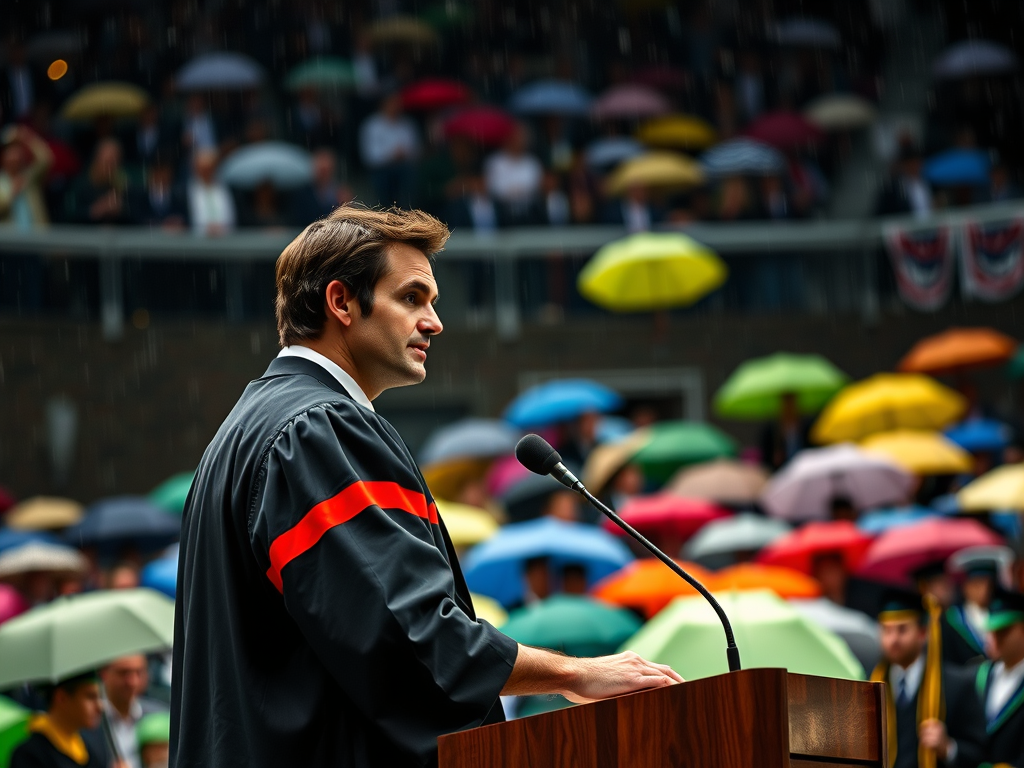
On a rainy and chilly June morning in New Hampshire, Roger Federer stood before a sea of umbrellas at Dartmouth College’s commencement ceremony and shared a story—one not about triumph, but about failure.
Federer, one of the most decorated athletes in tennis history, spent over 20 years building a legendary career. He played in 1,526 singles matches and secured victory in nearly 80% of them. Among his many accomplishments were 20 Grand Slam titles, including a record-breaking eight Wimbledon championships.
And yet, Federer had a question for the graduates gathered before him:
“What percentage of points do you think I won in all those matches?”
He let the question hang in the air for a moment.
“Just 54 percent,” he finally revealed.
It was a figure that caught many off guard. How could someone so dominant, so seemingly untouchable, win just over half the points he played?

Federer explained: “When you lose every second point on average, you learn not to obsess over every shot. You tell yourself, ‘That double fault? It’s just one point.’ Each point, while you’re playing it, feels like the most crucial thing in the world—and in that moment, it is. But once it’s over, you must move on. That mindset is essential. It allows you to play the next point with full commitment—sharp, focused, and unburdened.”
By the following day, his words had spread rapidly, viewed and shared by millions. Federer’s reflections resonated far beyond the tennis court, speaking to people across industries, generations, and walks of life. In a season filled with ceremonial clichés, his address stood out as something uniquely authentic.
Once a platform reserved for class valedictorians or university presidents, the graduation stage has, over time, become a place for notable figures—politicians, authors, business leaders—to impart wisdom. More recently, a growing trend has emerged: world-class athletes stepping up to share their insights. In the same graduation season, names like Derek Jeter, Carmelo Anthony, Grant Hill, and Simone Biles delivered commencement speeches at prestigious universities across the U.S.
American columnist Art Buchwald once quipped that a commencement speech lives about 15 minutes in memory. Indeed, few can recall the specifics of their graduation addresses, let alone who delivered them. Even Kareem Abdul-Jabbar poked fun at the ritual in a 2016 speech at Drew University: “Lilacs are blooming, love is in the air, and universities bring in success stories like me to justify the cost of your education.”
But Federer’s words felt different. Sincere, reflective, and humbly offered, his speech echoed the timeless messages of Steve Jobs’ address at Stanford or David Foster Wallace’s unforgettable “This is Water” at Kenyon College. As one colleague put it, “I’ve referenced that speech probably 20 times.”
So what made Federer’s message so impactful?
Though he jokingly said “beer pong” was the reason he chose to speak at Dartmouth, the actual motivation was more personal—his longtime agent Tony Godsick is a Dartmouth graduate, and Godsick’s daughter was a member of the Class of 2024. As is tradition, Federer also gave nods to local favorites, including Lou’s famous chicken sandwich and Dartmouth’s version of pong—a drinking game believed to have originated on campus.
Federer’s speech, a carefully composed 3,200-word address delivered over 25 minutes, was structured around three core takeaways—or, as he framed them, “tennis lessons.” These lessons reflected his extensive career and his recent transition into retirement, which he called his own kind of “graduation.”
Throughout his time in tennis, Federer was often praised for making the game look effortless. He floated across courts with grace, his signature one-handed backhand delivered with precision and flair. He rarely appeared flustered. But Federer made it clear: this apparent ease was not a gift—it was earned.
“It’s not about being born with talent,” he said. “It’s about perseverance.”

His point was underscored by the speech itself. Federer and his team had labored over it for six months, carefully editing and rehearsing until every word felt just right. According to Vinay Reddy, former chief speechwriter for President Joe Biden and a former Division I tennis player, Federer’s preparation was evident. “He didn’t just stand up and read a draft,” Reddy said. “He put in the work.”
Reddy recalled watching professional players like Andre Agassi and Ivan Lendl practice endlessly during tournaments in Cincinnati. Though their talent was undeniable, what stood out to him most was the hours they spent drilling and refining their craft. Listening to Federer speak, Reddy recognized the same dedication.
“It reminds us of what we tell ourselves growing up: Keep practicing, keep working, keep learning. Discipline never goes out of style,” he said.
The speech struck a balance between emotional openness and structured storytelling. Federer offered more than just advice—he shared himself. He even joked about being “Dr. Roger” now, not “Dr. Federer,” inviting the audience into his world without pretension.
Steven D. Cohen, a business communication expert at Johns Hopkins, noted this subtle but effective form of vulnerability. “Great communicators don’t fling the door open,” Cohen said. “They crack it—just enough to let people in.”
In one of the speech’s most powerful moments, Federer recalled the 2008 Wimbledon final, widely regarded as one of the greatest matches ever played. He battled Rafael Nadal across five grueling sets, nearly pulling off a comeback after losing the first two, only to fall 9-7 in the fifth set as darkness fell over Centre Court.
“You can give everything you’ve got and still come up short,” Federer said. “Perfection is a myth.”
This reflection brought him back to that surprising statistic: winning only 54% of the points in his career. “Wasting energy on negativity doesn’t serve you,” he told the graduates. “The real skill lies in moving on from tough moments.”
It’s a principle with broader applications. In investing, for example, a study from BlackRock concluded that successful portfolio managers only need to make the right decisions 53% of the time to outperform the market. In comedy, as comedian and former tennis pro Michael Kosta noted, timing is everything: “Federer always showed up when it mattered. In stand-up, you can bomb a few jokes, but if you finish strong, that’s what counts.”
Federer’s brilliance, then, wasn’t in winning every point, but in winning the ones that counted most.
One of the key principles in delivering an effective speech is making it relevant to the audience. Cohen calls it “WIIFT”—What’s In It For Them. Federer nailed this. His message wasn’t about his victories; it was about transition, growth, and resilience—experiences the graduates were about to encounter in their own lives.
In a post-Wimbledon interview with ESPN, Federer mentioned his two primary goals for the Dartmouth speech: to have fun and to keep people engaged. “That’s also how I approach life,” he said. “We’ve got to enjoy the ride.”
Federer shared a formative memory from his youth—leaving home at 14 to attend school in a French-speaking region of Switzerland. It was a difficult period, marked by homesickness and discomfort, but also by growth. He realized something profound: tennis could show him the world, but it wasn’t the world itself.
His message to the graduates was clear: you will go places, just as he did. And when you do, if you ever see him out in the world—say hello.
As the speech drew to a close in the gentle rain, Federer wrapped up his philosophical reflections with something more playful: a literal tennis lesson. Holding a racket, he demonstrated the Eastern grip, gave tips on knuckle placement, and emphasized the importance of footwork, preparation, and follow-through.
With a grin, he clarified: “No, this isn’t a metaphor. It’s just good technique.”
And in that moment, it became clear: Federer hadn’t just passed on wisdom—he had reminded everyone that even the best champions are still learning, still growing, and still having fun.




Leave a Reply