
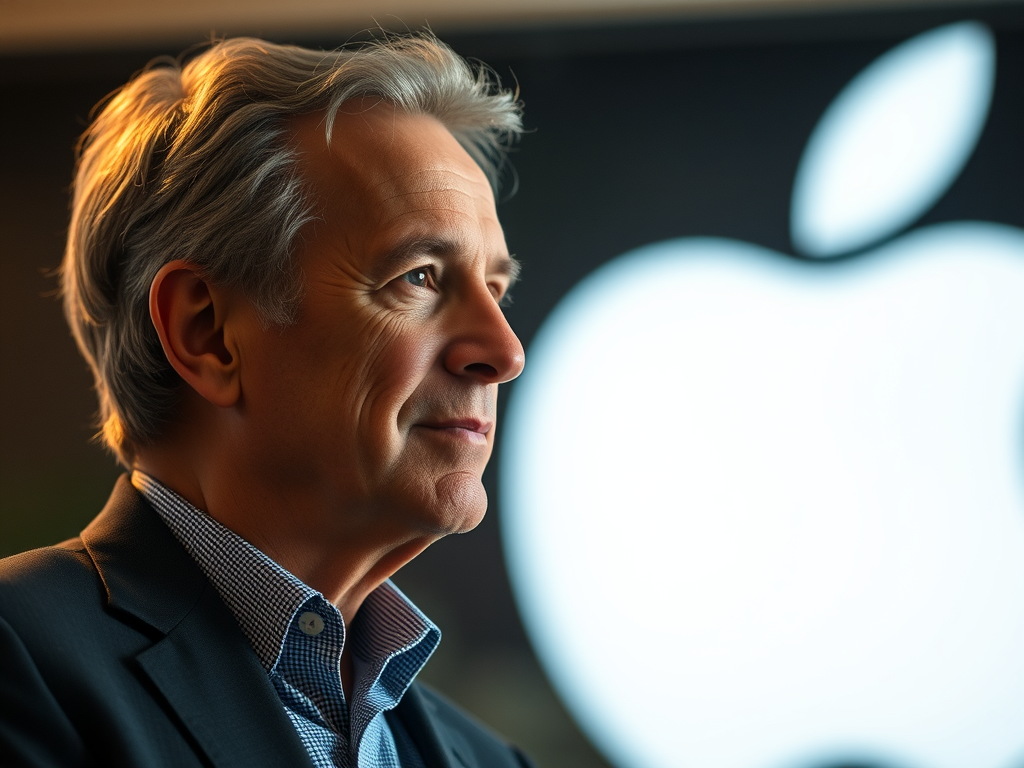

Jeff Williams, Apple’s Chief Operating Officer, Is Retiring After 27 Years

After more than 25 years of shaping Apple into a global operational powerhouse, Jeff Williams, the company’s Chief Operating Officer and a close associate of CEO Tim Cook, is stepping down. His retirement marks the end of a remarkable era for Apple, during which he played a vital role in scaling up the production capabilities that allowed the company to manufacture over 200 million iPhones annually—an accomplishment that significantly contributed to Apple’s record-breaking profitability.
At 62, Mr. Williams departs as one of the company’s most respected executives, widely seen for years as the most likely candidate to succeed Mr. Cook. With his retirement, attention turns to other prominent figures within Apple’s executive team, with speculation mounting over who might eventually take over the CEO role. Industry insiders and company watchers suggest that the shortlist includes John Ternus, who leads Apple’s hardware engineering division; Craig Federighi, who oversees software development; and Eddy Cue, the executive in charge of Apple’s growing services segment.
Later this month, Sabih Khan will officially succeed Williams as Apple’s Chief Operating Officer. A veteran with three decades of service at Apple, Mr. Khan has overseen the company’s global supply chain, procurement systems, and logistics operations since 2019. His promotion reflects a continuation of Apple’s internal leadership culture and its preference for seasoned executives with deep institutional knowledge.

In addition to naming Mr. Khan as his successor, Apple CEO Tim Cook will personally assume responsibility for several other departments that had been under Williams’ purview. These include teams focused on the Apple Watch, health-related initiatives, and the company’s design functions.
Williams’ legacy is deeply intertwined with Apple’s post-Steve Jobs evolution. Following Mr. Jobs’s death in 2011, Williams was tasked with leading the development of new products during a critical transition period. One of his most notable accomplishments during this time was orchestrating the creation of the Apple Watch. Working closely with design chief Jony Ive, Williams helped coordinate efforts across multiple teams to bring the smartwatch to life. The Apple Watch, which made its debut in 2014, went on to become the cornerstone of Apple’s wearables business—an area that generated $37 billion in revenue just last year.
In 2019, after Jony Ive left the company, Williams added the design team to his responsibilities, further broadening his influence within Apple. Alongside his leadership of the Apple Watch and health divisions, he became a key figure in shaping the company’s direction in both product development and wellness technology. He earned admiration from colleagues for his level-headed, pragmatic approach to leadership, as well as for his strong sense of integrity.
Like Mr. Cook, Williams holds an MBA from Duke University and began his professional career at IBM before joining Apple. The two shared not just educational and professional backgrounds but also a working relationship built on mutual trust and a shared vision for the company’s operational excellence.
People familiar with Williams’ tenure at Apple say his retirement is not entirely unexpected. Over the years, he shouldered an increasingly demanding workload and was instrumental in navigating Apple through complex logistical challenges. Most recently, he played a leading role in Apple’s efforts to diversify its supply chain—particularly the shift of some operations from China to India. This strategic pivot required intricate coordination, risk management, and extensive diplomatic skill.
Williams was also a central figure during one of the more politically charged periods in Apple’s recent history. He led the company’s operational response to mounting trade tensions between the U.S. and China, particularly during President Trump’s administration, which pressured American companies to move production back to the United States. Williams faced these challenges head-on, representing Apple’s operational interests while managing the practical realities of global manufacturing.
His decision to retire now reflects not only a desire for personal respite but also a sense that the timing is right for a leadership transition. With Apple’s operations running efficiently and a new generation of leaders stepping into more prominent roles, Williams is leaving behind a well-oiled machine that bears the mark of his decades-long dedication.
As Sabih Khan prepares to take over the reins, analysts believe that Apple’s operations are in capable hands. Khan’s deep experience with the supply chain, including his work during the global pandemic and the transition to more geographically diverse production hubs, positions him well for the role. Apple’s ability to maintain production volumes amid global disruptions has been seen as a testament to the strength of the operations team that Williams built and Khan helped lead.
Looking ahead, the retirement of such a key figure inevitably raises questions about the future leadership of Apple. While Tim Cook remains firmly in charge, the departure of his longtime deputy may accelerate internal discussions about succession planning. The company’s future direction—particularly in terms of innovation, diversification, and continued operational excellence—will depend in part on the strength and vision of whoever eventually steps into the CEO role.
John Ternus, known for his engineering acumen and his role in developing Apple’s latest hardware advancements, is one contender. Craig Federighi, whose dynamic presentations have made him a public face of Apple’s software ecosystem, brings technical depth and charisma. Eddy Cue, one of the longest-serving executives, has overseen the rapid expansion of Apple’s services—from iCloud and Apple Music to original programming through Apple TV+.
Each of these potential successors brings a unique set of strengths, and their performance in the coming years will likely influence how Apple’s board and shareholders think about the company’s future executive structure. In the meantime, Jeff Williams leaves behind an enduring legacy of discipline, innovation, and operational excellence—qualities that will continue to shape Apple’s journey long after his departure.
Though he largely stayed out of the public spotlight during his career, Williams was widely respected within Apple and across the broader tech industry for his thoughtful, strategic leadership. His retirement is not just a personal milestone but a symbolic moment for a company that has spent the last two decades ascending to the top of the global tech industry. With the foundational systems he helped establish, Apple is poised to navigate its next chapter with the same discipline and agility that defined his tenure.
询问 ChatGPT工具




Leave a Reply