
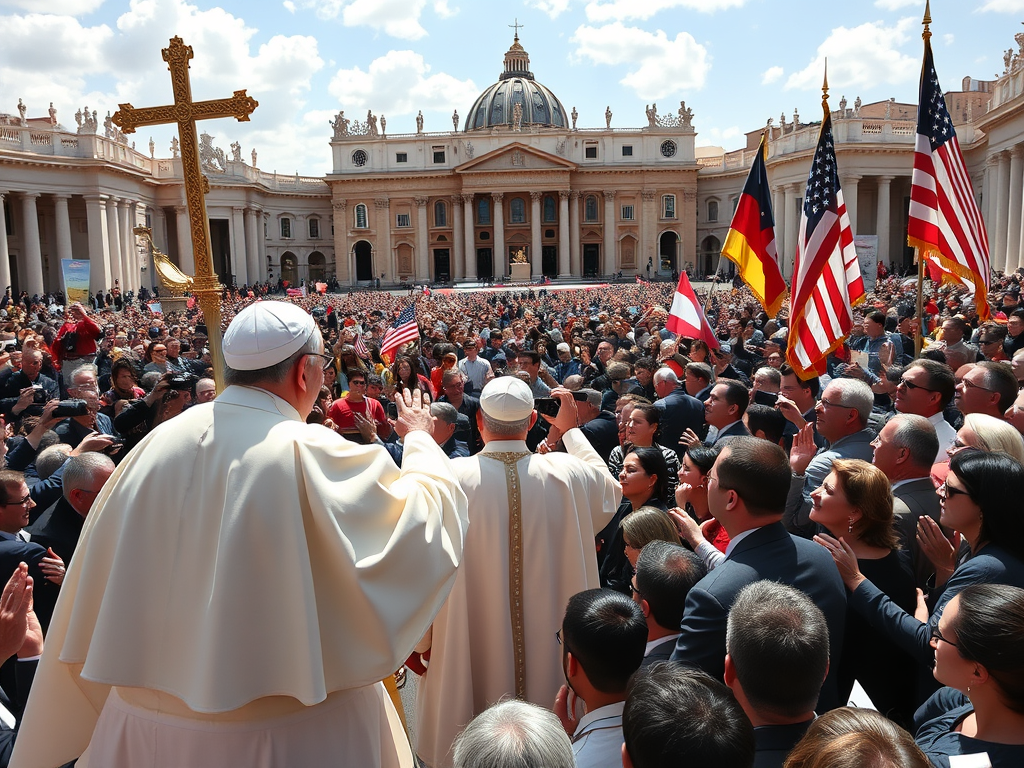

Americans Burst With Pride, and Surprise, at the First Pope From the U.S.

The declaration from St. Peter’s Square in Vatican City sent shockwaves across the United States, creating a mix of disbelief and pride: for the first time, an American had been elected pope. And as if that weren’t surprising enough, the new pontiff was also a die-hard White Sox fan.
In conversations with more than two dozen Americans, both Catholics and non-Catholics expressed their astonishment that the 2,000-year-old institution had chosen Cardinal Robert Francis Prevost, a native of Chicago’s South Side, as the new head of the Catholic Church. Now known as Pope Leo XIV, his unexpected ascension has left many reeling.
“We never saw this coming,” said Rev. Lawrence C. Tajah, a chaplain for the Nigerian Catholic community in Hyattsville, Maryland. “The speculation was always centered around Asia, Africa, or Rome. No one was really thinking about America. But this is a huge, albeit surprising, blessing.”

For some, the idea that a man who goes by “Bob” among friends could bring a more straightforward, American perspective to the Vatican’s traditional structure was a welcome prospect. Others hoped that having an American pope might help mend the growing divides within American Catholicism and perhaps bridge some of the gaps between the United States and its international allies that had deepened under President Trump.
“This feels like a new chapter for America,” said Alex Freeman, a 33-year-old event planner from Atlanta who was raised Baptist but occasionally attends services at a historically Black Catholic church.
The announcement created a rare moment of political unity in an otherwise deeply divided nation. President Trump called the election of Pope Leo “a tremendous honor for our country,” while former President Joseph R. Biden Jr., a lifelong Catholic, said, “May God bless Pope Leo XIV of Illinois.”
Across the country, the reaction was one of shock and awe. At Xavier University in Cincinnati, a Jesuit institution, students erupted in cheers upon hearing the news, according to Father Eric Sundrup, the school’s vice president for mission and ministry.
In Oakland, California, Spanish-speaking parishioners were excited to learn that the new pope was fluent in Spanish, having spent significant time in Peru as a missionary. Meanwhile, in Boston, a group of golfing buddies who had been betting on the outcome of the conclave admitted none of them had considered an American contender.
“I just never thought I’d see it in my lifetime,” said Tom Keane, a 71-year-old golfer.

Meanwhile, in Washington, D.C., officials at the Basilica of the National Shrine of the Immaculate Conception, widely regarded as America’s Catholic Church, were so caught off guard by the announcement that they had to adjust their décor plans, said spokeswoman Jacquelyn Hayes. Alongside the usual white-and-gold papal bunting, they decided to hang an American flag from the Knights Tower.
On the nearby campus of the Catholic University of America, students paused amid the end-of-semester rush to discuss the implications of having an American pope. Matt Castles, a 21-year-old nursing student from Westbury, New York, said his family’s group chat buzzed with excitement at the news.
“I think it might encourage more Americans to explore Catholicism,” he said. “It feels like a chance to reshape the perception of the Church in this country.”
Liberal Catholics expressed hope that Pope Leo XIV would carry forward Pope Francis’ legacy of compassion for the marginalized and a welcoming attitude toward the LGBTQ community. Maura Keller, a 30-year-old Catholic from the Chicago area, was moved by Pope Leo’s inaugural address, in which he emphasized God’s unconditional love for all people.

“If the Church keeps moving in that direction — toward embracing everyone, regardless of their circumstances — then that’s the kind of Catholic Church I want to see thrive,” she said.
However, some noted that Pope Leo’s record suggests he may not be a carbon copy of Francis. In a 2012 speech, he referred to what he called “lifestyles contrary to the gospel,” pointing to same-sex relationships and non-traditional family structures. This left some wondering whether his papacy would mark a more conservative shift.
Clergy members across the country have already started incorporating prayers for Pope Leo into their services. In Maryland, Monsignor Andrew Baker, rector of Mount St. Mary’s University seminary, mentioned the new pope during Mass on Thursday.
“I felt a great sense of joy,” he said.
The city of Chicago, in particular, has embraced its hometown pope with enthusiasm. Rev. William Lego, pastor of St. Turibius Parish in Chicago, was stunned to learn that his former seminary classmate had become pope.
“I think they made a great choice,” he said. “Bob was always a good man.”

Political strategist David Axelrod, known for helping another long-shot Chicagoan reach a position of global influence, also expressed his amazement. “Holy smokes!! An American pope! And he’s from Chicago!!” he tweeted.
Yet, outside the Windy City, many Americans had never heard of Cardinal Prevost before his name was read aloud from the balcony of St. Peter’s Basilica in Latin. For some, their initial reaction was simply, “Who?”
“I didn’t even know there was an American candidate,” said Danielle Charles, a 33-year-old insurance agent from San Antonio.
In a country where even the most apolitical events can become fodder for partisan bickering, both liberals and conservatives were quick to scrutinize the new pope’s social media history. Liberals highlighted a February post from an X account under his name that linked to a National Catholic Reporter essay criticizing Vice President JD Vance for invoking Scripture to prioritize family and community over the global poor.
Meanwhile, conservatives pointed to voting records from Illinois showing that Prevost had participated in Republican primaries in 2012, 2014, and 2016.
Nonetheless, Father Robert A. Dowd, president of the University of Notre Dame, saw the election as a potential unifying moment for American Catholics.
“It’s clear to me that Pope Leo wants to bring people together,” he said. “We need to make sure that our differences enrich us rather than divide us.”
In New York City, Rosario Gonzales, a 72-year-old retired accountant and Filipino immigrant, said she wasn’t particularly concerned with the new pope’s nationality. “It doesn’t matter where he’s from,” she said. “He’s still the pope.”
Despite watching the news closely, she admitted she had never heard of Cardinal Prevost before today. Still, she found him likable. “He looks like a pope,” she said with a grin. “Very pope-like.”




Leave a Reply