
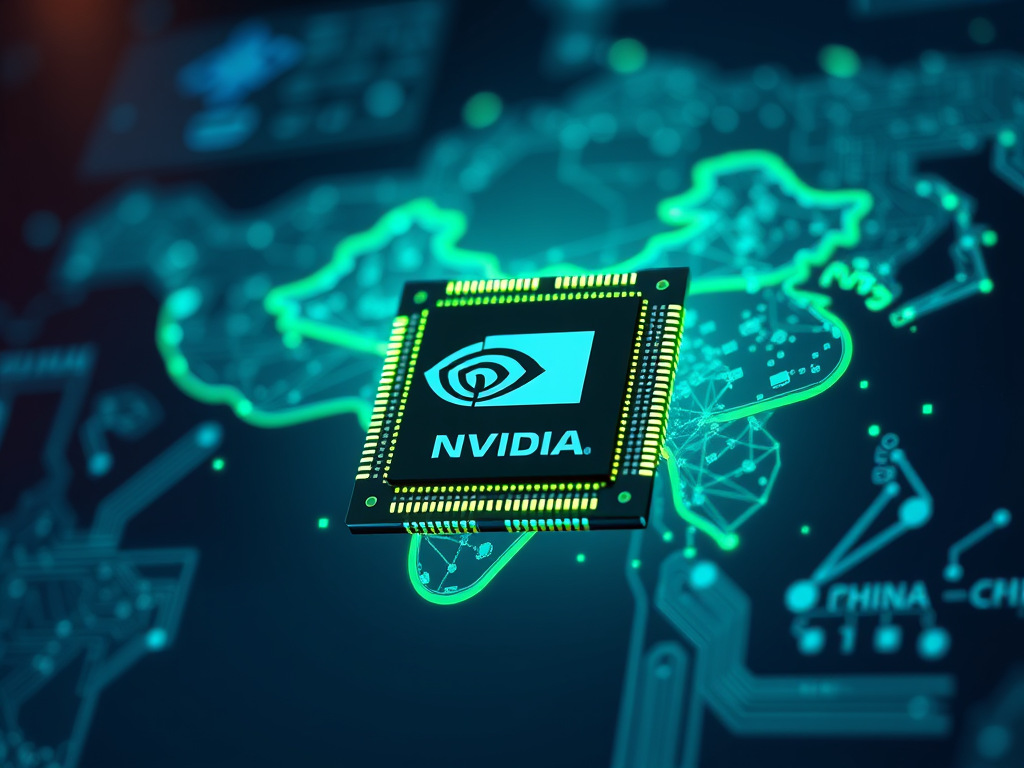

Nvidia Says U.S. Will Restrict Sales of More of Its A.I. Chips to China

Nvidia announced on Tuesday that the United States government has introduced new restrictions on the export of its artificial intelligence (AI) chips to China. This move effectively blocks the sale of certain products to Chinese buyers unless companies obtain a special license, adding another layer to the ongoing tensions between the two global powers in the tech industry.
This development marks the first significant instance of President Trump’s administration tightening controls on overseas semiconductor sales. The policy shift may dramatically reduce Nvidia’s ability to maintain its business in China, a market already weakened by earlier U.S. regulations on advanced chip exports.

Over the past few years, Nvidia has been under increasing pressure from Washington’s growing scrutiny over technological ties with China. When the Biden administration introduced restrictions in 2022 that limited the export of Nvidia’s top-tier AI chips, the company responded by engineering a workaround. It modified one of its most advanced chips, the H100, to comply with U.S. rules by reducing its performance. This led to the creation of the H20 chip, tailored specifically for Chinese clients.
Now, with the Trump administration’s fresh mandate, even the H20 chip is subject to licensing requirements, making its sale and distribution in China highly uncertain. Nvidia disclosed that it expects to record a $5.5 billion charge this quarter related to unsold H20 inventory, purchase agreements, and reserves. These losses stem directly from the company’s inability to fulfill orders under the new regulations.
While the financial impact is considerable, the broader implications are even more strategic. Nvidia is a dominant player in the AI semiconductor market, and China has been a vital customer. The loss of access to this significant market may pave the way for domestic Chinese companies—most notably Huawei—to fill the gap.
“This move effectively cuts Nvidia off from a major source of revenue and influence,” said Patrick Moorhead, an analyst with Moor Insights & Strategy. “As Nvidia loses ground, Chinese firms are likely to pivot fully to Huawei and other local alternatives.”
Nvidia chose not to make any public comment on the matter. Nonetheless, investor sentiment was clearly affected—shares of the company dropped more than 5% during after-hours trading on Tuesday.

Benno Kass, a spokesperson for the Commerce Department, confirmed the administration’s decision to enforce new licensing rules. The restrictions apply not only to Nvidia’s H20 chip but also to similar high-performance processors such as AMD’s MI308. “The Commerce Department remains fully committed to executing the president’s vision of safeguarding both national and economic security,” Kass said in a statement.
Interestingly, Nvidia revealed the policy change in a regulatory filing just one day after it had been praised by the White House for pledging a massive $500 billion investment in U.S.-based AI infrastructure. The company had also announced plans to start manufacturing AI servers at a facility in Houston and to collaborate with chip packaging firms located in Arizona.
However, Nvidia clarified that these commitments came after it had already been privately notified by the Trump administration the previous Wednesday about the pending licensing requirements. In its filing, the company noted that the administration had since confirmed the rules would apply indefinitely.
This new policy also follows a meeting between Nvidia CEO Jensen Huang and Donald Trump at a Mar-a-Lago fundraising dinner, where attendance cost $1 million per person. In the aftermath of that event, there had been speculation that the administration might soften its stance on Nvidia’s Chinese business. However, the new licensing mandate has dispelled those hopes.
The political pressure on chip exports has also intensified on Capitol Hill. On Monday, Senator Elizabeth Warren of Massachusetts sent a letter to Commerce Secretary Howard Lutnick, urging the government to act swiftly to limit H20 chip sales. She expressed concern that major Chinese tech firms—such as ByteDance, Alibaba, and Tencent—were rushing to buy up large quantities of the chip while smaller U.S. startups struggled to secure sufficient supplies. “It is critical that the Commerce Department not delay the implementation of essential safeguards to protect U.S. national interests,” Warren wrote.
The broader U.S. strategy to curb Chinese technological growth has been building since Trump took office. A recent example that alarmed Washington involved the Chinese startup DeepSeek, which unveiled an AI model that reportedly matched U.S. capabilities but was developed at a fraction of the cost. The announcement fueled concern that American technologies were inadvertently enabling China to become a serious global competitor in AI.
During his confirmation hearings, Commerce Secretary Lutnick stated that the U.S. must prevent Chinese firms from accessing advanced American-made technologies. He specifically cited Nvidia as a key example of technology that should not be used by foreign rivals to “undercut our position in the global AI race.”
In fiscal year 2023, Nvidia reported $17 billion in sales to China, representing a significant portion of its global revenue. But the share of its business from China has been shrinking. Once accounting for about 20% of Nvidia’s total revenue, the figure dropped to 13% last year due to increasing export restrictions and geopolitical tensions.

Although Nvidia’s filing did not specify whether future sales would be completely halted, industry analysts believe that the company’s supply of H20 chips is limited. The chip is essentially a downgraded version of the H100, designed specifically to meet regulatory requirements for export. The more powerful, original H100 chips—unmodified—can still be sold to customers in the U.S. and Europe.
With the geopolitical landscape shifting rapidly, the uncertainty facing Nvidia—and other U.S. tech firms—continues to grow. As U.S. regulations evolve, these companies must balance the demands of national security policy with the realities of doing business in one of the world’s largest and fastest-growing technology markets.
For now, Nvidia finds itself at a crossroads. It can either continue adapting its technology to comply with shifting regulatory standards or risk ceding ground to Chinese firms that are eager to fill the vacuum. Either path presents enormous challenges, and the ultimate outcome will likely shape the global AI semiconductor industry for years to come.




Leave a Reply