
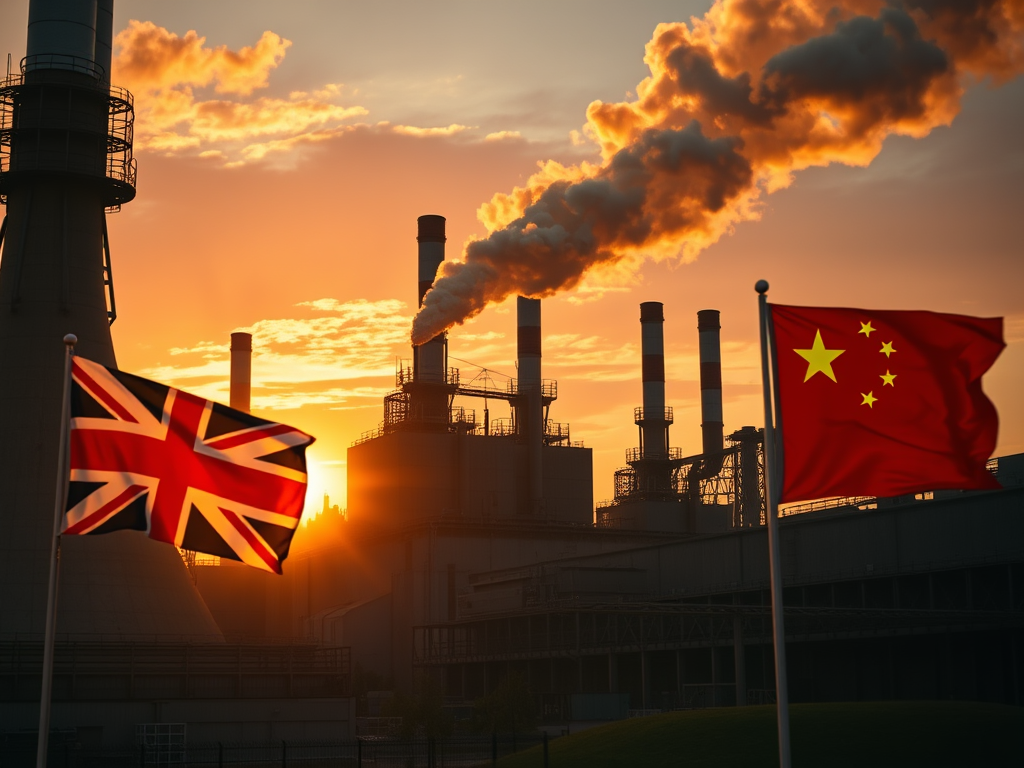

A Crisis at a British Steel Mill Has Cast a Shadow Over U.K.-China Relations

In a year that has seen a succession of high-level British officials travel to China in an attempt to rebuild a once-promising relationship, a sudden and forceful move by the British Parliament has injected tension into the diplomatic effort. The British government’s recent decision to intervene in the operations of a Chinese-owned steel plant has raised eyebrows and could challenge Prime Minister Keir Starmer’s broader strategy to re-engage with Beijing.
The controversy centers on a steel mill in Scunthorpe, Lincolnshire, owned by the Chinese conglomerate Jingye. The plant is one of the last in the United Kingdom capable of producing crude steel, a material deemed essential for national infrastructure and strategic development. When Jingye announced plans to shut down its two blast furnaces, potentially halting production entirely and eliminating 2,700 jobs, the British government responded with urgency. In a rare and bold move, Parliament stepped in to take control of the plant in an effort to keep it running.
This action marked a striking departure from the government’s recent tone of diplomatic optimism toward China. It also highlighted the delicate balance the U.K. faces: fostering economic ties with a global power like China while protecting critical national industries from foreign control.

The steel plant issue has sparked a larger debate within government circles about the risks of allowing Chinese firms to operate in sectors considered vital to national security. Business Secretary Jonathan Reynolds did not mince words when speaking on Sky News, saying, “We need to be clear about which sectors are suitable for cooperation and which, frankly, are not. Personally, I wouldn’t invite a Chinese company into our steel industry.”
According to Mr. Reynolds, Jingye refused to order the essential raw materials needed to continue operations at the plant—an act that some interpreted as a deliberate step toward forcing its closure. Although there is no public evidence to confirm this theory, the refusal led to rumors of possible sabotage and bad faith on the part of the Chinese company. British officials have rejected those claims, but tensions remain high.
To avoid an immediate shutdown, the government scrambled to secure the necessary materials. On Monday, it confirmed that two cargo ships carrying iron ore and coking coal were en route to supply the Scunthorpe plant. This move may provide a temporary reprieve, but the economic cost is steep—the plant is reportedly losing nearly £700,000 (about $922,000) every day.
In response, Beijing issued a formal warning, cautioning Britain not to politicize what it sees as a purely economic matter. Chinese Foreign Ministry spokesperson Lin Jian urged the U.K. to avoid transforming trade cooperation into political and security conflicts, warning that such a shift could erode the confidence of Chinese investors.

This friction comes at a critical time for Prime Minister Starmer’s administration. Since taking office, the Labour government has been attempting to reverse the cooling of U.K.-China relations that began under previous leadership. The deterioration stemmed from several flashpoints, including Beijing’s tightening grip over Hong Kong and accusations of Chinese cyberespionage that compromised millions of British voters’ data.
Despite concerns over China’s human rights record and potential security threats, Starmer’s government appears to view stronger trade relations with China as an essential piece of its economic recovery plan. With global markets under strain and the threat of renewed protectionism from a possible second Trump presidency in the United States, Downing Street sees Chinese investment as a stabilizing force.

But the Scunthorpe incident may test that calculus. Analysts warn that the government now faces a difficult choice between economic pragmatism and national security.
Dr. Steve Tsang, director of the SOAS China Institute at the University of London, framed the dilemma this way: “Ministers must decide whether to confront the situation head-on or downplay it to avoid escalating tensions during an already turbulent global moment. I suspect most will opt for the latter.”
In January, Chancellor of the Exchequer Rachel Reeves traveled to Beijing in a bid to secure Chinese investment, a trip that underscored the government’s emphasis on rebuilding commercial ties. While her trip generated only modest investment pledges—about £600 million or $791 million—it symbolized a new phase in the U.K.’s diplomatic engagement with China.
That same spirit was reflected in another notable visit last week. Admiral Tony Radakin, head of the British Armed Forces, went to Beijing to foster military-to-military communication. During the trip, he held meetings with Chinese officials and delivered a speech at China’s prestigious National Defense University. Such outreach efforts harken back to the early 2010s, when former Prime Minister David Cameron heralded a “golden era” in Sino-British relations. At the time, symbolic gestures like taking President Xi Jinping to a historic English pub demonstrated the warmth between the two governments.
However, that “golden era” was short-lived. By 2020, tensions had resurfaced, especially after then-Prime Minister Boris Johnson decided to exclude Huawei from Britain’s 5G network over national security concerns.
Even amid recent overtures, signs of diplomatic strain persist. Last week, Hong Kong officials barred entry to Wera Hobhouse, a British Member of Parliament affiliated with the Inter-Parliamentary Alliance on China, a group critical of Beijing’s policies in Hong Kong. Her exclusion occurred during a visit by British Trade Minister Douglas Alexander, further complicating the optics of the situation.
Luke de Pulford, executive director of the Inter-Parliamentary Alliance, commented that the steel mill standoff would likely be viewed by the government as “an inconvenience.” Still, he noted the broader context, saying, “There has long been a belief in the Treasury that Chinese investment is the key to rescuing the British economy.”
Another looming decision involves whether the government will approve China’s plans to build a massive new embassy next to London’s financial district. The proposed location has triggered pushback from local residents and national security experts alike, who worry about the proximity of the embassy to major financial institutions and the potential for surveillance.
“It’s clearly a diplomatic priority for the Chinese,” Mr. de Pulford said, noting that the issue was raised by President Xi during conversations with Prime Minister Starmer.
All of these developments point to the inherent contradictions in the U.K.’s approach to China. On one hand, the government is actively pursuing closer economic ties to stabilize post-Brexit Britain in an uncertain world. On the other, it must grapple with growing domestic pressure to scrutinize Chinese involvement in strategic industries and push back against encroachments on democratic norms.
The Scunthorpe case is more than a dispute over blast furnaces and raw materials. It encapsulates the broader challenges that Western nations face in dealing with an assertive and increasingly powerful China. As Britain navigates its post-Brexit identity and strives to define its role on the world stage, the path forward will demand not only diplomatic finesse but also hard decisions about where its values—and vulnerabilities—truly lie.




Leave a Reply