
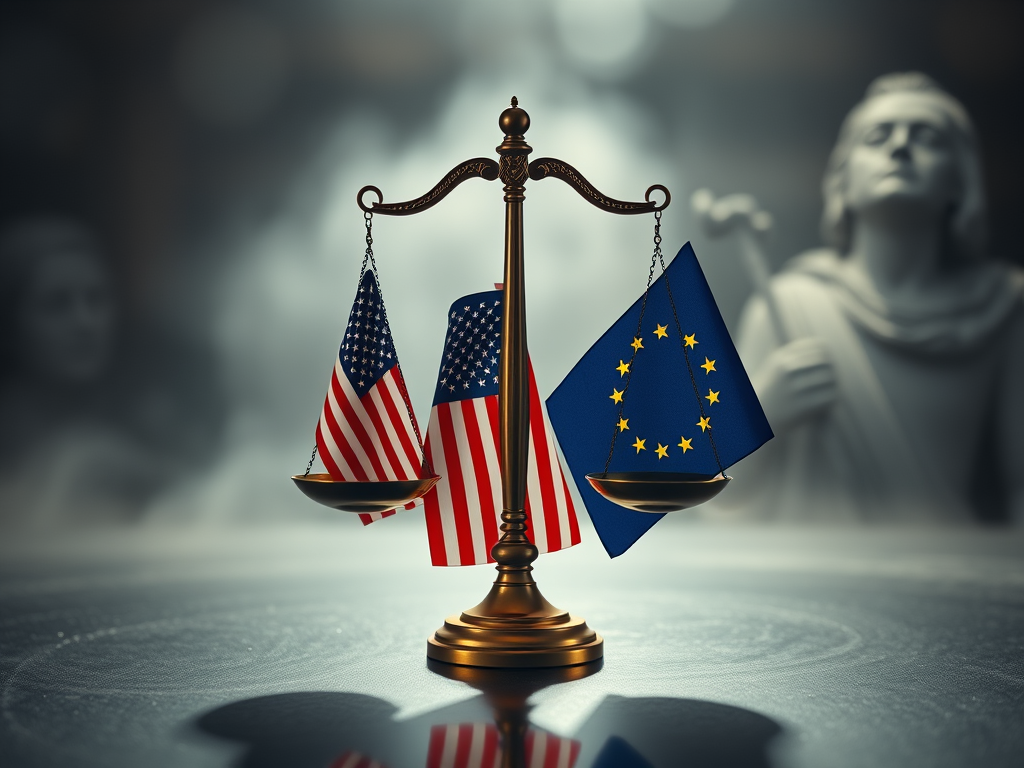

Trump Administration Pauses Tariffs: EU’s Strategic Response

On Thursday, officials from the European Union announced a decision to postpone the implementation of planned retaliatory tariffs in response to President Donald Trump’s sudden move to temporarily ease some of the trade levies targeting Europe and other regions.
President Trump’s decision, made public on Wednesday, did not signify a full withdrawal of the imposed duties. Tariffs on European cars, steel, and aluminum remain in effect, and the latest delay is only temporary. The lack of clarity has contributed to a climate of economic uncertainty across Europe, leaving both consumers and businesses unsure of what lies ahead.
Despite this ambiguity, European leaders saw a glimmer of opportunity in Washington’s change of course. The delay was interpreted as a possible opening for renewed negotiations.
The shift in U.S. policy occurred mere hours after the EU had finalized and approved its own retaliatory tariffs, set to range from 10 to 25 percent on an estimated $23 billion worth of American goods. However, in light of the evolving situation, European officials opted on Thursday to implement a 90-day hold on their countermeasures.

“If discussions fail to deliver satisfactory outcomes, we will not hesitate to move forward with our response,” declared Ursula von der Leyen, President of the European Commission, in an official statement. “We are continuing preparations for additional retaliatory actions in parallel.”
The Trump administration’s latest move involves pausing what it calls “reciprocal” tariffs—generalized duties varying in rate depending on the country affected. Initially introduced on April 2, these measures included a proposed 20 percent tariff on EU imports. However, under the revised terms, Europe now faces a reduced 10 percent tariff for the 90-day reprieve.
Nevertheless, the more severe 25 percent tariffs targeting vital sectors such as steel, aluminum, and automobiles remain firmly in place. The retaliatory package endorsed by European leaders earlier this week was designed in direct response to these specific metal-related duties, rather than the recently postponed general tariffs. The EU’s planned retaliation would have imposed duties on a wide variety of U.S. goods, including agricultural and consumer products like soybeans, peanut butter, and hair spray.
In the wake of the developments, EU Commission spokesperson Olof Gill addressed the media on Thursday, emphasizing a need for measured reflection. “We intend to take time—to think carefully, to analyze thoroughly, and to reflect strategically,” he stated during a press conference.

U.S. officials have expressed cautious optimism that Europe will refrain from activating its retaliatory tariffs, which were originally scheduled to take effect on April 15.
Commerce Secretary Howard Lutnick remarked on Wednesday, “Our hope is that this delay allows time for meaningful dialogue with the President, without retaliatory measures clouding the negotiations.”
The decision by the Trump administration to soften its stance appears closely tied to recent turmoil in financial markets. Yet Washington maintains that its goal is to use the temporary pause as a window for striking improved trade agreements. This development could benefit European policymakers, many of whom have long advocated for constructive discussions.
Over recent weeks, EU officials have been urging their American counterparts to return to the negotiating table. President von der Leyen has repeatedly suggested that both sides could benefit from a mutual elimination of tariffs on industrial goods—including vehicles.
“Tariffs function as hidden taxes, hurting businesses and consumers alike,” von der Leyen said in a statement issued Wednesday. “This is why I’ve consistently pushed for a ‘zero-for-zero’ agreement with the United States—abolishing tariffs on industrial products altogether.”
According to spokesperson Gill, the EU is also open to exploring other sectors where such zero-tariff arrangements might be feasible, provided the United States demonstrates a willingness to engage.
Yet substantial progress remains elusive. European negotiators have found that U.S. officials seem more interested in a comprehensive overhaul of the global trade framework than in resolving bilateral issues through quick fixes.
Furthermore, European industries continue to feel the strain of existing tariffs. American duties on Chinese exports may lead to a surge of low-cost goods into the European market, heightening competition and destabilizing prices. In Germany, the automotive sector remains particularly hard-hit by U.S. tariffs, while additional American levies on pharmaceuticals remain a looming threat for countries like Ireland and Denmark.
Faced with this challenging and uncertain landscape, the European Union is pursuing a multifaceted strategy. It is keeping the door open for negotiations with Washington while simultaneously preparing its retaliatory measures. At the same time, it is working to diversify trade partnerships by finalizing new deals with other countries and investing in policies that strengthen domestic industry.
Von der Leyen emphasized the importance of these efforts during her remarks on Thursday. According to her, the EU must take steps to reduce its dependence on the increasingly unpredictable U.S. administration.
She has recently been engaged in a flurry of diplomatic activity, holding conversations with leaders from Canada, New Zealand, and the United Arab Emirates. These talks form part of a broader EU campaign to deepen economic ties with like-minded trade partners.
“This situation has highlighted a fundamental truth,” von der Leyen said. “In moments of global instability, the European single market remains our most reliable source of economic resilience and stability.”
Even as European policymakers agreed to delay retaliation, the atmosphere remained highly volatile. Asked for clarity about which tariffs had been postponed and which were still in force, Olof Gill candidly admitted that the situation was evolving rapidly.
“Please bear with me if I don’t get every detail right,” he said. “Everything is moving very fast. We’re all trying our best to keep up.”



Leave a Reply