

Nintendo Switch Game Console Release Is Whipsawed by Tariff Threats

For several months, Nintendo — the iconic video game company behind classics like Super Mario Bros. and Donkey Kong — had been preparing for a major celebration on the morning of April 2. The occasion was set to mark a significant milestone: the official unveiling of the price and release date for the much-anticipated Switch 2, a console that had been in development for nearly eight years.
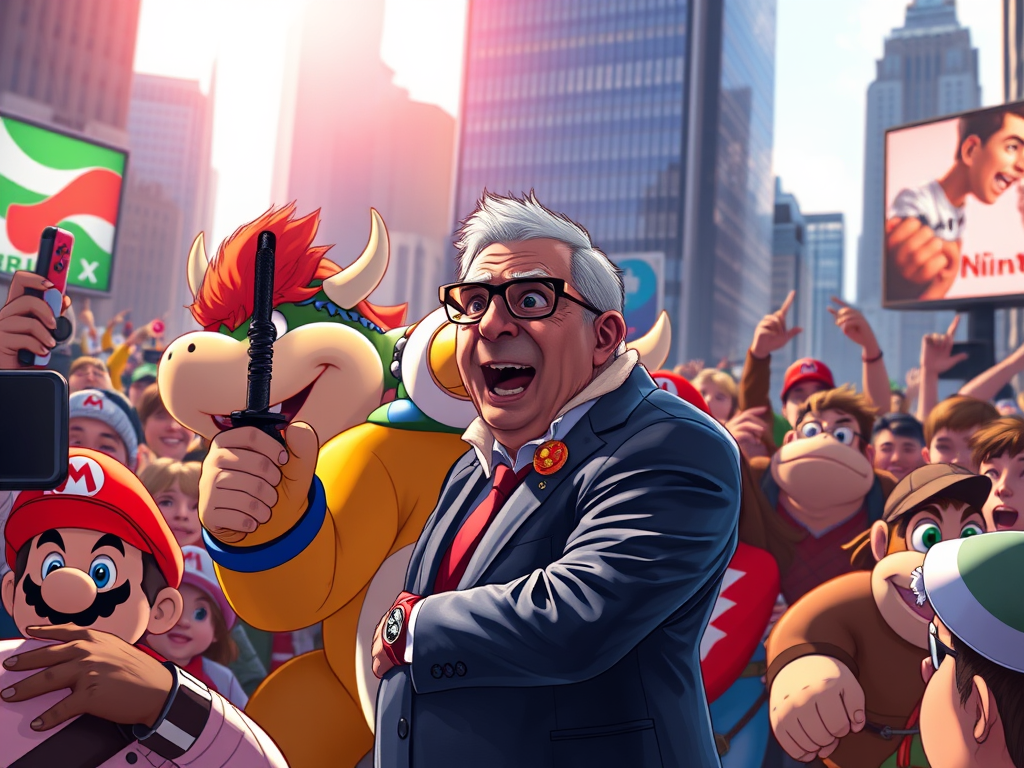
The announcement event took place in New York City with much excitement and fanfare. Doug Bowser, the president of Nintendo of America, addressed an enthusiastic crowd, revealing a slate of new games to accompany the console launch. Familiar characters such as Mario, Donkey Kong, and Kirby were all part of the presentation, creating an atmosphere of joyful anticipation among fans and industry insiders alike.
However, what began as a triumphant day for Nintendo quickly turned into a source of anxiety and uncertainty. Just hours after the console reveal, former President Donald Trump made an unexpected announcement that rattled global financial markets: a new round of tariffs that would affect imports from several countries — including Vietnam, where the Switch 2 is manufactured.

The repercussions were swift. Within 48 hours of the announcement, Nintendo revealed that it would be postponing pre-orders for the Switch 2 and potentially increasing its launch price, originally set at $450. The company did not clarify the extent of the price hike. Then, in a partial reversal, Trump announced a 90-day delay on the implementation of the proposed tariffs targeting countries such as Vietnam, Japan, Malaysia, and Cambodia. While this move offered a temporary reprieve, Nintendo remained quiet on how the delay might impact the pricing or release timeline of the Switch 2.
This situation reflects a broader pattern of disruption caused by the uncertainty of the Trump administration’s trade policies, especially in the technology sector. The unpredictability surrounding tariffs has created challenges for hardware producers, particularly those relying on global supply chains.
Before the delay was confirmed, Nintendo had issued a statement affirming that the Switch 2 was still on track for a June release. However, it refrained from setting a new date for reopening pre-orders or announcing an updated price point, leaving fans in limbo.
Frustrated by the ambiguity, gamers quickly voiced their discontent across platforms like Reddit and X (formerly Twitter). While it’s common for consumers to criticize companies over high console prices, this time the anger was aimed squarely at Trump’s policy changes rather than Nintendo itself.
Jake Steinberg, a gamer and writer from Philadelphia, had recently traveled to New York to experience a demo version of the Switch 2. The sudden tariff news left him uncertain about how much more he’d be willing to spend on the console. “It’s deeply ironic,” he noted. “People always say, ‘Keep politics out of gaming,’ and yet, here we are.”
For years, Nintendo produced most of its gaming hardware in China. But during Trump’s first term, amid growing tensions and the looming threat of a U.S.-China trade war, the company shifted a large portion of its manufacturing operations to Vietnam in an effort to avoid tariffs.
That strategy now appears to be in jeopardy. The proposed new tariffs — which could be as high as 46 percent on Vietnamese goods, 24 percent for Japanese and Malaysian imports, and 49 percent for those from Cambodia — are leaving tech manufacturers with limited options for relocation.
Still, the 90-day delay gives Nintendo a narrow window to strategize. According to Michael Pachter, a market analyst at Wedbush Securities, the delay may allow the company to boost production and build up inventory within the U.S. prior to any tariffs taking effect. That might buffer them temporarily from the worst financial impact.
Other technology giants, such as Apple, may not be as fortunate. Apple traditionally begins manufacturing its new iPhones just months ahead of their official launches, making it harder to adjust plans on short notice.
Nintendo now faces a difficult balancing act. The company must decide how much it can raise the Switch 2’s price without alienating potential buyers. Many fans already felt the $450 price tag was pushing the limit. With uncertainty looming, the company may be hoping that the full implementation of tariffs will either be canceled or further delayed.

It’s important to remember that for Nintendo, as well as competitors like Sony and Microsoft, hardware sales are only part of the equation. Selling consoles is a gateway to selling games, which often yield higher profit margins. If consumers skip a console purchase due to high prices, the loss isn’t limited to hardware revenue — software sales take a hit as well.
Should prices rise across the board in consumer electronics, it’s likely that headline-making launches — like the Switch 2 — will attract the most consumer backlash. Pachter estimates that if the Trump tariffs proceed as planned, the Switch 2 could become up to $100 more expensive in the U.S.
“The average person isn’t going to notice if TVs get slightly more expensive,” Pachter said. “No one is circling a calendar for the exact day they’re buying a new television. But with something like a new game console, fans have been waiting for years — and they’ll definitely notice a price increase.”
Before the tariff news broke, Nintendo’s Doug Bowser stated publicly that the $450 price for the Switch 2 didn’t account for future tariffs. However, industry experts question that assertion, especially when comparing it to the Japanese retail price of ¥51,000 (roughly $340 USD). A Nintendo spokesperson clarified that the Japanese model is limited to Japanese-language functionality, partially explaining the difference.
Doug Creutz, an analyst at investment firm Cowen, believes Nintendo will hold off on final pricing decisions until the trade situation becomes clearer. “They’re trying to avoid the need for multiple price changes,” he said. “The questions they’re asking themselves are: Can we accept lower profit margins in the U.S.? Or do we prioritize protecting our bottom line?”

Interestingly, the price delay only applies to the U.S. market. Pre-orders remain available in other regions, where prices are slightly different — approximately $442 in the UK, $435 in Australia, and $450 in Canada. According to David Gibson, an analyst at MST Financial, Nintendo still manufactures about 30 percent of its consoles in China, mostly for non-U.S. markets.
Gibson added that Nintendo had already shipped around 746,000 units of the Switch 2 to the U.S. before the tariff threat surfaced. These units won’t be affected by the new tariffs even if they’re eventually implemented, providing some breathing room in the short term.
“That stock will cover them for at least one financial quarter,” Gibson said. “But after that, unless something changes, they’ll be facing the full brunt of the tariffs.”
Nintendo isn’t the only company grappling with these tough choices. Apple also began shifting part of its manufacturing base to Vietnam in 2019, and companies like Sony and Microsoft may soon have to make similar decisions as they prepare for their next-generation console launches, anticipated around 2027.
“It’s not just about gaming,” Gibson emphasized. “These tariffs could impact every major consumer electronics brand — Samsung, LG, Apple — across TVs, smartphones, and gaming devices. Everyone’s going to feel it.”



Leave a Reply