

Used Tesla Market Heats Up as Owners Sell to Protest Elon Musk

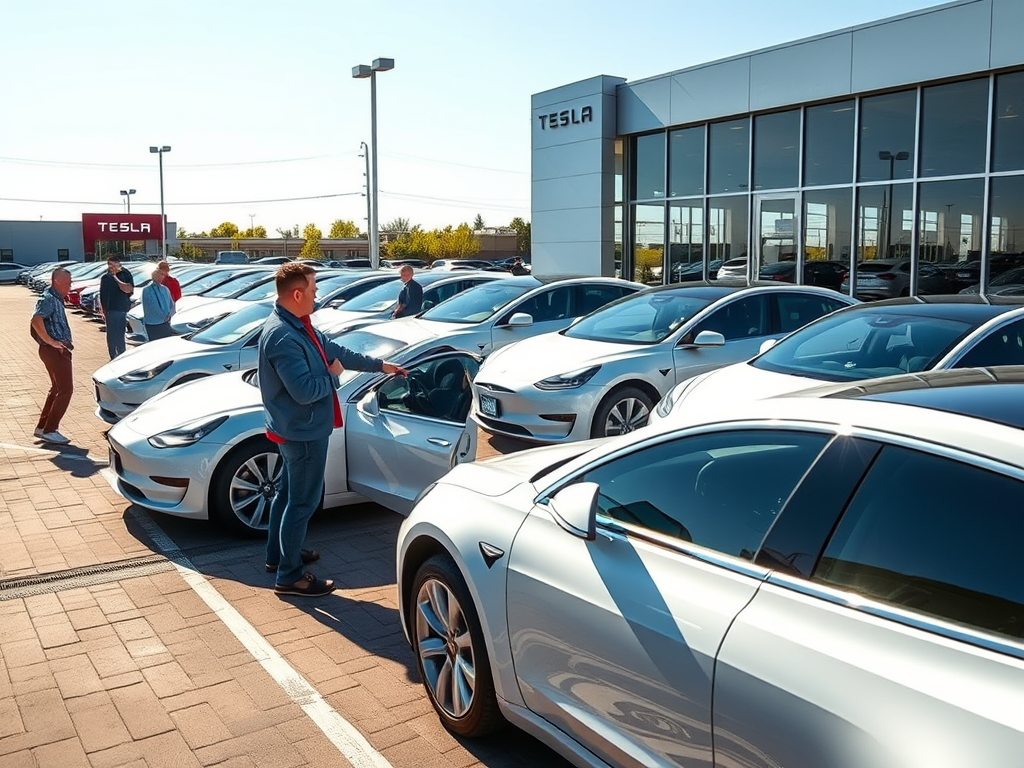
Over the past several months, Ken Harvey, a car dealer based in Northern California, has been steadily expanding a unique niche within his existing business. Known for operating Honda and Mazda dealerships in Alameda County, Harvey has recently found success in an unexpected market: reselling used Teslas.
A few times each month, Harvey attends local car auctions where he acquires pre-owned Teslas, particularly the popular Model 3s. These vehicles, once symbols of cutting-edge automotive technology and environmental consciousness, are now appearing on his lot with increasingly appealing price tags. Thanks to a federal tax credit of $4,000 for qualifying used electric vehicles priced below $25,000, buyers can often drive away in a used Tesla for much less than the cost of a new one. And for those who also qualify for state-level incentives, the total price can dip below $20,000 — a fraction of the cost of a brand-new Tesla.
“We sold three last week alone,” Harvey shared. “And since the start of the year, we’ve moved close to 20.” His dealerships, he added, currently have three used Teslas available, with two more expected soon. “They don’t last long once they’re on the lot,” he said. “A few days at most.”

This wave of interest in secondhand Teslas has emerged as a somewhat ironic result of public backlash against the company’s CEO, Elon Musk. While Musk’s close ties to former President Donald Trump and his recent political role have drawn considerable criticism, this has also inadvertently fueled a robust secondary market for Tesla vehicles.
Even before Musk’s alignment with Trump made headlines, the market for used Teslas had been steadily growing. However, as Musk’s political profile increased and his controversial actions drew more attention, many Tesla owners began distancing themselves from the brand. What began as a slow churn of resale has accelerated dramatically in recent months, fueled in part by growing dissatisfaction with Musk’s leadership and political involvement.
A significant turning point came when Musk assumed a leadership position in what he and Trump dubbed the “Department of Government Efficiency” — a non-official but powerful federal office reportedly authorized to reduce bureaucratic redundancy by terminating government employees and dismantling certain agencies. This move, coupled with public appearances and gestures that many found deeply offensive — including one gesture widely interpreted as resembling a Nazi salute — led some longtime Tesla supporters to abandon the brand altogether.
Dr. Jerome Winegarden, a resident of Ann Arbor, Michigan, was among those who felt compelled to make a change. Despite having only put 35,000 miles on his Tesla Model 3, he traded it in last month for a Ford F-150 Lightning, an electric pickup truck. The Model 3, which originally cost about $40,000, fetched just $18,000 in the trade-in deal.

“I became increasingly uncomfortable with Elon Musk’s behavior and public actions,” said Dr. Winegarden, 54. “The gesture was the final straw. It was symbolic of something I couldn’t support. I felt genuinely ashamed to be driving that car.”
Tesla has not issued any public response to inquiries regarding the growing wave of negative sentiment or its impact on used car sales.
Across the country and even abroad, this sentiment has been reflected in protests and public demonstrations. Tesla showrooms have become targets for organized protests, and in more extreme cases, acts of vandalism and arson have occurred at Tesla facilities and charging stations. A grassroots movement called “Tesla Takedown” has emerged, urging current owners to part ways with their vehicles and calling on investors to divest from Tesla stock. Over the past month, the group has organized dozens of protests not just in the United States, but also in Europe, Australia, and New Zealand.
Outside of the U.S., Tesla’s fortunes have taken a noticeable hit. According to automotive research firm Jato Dynamics, Tesla sales across 25 European countries plummeted by approximately 45% during the first two months of the year. Analysts attribute this decline in part to Musk’s increasingly polarizing political activities and his association with Donald Trump.

While it is more difficult to quantify the impact on U.S. sales — as Tesla does not disclose specific numbers by region — the rising availability of used Teslas is telling. According to AutoTrader.com, listings for used Teslas by both private sellers and dealerships surged to about 11,700 by late March, up from around 8,000 in January.
Other sources have observed similar trends. Edmunds, a respected automotive data provider, reports a sharp increase in Tesla trade-ins at dealerships. In March alone, Teslas from 2017 or newer accounted for 1.4% of all vehicles traded in for new or used models — a significant rise from just 0.4% the year before.

Stephanie Valdez Streaty, who leads industry insights at Cox Automotive — the parent company of AutoTrader.com and major auction house Manheim — noted that Tesla’s spike in sales around 2020, particularly following the launch of the Model Y, may also be contributing to the rise in used inventory. “We’re seeing the lifecycle turn over now,” she explained. “People who bought in during the boom years are starting to trade in or sell.”
She acknowledged that Musk’s political persona may be damaging Tesla’s brand perception, though she cautioned that more data is needed to draw firm conclusions. “There’s clearly a shift happening,” she said. “But it’s not just one factor driving it.”
Back in the Midwest, Enzo Costa, sales director for the Patrick Dealer Group — a company that runs eight dealerships in the Chicago area — has also noticed the trend. “We took in about 10 Teslas just last week,” Costa said. Unlike Harvey, however, Costa prefers not to sell the cars directly to customers. Instead, he typically offloads the vehicles through wholesale auctions.

“The pricing for Teslas is just too unstable,” Costa said. “In the last month alone, we’ve seen used Tesla values drop between 10 and 15 percent. It’s a risky market to hold inventory in, so we try to move them quickly.”
Back in California, Ken Harvey remains optimistic. He sees the volatility as an opportunity — especially for cost-conscious buyers who still want to drive electric. “We get a lot of interest from younger buyers and rideshare drivers,” Harvey said. “People who maybe wouldn’t have considered a Tesla before, but now see a chance to afford one thanks to the federal and state incentives.”
While Tesla’s brand may be facing an identity crisis and Elon Musk’s leadership continues to spark heated debate, for dealers like Harvey, the shifting market dynamics are opening new doors. He sees it as a win-win for both the dealership and the customer.
“Whatever the reason someone is giving up their Tesla,” Harvey said, “there’s usually someone else out there who wants one — especially at these prices.”


Leave a Reply