
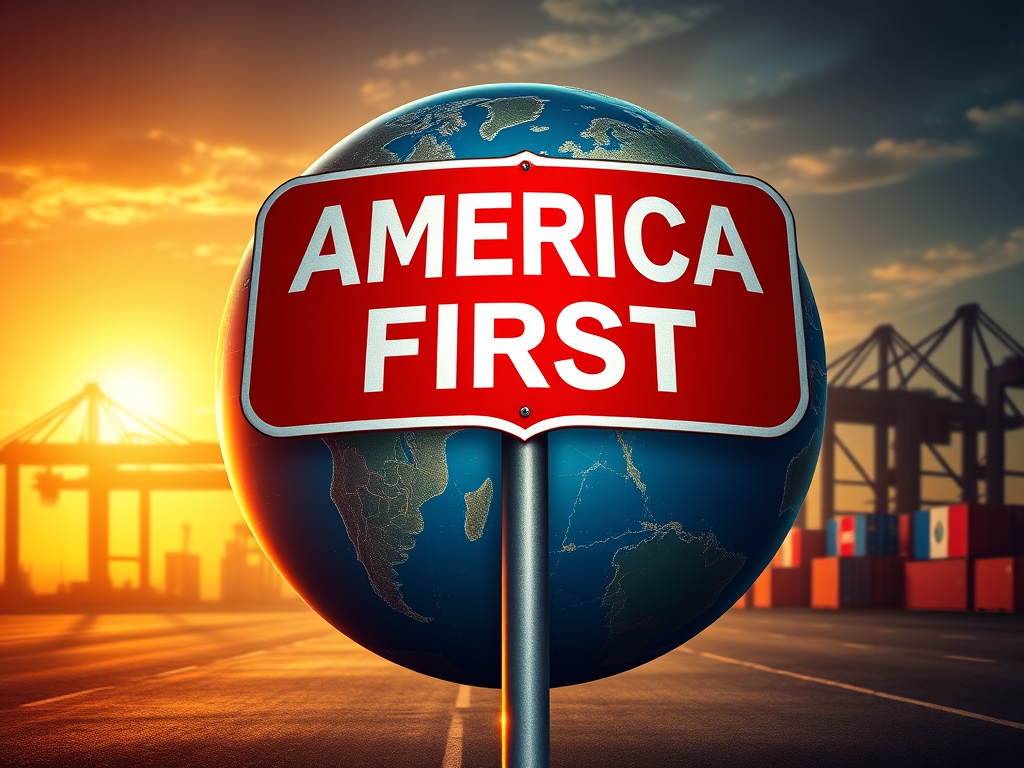

President Donald Trump’s announcement of sweeping tariffs on key U.S. trading partners marked what he hailed as “liberation day,” a declaration aimed at redefining America’s place in the global trade order. This bold move, however, bears an unsettling resemblance to other moments in recent history when major Western powers chose to isolate themselves from broader economic frameworks. Much like Britain’s 2016 decision to leave the European Union—a move justified as reclaiming sovereignty—Trump’s imposition of tariffs seeks to reassert national control over trade policy. Both decisions reflect a populist rejection of globalization and an effort to restructure long-established international economic relationships.
Trump’s Tariffs Will Wound Free Trade, but the Blow May Not Be Fatal

Trump’s decision is arguably even more disruptive, given the sheer scale of the American economy and its central role in global commerce. While Brexit impacted Europe significantly, the U.S.’s withdrawal—or at least retreat—from the principles of free trade reverberates across continents. The United States, after all, is not just another participant in global trade; it is the axis around which much of the system turns. As such, any protectionist turn taken by Washington inevitably prompts a recalibration across the global economy.
Yet, as was the case with Brexit, the long-term consequences of Trump’s tariff measures remain unclear. There is always the possibility that economic backlash—from market instability to mounting political pressure—could prompt the administration to soften its stance. Temporary trade deals or sector-specific exemptions might be negotiated in the short term. But the more profound question is whether this signals a permanent departure from America’s commitment to multilateral trade or merely a brief deviation.
The Resilience of Free Trade

Despite Trump’s unilateralism, many economists argue that the march of free trade may prove difficult to reverse entirely. The system of global trade, they contend, has yielded such substantial benefits over the past several decades that countries will likely find ways to preserve its structure, even in the absence of the U.S. as a cooperative player.
Indeed, trade liberalization has weathered numerous setbacks in the past. While Trump’s actions have introduced uncertainty and sparked retaliatory measures, the underlying trend has generally been toward reducing trade barriers, not increasing them. Even after the United Kingdom voted to leave the EU, the European bloc remained intact. In fact, Britain itself is now seeking closer alignment with the EU after years of instability. This pattern may be repeated in response to Trump’s protectionist turn—temporary disruption, followed by eventual reintegration.
According to Professor Eswar Prasad, a trade expert at Cornell University, what the world is witnessing is not the end of free trade but a retreat from its most expansive, unfettered form. “Ideally, this would be a moment when other countries rally to promote open trade among themselves,” he explained. “But in reality, what we are seeing is each nation scrambling to protect its own interests.”
Fragmentation and the Risk of Conflict

This shift toward national self-interest creates a more fragmented and volatile global trade environment. While trade conflicts do not always escalate into military confrontations, history offers reminders that economic disputes can be precursors to larger geopolitical tensions. Notable examples include the War of 1812 and the mid-19th-century Opium Wars—conflicts that had their origins in trade disagreements.
Although Trump’s approach stops short of old-style gunboat diplomacy, his combative rhetoric and antagonism toward traditional allies such as Canada and Mexico have intensified global unease. The prospect of a full-scale trade war between the United States and China, in particular, poses a significant threat to global stability. The economic interdependence between the two powers has historically acted as a stabilizing force; dismantling that relationship increases the risk of broader conflict.
Professor Prasad warns that this deterioration in economic ties undermines the balance that has long helped manage the larger strategic rivalry between the U.S. and China. Without that economic ballast, both countries may find themselves in a more adversarial posture, increasing the risk of escalation.
The American Market’s Unique Influence

One reason Trump’s tariff strategy has had such a broad impact is the United States’ role as a consumption-driven economy. Its demand for foreign goods—from German automobiles to Chinese electronics—drives global production chains. Reducing access to the American market forces other countries to reconsider their trade models.
Some, like the United Kingdom under Prime Minister Keir Starmer, have signaled a willingness to negotiate directly with Washington in hopes of securing better terms. Others may respond with retaliatory tariffs, seeking to strengthen their bargaining position. China, for instance, wasted no time in enacting reciprocal tariffs, raising duties by as much as 34 percent. The European Union, meanwhile, has warned against redirecting products excluded from the U.S. market into Europe, fearing a flood of cheap imports.
As Simon Johnson, an MIT professor and former IMF economist, pointed out, Europe’s response will be pivotal. Closer trade ties with China might allow the EU to fill some of the void left by the U.S., potentially forming a powerful non-American trade bloc. Yet, such a pivot could prove difficult, especially if European leaders are unwilling to absorb the volume of Chinese exports displaced by the American market.
China at a Crossroads

China now faces a dilemma. On the one hand, it can continue trying to rebalance its economy by fostering domestic consumption and reducing reliance on exports—a policy it has pursued with mixed success. On the other hand, it could attempt to reach an agreement with the Trump administration, despite past failures during his first term. Either path carries significant economic and political risks.
Trump’s critics may disapprove of his blunt approach, but many acknowledge the legitimacy of the concerns driving it. China’s model of subsidizing domestic industries and pursuing aggressive trade practices has disrupted global markets and contributed to the decline of certain sectors in the U.S., particularly manufacturing. Trump’s tariffs, in his view, are intended to reverse this trend and restore American industrial strength.
These concerns are not new. During his presidency, Barack Obama also questioned the concessions made to China during its accession to the World Trade Organization. He even imposed a 35 percent tariff on Chinese tires in 2009. Joe Biden, Trump’s successor, has largely maintained many of the tariffs imposed during Trump’s first term, suggesting bipartisan support for a tougher stance on China.
Trade as a Path to Prosperity

The idea that trade is fundamental to economic development remains widely accepted. Professor Johnson, who was awarded the Nobel Memorial Prize in 2024 alongside Daron Acemoglu and James A. Robinson, emphasized that virtually every country that escaped poverty did so through trade. Their research on the legacy of colonial institutions reinforced the notion that openness to trade is a key driver of growth, regardless of a country’s starting point.
Because of this, a wholesale return to economic self-sufficiency—or autarky—seems unlikely. Global supply chains are simply too complex and too interconnected. From semiconductor production in Taiwan to car parts manufacturing in Mexico and Canada, no country can realistically isolate itself without paying a steep price.
Nonetheless, the short-term pain of a trade war could be severe, especially for smaller, low-income countries that lack bargaining power. African nations such as Nigeria, Kenya, and Ghana have already been hit with tariffs ranging from 10 to 14 percent. These countries are particularly vulnerable because their economies depend heavily on commodity exports, and they have limited capacity to retaliate.
Long-Term Shifts and New Trade Alliances

The World Trade Organization has projected that Trump’s new tariffs, in conjunction with earlier measures, could lower global merchandise trade by 1 percent in 2025. This represents a downward revision of nearly four percentage points from its previous forecast, with the potential for even deeper declines if the trade war intensifies.
Yet, even in the face of these challenges, some analysts see opportunity. Trump’s actions could accelerate the formation of alternative trade frameworks. Countries excluded from favorable U.S. access may band together through regional partnerships or bilateral agreements. A prime example is the Trans-Pacific Partnership, which was renegotiated after the U.S. withdrawal and continues to function as a vital regional trade bloc.
Interestingly, although Brexit emerged from similar populist frustrations with globalization, it was not inherently protectionist in nature. Proponents argued that the U.K., free from EU constraints, could strike better trade deals independently. Recently, some Brexiteers even claimed that the U.K.’s 10 percent tariff from the U.S.—half that of the EU—was evidence of post-Brexit flexibility.
According to Jason Furman, former chairman of the Council of Economic Advisers under President Obama, the world may now begin to coalesce around new trade arrangements that deliberately exclude the U.S. “We are witnessing a pivotal moment for America’s role in global trade,” he noted. “But this is not the end of free trade—just a shift in its center of gravity.”




Leave a Reply