
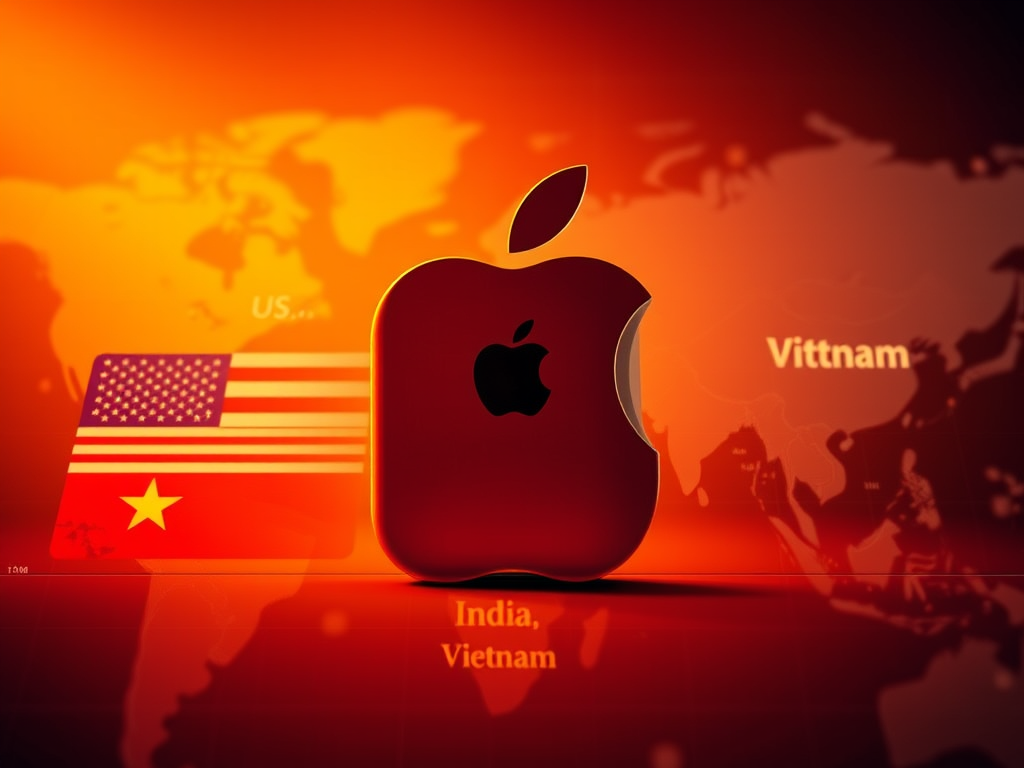

Trump’s New Tariffs Test Apple’s Global Supply Chain

When former President Donald Trump introduced tariffs on China in 2018, Apple began shifting production of certain products—such as iPads and AirPods—to Vietnam, while moving some iPhone manufacturing to India. This strategic decision was meant to diversify Apple’s supply chain and mitigate the impact of U.S.-China trade tensions.
However, with Trump’s return to the White House, this approach may have backfired on Apple, the world’s most valuable publicly traded company. On Wednesday, Trump announced that the United States would impose tariffs of 46% on Vietnam and 26% on India. While the White House stated that these tariffs were effective immediately, some trade experts believe they are preliminary figures intended to initiate negotiations aimed at lowering foreign tariffs on U.S. exports.
These new tariffs add to the existing pressures on Apple’s business. Currently, the company is already contending with a 20% tariff on products imported from China, where approximately 90% of Apple’s global iPhone production takes place. Under Trump’s updated tariff plan, this rate is set to rise to 34%, further straining Apple’s supply chain and financial outlook.
Apple declined to comment on the matter.
Although Apple is the most prominent tech company affected by these trade policies, other major players in the industry will also feel the impact. While companies like Google and Microsoft rely less on international suppliers than Apple, they still operate significant consumer electronics businesses. Additionally, the tariffs may drive up costs for building the large-scale data centers that these companies require to support new developments in artificial intelligence.

Trump’s tariff strategy is part of his broader initiative to restructure global trade by imposing duties on any country that enforces tariffs on American exports. U.S. trade officials estimate that India currently applies an average tariff of 13.5% on U.S. goods, including a steep 39% rate on agricultural products. Vietnam, in comparison, has an average tariff rate of 8.1%, with a 17.1% tariff on agricultural imports from the U.S.
During a press conference at the White House, Trump emphasized that tariffs, currency manipulation, and trade barriers collectively have a far more significant economic impact than individual tariff rates suggest. He has framed these new levies as “reciprocal tariffs,” meaning they are intended to counterbalance foreign tariffs on American exports.
For Apple, these measures could prove particularly challenging. The company generates roughly three-quarters of its nearly $400 billion in annual revenue from the sale of iPhones, iPads, and Apple Watches. With Trump making it clear that no product exemptions will be granted, Apple faces a difficult choice: absorb the additional costs, which would reduce profitability, or pass them on to consumers through price increases.

According to an analysis by Morgan Stanley, tariffs on Apple products imported from China alone will add $8.5 billion in costs per year. Without intervention from the Trump administration, this could reduce Apple’s annual profit by $7.85 billion, or about $0.52 per share—roughly a 7% decline in projected earnings. Following Trump’s tariff announcement, Apple’s stock dropped 5.7% in after-hours trading.
“Apple will take these new tariff figures, plug them into its financial models, and within hours, the company will understand the full scope of the problem it faces,” said Anna-Katrina Shedletsky, founder of Instrumental, a Bay Area firm that utilizes AI to optimize manufacturing processes. Shedletsky, who previously worked at Apple, highlighted how quickly the company assesses financial risks and supply chain impacts.
During Trump’s previous term, Apple’s CEO, Tim Cook, engaged directly with the administration to protect Apple’s interests. He personally met with Trump and pledged to invest hundreds of billions of dollars in the United States. In February, Apple followed through by committing to invest $500 billion in domestic initiatives, a figure that largely aligns with its existing spending plans.
Cook’s efforts during Trump’s first term helped Apple avoid tariffs on most of its core products. The administration at the time refrained from imposing tariffs on iPhones and even removed planned tariffs on the Apple Watch. In 2019, Trump visited an Apple facility in Texas that manufactures desktop computers. Standing alongside Cook, he took credit for the factory, despite the fact that it had been producing computers since 2013.

In the years that followed, Apple chose not to relocate major product manufacturing to the U.S. Instead, it sought to diversify its production beyond China. When Trump took office in 2017, Apple began establishing iPhone assembly lines in India. The company spent five years training workers and building the necessary infrastructure to manufacture its latest iPhone models within the country. Apple now aims for Indian factories to produce around 25% of the 200 million iPhones it sells annually.
Similarly, Apple relocated some of its AirPods, iPad, and MacBook production to Vietnam. The country became a key manufacturing hub for Apple and other tech firms after COVID-19-related shutdowns disrupted Chinese factories in 2020. By 2023, Vietnam accounted for over 10% of Apple’s top 200 suppliers.
Vietnam was an attractive option due to its proximity to China, allowing Apple to maintain a supply chain network that relied on Chinese components. India, on the other hand, was appealing because of its massive smartphone market, making local production an advantageous strategy for boosting iPhone sales in the country.
However, Apple has historically faced challenges with U.S.-based manufacturing. The Texas plant that produced Mac computers encountered issues, including worker shortages that led to unplanned assembly line shutdowns. Additionally, the company struggled to find reliable domestic suppliers for key components, such as custom screws required for production.
Tim Cook has previously expressed skepticism about the viability of large-scale manufacturing in the U.S. In a 2017 conference, he remarked that China possesses a vastly superior pool of skilled manufacturing workers compared to the U.S. “If you tried to assemble all the tooling engineers in the United States, you might not even fill a room,” he said. “In China, you could fill multiple football fields.”
With Trump’s tariffs now affecting India and Vietnam—two of Apple’s key alternative manufacturing hubs—the company faces new obstacles in its supply chain strategy. Whether Apple can navigate these challenges without significant financial setbacks remains to be seen.



Leave a Reply