

White House Denies Violating Judge’s Order in Deporting Venezuelans

The Trump administration denied on Sunday that it had violated a court order by deporting hundreds of Venezuelan immigrants to a prison in El Salvador over the weekend. Officials argued that the president had broad authority under an 18th-century wartime law to expel them swiftly.
White House Press Secretary Karoline Leavitt stated that federal courts “lack jurisdiction” over the president’s management of foreign affairs and his authority to expel foreign threats.
“A single judge in a single city cannot dictate the movements of an aircraft carrier filled with foreign alien terrorists who have been physically removed from U.S. soil,” she said in a statement. However, her reference to an aircraft carrier was puzzling, as reports indicated that the Venezuelans had been transported by plane to El Salvador.
While White House officials hailed the move as a groundbreaking step in accelerating deportations, their statements implicitly acknowledged that legal battles over their justification had only just begun.
On Friday, President Trump signed an executive order invoking the Alien Enemies Act of 1798 to expedite the arrest and deportation of individuals identified as members of the Tren de Aragua gang, bypassing many standard immigration legal procedures. The act permits the summary removal of individuals from countries at war with the United States.
However, on Saturday, Judge James E. Boasberg of the Federal District Court in Washington issued a temporary restraining order blocking deportations under this directive.

In an emergency hearing requested by the American Civil Liberties Union, the judge expressed skepticism about the legal validity of the president’s actions and ordered that any flights carrying Venezuelan immigrants under the executive order return to the U.S., stating, “This must be enforced immediately, whether that means turning planes around or taking other measures.”
Officials have not confirmed when the deportation flights landed in El Salvador, but on Sunday, Ms. Leavitt insisted that the individuals had already been removed from U.S. territory before the judge’s order was issued. She did not clarify whether any planes could have complied with the court’s directive and returned.
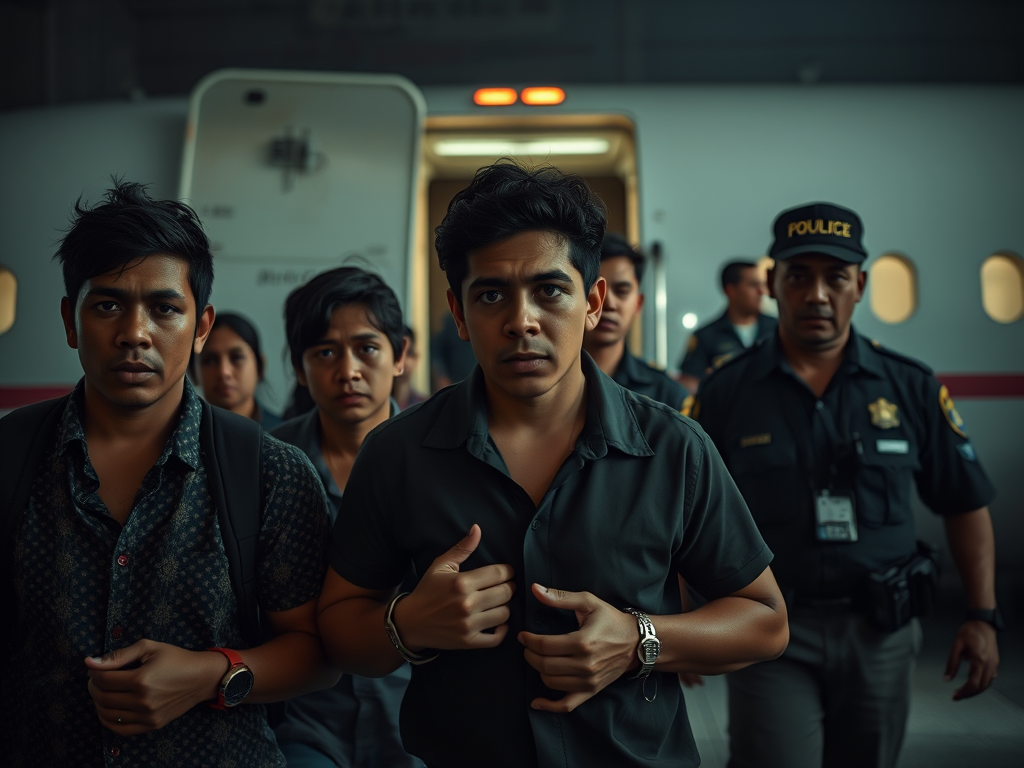
El Salvador’s President Nayib Bukele shared a three-minute video on social media showing handcuffed men being escorted off a plane at night and led into a prison, where officials were seen shaving their heads.
The Trump administration views this unusual transfer—an arrangement for El Salvador to accept suspected gang members rather than a prisoner exchange—as a potential precedent for expanding the use of the Alien Enemies Act.
This law, infamous for its role in the internment of Japanese Americans during World War II, has only been invoked three times in U.S. history: during the War of 1812 and both World Wars, according to the Brennan Center for Justice. Sources familiar with the agreement stated that the U.S. had agreed to pay El Salvador approximately $6 million to house the deportees.
During Saturday’s hearing, Judge Boasberg justified his order to halt the flights, citing “uncontested evidence” that deportation flights were actively departing.
Drew Ensign, a government attorney, told the judge that he lacked detailed information about the flights and suggested that revealing specifics could pose “national security concerns.”
The timeline of the flights is critical, as Judge Boasberg issued his order shortly before 7 p.m. Washington time. However, video footage from El Salvador shows deportees arriving at night. Given that El Salvador is two hours behind Washington, questions have emerged about whether the Trump administration disregarded the court’s directive.

Earlier on Saturday, Judge Boasberg had ordered officials to halt the deportation of five Venezuelan men at the center of the legal challenge. The Trump administration has since appealed his ruling.
In a court filing, the administration stated that the Departments of State and Homeland Security were “promptly informed” of the judge’s order when it was electronically posted at 7:26 p.m. Saturday.
The filing also asserted that the five plaintiffs seeking to block their deportations had not been removed. However, it acknowledged that “some gang members designated for removal” under the president’s order had already been deported before Judge Boasberg’s broader ruling took effect.
On Sunday, Mr. Bukele reacted to the judge’s order by posting a screenshot on social media with the caption, “Oopsie… Too late.” Secretary of State Marco Rubio later shared his post.
Mr. Rubio also referenced two MS-13 members: one identified as a high-ranking leader and another suspected gang member.
The first, Cesar Humberto Lopez-Larios, was among 14 top gang leaders indicted on Long Island in 2020. Arrested last year in Texas, he had been in U.S. custody awaiting trial.
The second, Cesar Eliseo Sorto-Amaya, had been arrested in February for illegal entry into the U.S.—his fourth such offense since 2015. Wanted in El Salvador for double aggravated homicide, he had already been sentenced in absentia to 50 years in prison.

Court records unsealed on Sunday revealed that U.S. prosecutors had dropped the charges against both men earlier in the week. In a letter to the judge in Mr. Lopez-Larios’s case, prosecutors cited “sensitive and significant foreign policy considerations” as the reason for their decision to forgo prosecution.
The transfers have sparked concerns among U.S. law enforcement officials, who worry that the deported individuals, once outside U.S. custody, could either escape or issue orders that put witnesses at risk in both the United States and El Salvador. Several officials, speaking anonymously, confirmed that these concerns had been raised internally.
Mr. Bukele rose to power on a platform of eradicating gang violence, particularly targeting MS-13. While his crackdown has gained him widespread support in El Salvador and beyond, critics argue that his approach has come at the expense of human rights.
Under his administration, a state of emergency has enabled mass arrests without due process, leading to the imprisonment of thousands, including many with no verifiable ties to criminal organizations. Reports of human rights abuses, including torture, have surfaced within El Salvador’s overcrowded prisons.
Mr. Bukele has actively promoted his hardline policies by sharing dramatic images from his country’s prisons—many of which resemble the footage released this weekend. The images often depict rows of tattooed inmates, their heads shaved, shackled, and forced into submissive positions.




Leave a Reply