

Court Challenges Homeland Security’s TPS Changes for Venezuelans

On Monday, immigration rights attorneys urged a federal judge in San Francisco to halt two decisions made by Homeland Security Secretary Kristi Noem, which would strip Venezuelan migrants of their ability to remain in the U.S. under the Temporary Protected Status (TPS) program.
TPS grants individuals from crisis-stricken nations such as Haiti and Ukraine the legal right to live and work in the U.S. However, under Noem’s February directives, the status of certain Venezuelan migrants would begin expiring, putting nearly 350,000 people at risk of deportation as early as April, with hundreds of thousands more affected later this year.

During the court hearing, plaintiffs—including an immigrant advocacy group and a coalition of Venezuelan TPS holders—petitioned the judge to suspend Noem’s policy while legal proceedings continue. They argue that her actions violated administrative procedures and were influenced by racial discrimination, as she sought to revoke extensions previously granted under the Biden administration.
Federal officials have dismissed these claims, asserting that Noem acted within her legal authority.
Presiding over the case, Judge Edward M. Chen noted that based on testimony from TPS holders and their advocates, ending these protections would have significant negative consequences for the U.S. economy, as well as the health and stability of families and communities. However, his questioning primarily centered on whether Noem had failed to follow proper legal procedures in implementing her decisions and whether the court had the jurisdiction to intervene.

This lawsuit is among more than two dozen cases challenging the Trump administration’s aggressive immigration policies, which aim to deport millions of undocumented immigrants. Immigration enforcement agencies have intensified efforts to remove those without legal status, while the administration has rescinded TPS protections for hundreds of thousands of individuals, citing national security concerns.
Additionally, on Friday, the Trump administration terminated the CHNV program, an initiative launched under President Biden that allowed migrants from Cuba, Haiti, Nicaragua, and Venezuela to fly to the U.S., obtain work permits quickly, and remain legally if they passed security screenings and had financial sponsors.
The legal battle in California, along with similar cases in Massachusetts, Maryland, and New York, represents an effort to resist the administration’s rollback of major TPS protections. The program, originally established under President George H.W. Bush, offers legal status to migrants from countries experiencing natural disasters, armed conflicts, or severe instability.
Venezuelans comprise the largest group of TPS recipients in the U.S., with as many as 700,000 individuals having sought refuge due to economic devastation and political repression under Nicolás Maduro’s authoritarian regime. Similarly, about 500,000 Haitians are now eligible for TPS following the 2021 assassination of Haiti’s president, which triggered government collapse and widespread violence by armed gangs. Some Haitian migrants have been under TPS protections since 2010 when the Obama administration granted relief after a catastrophic earthquake.
Trump administration officials argue that the program, initially intended as a temporary measure, has instead allowed some migrants to remain indefinitely. Throughout the 2024 presidential campaign, Trump and his allies have accused the Biden administration of improperly expanding TPS and other programs as part of its broader response to the growing number of migrants at the U.S.-Mexico border.

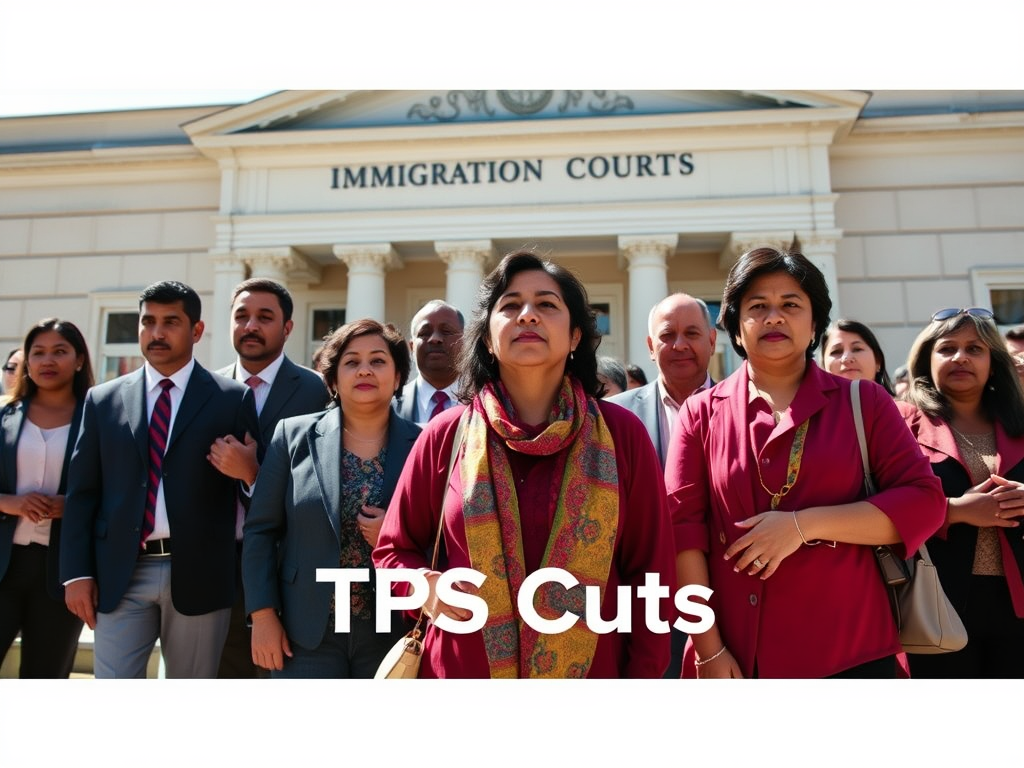
On Monday, outside the courthouse in San Francisco, around 300 demonstrators—including TPS holders from Venezuela, Haiti, and other nations—protested the administration’s actions. Many criticized Noem’s characterization of Venezuelan migrants as criminals and accused the administration of using fear tactics to pressure them into leaving voluntarily.
Cecilia González Herrera, 26, a community organizer and one of the plaintiffs, denounced the rhetoric as a dehumanization attempt against individuals like her and her parents, despite their contributions to the U.S. Her family has been seeking political asylum since 2017, during which time she earned a college degree, worked at Florida theme parks, and assisted in voter registration efforts.
“For many Venezuelans, TPS is their only means of earning a living,” she explained in an interview. “For students, it’s their only path to attending public universities. And for countless others, it’s their sole safeguard allowing them to remain in the country.”
During the hearing, attorneys representing Venezuelan TPS holders and the National TPS Alliance argued that the abrupt termination of the program would cause devastating harm to families, many of whom are employed as teachers, laborers, and caregivers, and would face immediate deportation risks.
Court filings from the plaintiffs reference Trump’s inflammatory remarks about Venezuelan and Haitian immigrants during his campaign, as well as Noem’s statements comparing some Venezuelans to gang members and “dirtbags,” as evidence of discriminatory intent.

Judge Chen, an Obama appointee, cited declarations indicating that Venezuelan TPS holders pay taxes, contribute to Social Security, and have higher rates of employment and higher education attainment than the general U.S. population.
In response, Justice Department lawyers representing Noem argued that any court-ordered delay in ending Venezuelan TPS protections would effectively override the administration’s nationwide policy, a move they claim is beyond the court’s authority. They also defended Noem’s decision, insisting that it was based on national security concerns rather than racial bias. They pointed to reports of the Venezuelan gang Tren de Aragua being among recent border crossers as justification.
However, Judge Chen questioned whether Noem’s policies were truly motivated by national security, noting the rapid implementation of her decisions and suggesting they may have been primarily aimed at reversing Biden-era policies. He pressed government attorneys on allegations of racial bias.
Sarah L. Vuong, a Justice Department lawyer, countered that Noem’s remarks were “taken out of context,” though her statement was met with audible skepticism from Venezuelan TPS holders in the courtroom.
The Trump administration has made Venezuelan and Haitian immigrants a focal point of its immigration crackdown.
Recently, Trump invoked a rarely used provision of the 1798 Alien Enemies Act to deport Venezuelan migrants to El Salvador without due process. His administration has also clashed with the federal judge who attempted to restrict these deportations, escalating tensions to what some describe as a constitutional crisis. Additionally, the White House has pressured Maduro’s government to resume accepting deported Venezuelans.
In February, the administration rescinded an 18-month extension of TPS for Venezuelans granted under Biden and ended protections for those who initially registered in 2023. It later nullified parts of another extension for Haitian migrants.
Officials have not confirmed whether they intend to dismantle the TPS program entirely.
Trump has previously attempted to eliminate TPS protections. During his first term, his administration sought to revoke TPS for over 400,000 people, but the National TPS Alliance successfully challenged those efforts in court, using arguments similar to those presented on Monday.




Leave a Reply