

Black Lives Matter Plaza Is Gone. Its Erasure Feels Symbolic.

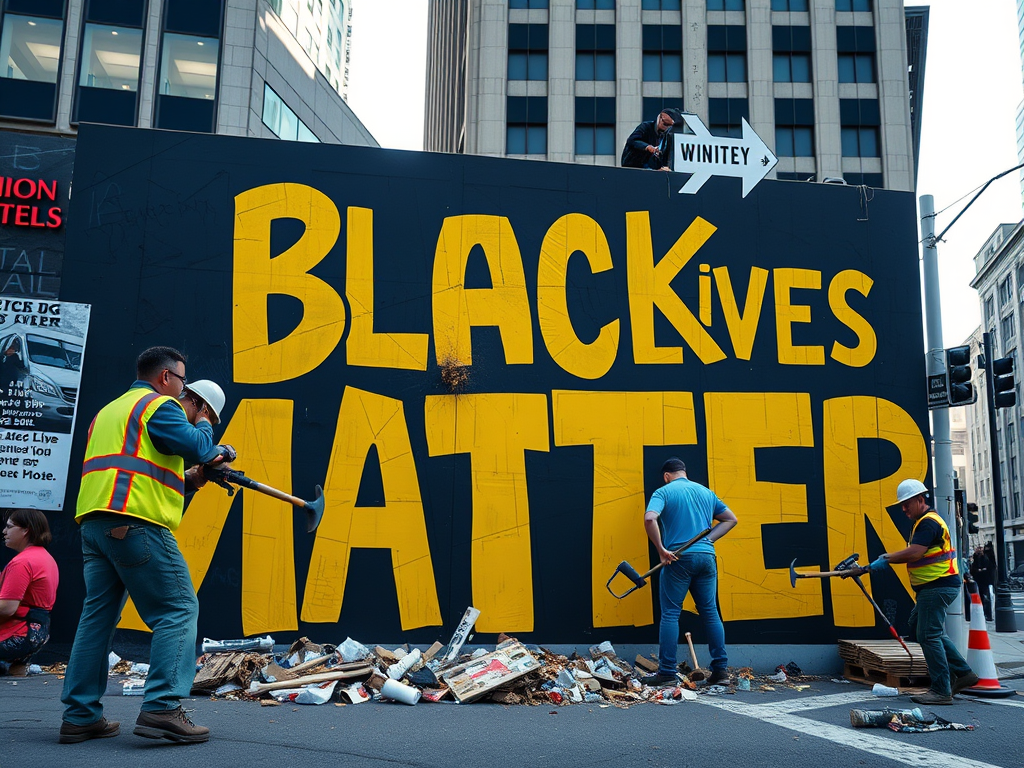
This week, government workers near the White House, in an area surrounded by luxury hotels and union headquarters, used jackhammers and pickaxes to dismantle a mural bearing the words “Black Lives Matter.” Originally painted on the road during the intense summer of 2020, its removal carried profound symbolism.
The striking yellow letters on Black Lives Matter Plaza, emblazoned on 16th Street in the wake of George Floyd’s murder by a Minneapolis police officer, had stood as a bold statement. Its erasure, however, signified a concession by Washington’s mayor, Muriel Bowser, who faced pressure from congressional Republicans threatening to cut federal funding unless the mural was taken down. But for many Black Americans grappling with what they perceive as a powerful pushback against social justice and civil rights, this act meant far more.
“That plaza was spiritual,” said Selwyn Jones, George Floyd’s uncle. “But taking the time to destroy it? That’s sending a message, man. That’s saying, ‘we don’t care.’”

Even those skeptical of the mural’s impact were stunned.
“Bowser’s immediate capitulation to even the slightest pressure over the plaza’s name is somehow more cynical than her initial decision to name it Black Lives Matter Plaza in the first place,” remarked Olúfẹ́mi O. Táíwò, a Black philosophy professor at Georgetown University.
A movement that once saw former Republican senator Mitt Romney marching in the streets has now lost momentum. The national conversation on systemic racism and Black advancement, which had briefly gained traction, was cut short in November when voters re-elected President Trump—a leader who, in his previous term, labeled “Black Lives Matter” a “symbol of hate” and dismissed Black-centric historical narratives as “toxic propaganda.”
Samuel Sinyangwe, executive director of Mapping Police Violence, lamented the loss of what had once seemed like a transformative moment. “We witnessed the largest protest movement in U.S. history, a moment of extraordinary potential, where it felt like real change was within reach,” he said.
The influx of donations to organizations associated with Black Lives Matter has slowed dramatically. The Black Lives Matter Foundation Inc., which raised $79.6 million in 2021, saw that figure drop to $8.5 million the following year. By 2023, revenue had dwindled to $4.7 million, while expenses climbed to $10.8 million, according to ProPublica.


As public support fades, Trump has sought to further bury the movement. Within months of returning to office, his administration has aggressively dismantled diversity, equity, and inclusion initiatives within the federal government, pressuring private corporations to follow suit. The National Law Enforcement Accountability Database, designed to track misconduct among federal officers, has been shut down.
Even references to racial, ethnic, and gender inclusivity are being systematically removed from federal websites and documents. Just this week, the Environmental Protection Agency announced plans to eliminate offices addressing pollution in low-income, minority communities.
Elon Musk, now a White House adviser, has even suggested that pardoning George Floyd’s killer is “something to consider.”

Beyond Washington, scholars and journalists who gained prominence in the wake of Floyd’s murder for their critical examinations of race and history are now finding themselves marginalized or under attack.
“I feel like we’re moving backward,” Jones said.
Given the shifting landscape, many within the Black Lives Matter movement are asking themselves a fundamental question: How can they continue the fight for racial justice in the face of such strong opposition?
Veteran activists believe the movement must evolve, becoming broader in scope, more inclusive of different racial and socioeconomic groups, and more focused on economic issues. While Trump has made inroads with some voters of color—even claiming that parts of the Black Lives Matter movement support him—activists argue that his base remains rooted in bigotry.

“People bought into a narrative built on racism and xenophobia,” said Addys Castillo, a social justice organizer and law student in Connecticut.
However, she emphasized that Trump’s policies will harm everyone outside the wealthiest elites. “If ever there was a moment for a multiracial, cross-cultural movement, it’s now.”
James Forman Jr., a former public defender and critic of the criminal justice system, echoed this sentiment. “The challenge has always been getting people to see two realities simultaneously: that these institutions disproportionately harm Black people, but also that they harm everyone,” he said.
Bowser, who is Black, recently told laid-off federal workers that the mural had been an important part of the city’s history, but priorities had shifted. “Our focus now is on ensuring our residents and economy survive,” she said.
Observers note that the racial justice movement, which surged after Floyd’s murder, did achieve some victories, particularly in raising awareness about systemic racism and police violence. Protesters and activists pushed the public to recognize that racial justice requires more than superficial support—it demands systemic institutional change.
Still, the movement must mature, said Representative Wesley Bell, a Missouri Democrat who rose to prominence following the police shooting of Michael Brown in Ferguson. Last year, he defeated progressive House member Cori Bush in a primary, campaigning on a message of pragmatic leadership.
“Some people think activism is just about protesting,” said Bell, advocating for shifting the movement from street demonstrations to policymaking. “The best protesters don’t necessarily make the best politicians, and the best politicians don’t always make the best protesters.”
Black Lives Matter started in 2013 as an online hashtag following the acquittal of George Zimmerman in the killing of Trayvon Martin. The movement gained traction after Michael Brown’s death the following year. From its inception, it faced criticism.

“Saying ‘Black lives matter’ is inherently racist,” former New York City mayor Rudy Giuliani declared in 2016. “Black lives matter. White lives matter. Asian lives matter. Hispanic lives matter.”
By 2020, as protests swept the nation, even conservative figures like Heritage Foundation leaders and former U.N. ambassador Nikki Haley acknowledged Floyd’s death as a tragedy. However, instances of unrest, including the burning of a Minneapolis police station, allowed Trump to shift the narrative. Calls for modest police reform were drowned out by the divisive slogan “defund the police,” which Trump weaponized to portray the movement as a threat to law and order.
Due to its decentralized nature, the movement faced intensified scrutiny. Any perceived misstep carried severe repercussions. The Black Lives Matter Global Network Foundation, for instance, faced backlash over financial mismanagement, including the purchase of a $6 million California home.
“I’m not thrilled with Black Lives Matter as an organization because of their missteps,” Jones admitted.
Angela Harrison, Floyd’s aunt, acknowledged the movement’s flaws. “They made mistakes. Everyone does. But their intentions were good.”
Over time, efforts to examine how racism has shaped disparities in housing and wealth creation were met with strong resistance. Conservative activists successfully pushed for bans on teachings that, in their view, made individuals feel guilty for past injustices.
Corporations, once eager to showcase racial sensitivity, are rolling back diversity initiatives, wary of conservative backlash. Damon Hewitt, president of the Lawyers’ Committee for Civil Rights Under Law, suggested this shift reflects either insincere commitment or resignation to political realities.
Despite the setbacks, Sinyangwe takes a historical perspective, noting that freedom struggles in the U.S. have always faced cycles of progress and backlash.
“This is how America operates,” he said. “A marginalized community fights against injustice, sees some progress, demands more, and then encounters resistance.”




Leave a Reply