
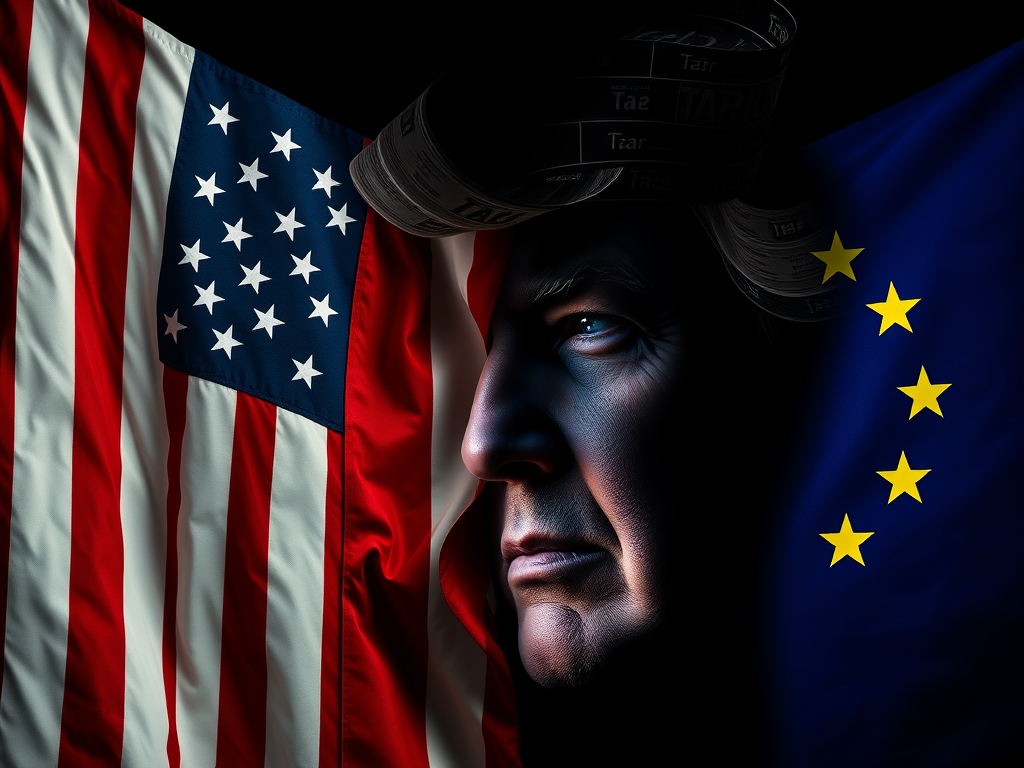

Europe Expected a Transactional Trump. It Got Something Else.

Former President Trump has never hidden his disdain for the European Union. He has repeatedly asserted that the EU was established to take advantage of the United States, has threatened to impose hefty tariffs on European automobiles, and recently implemented global tariffs on steel and aluminum—measures expected to affect approximately $28 billion worth of European exports.
For months, EU officials had hoped to persuade the U.S. president to reconsider, aiming to avert a damaging trade war. They attempted to appease his administration with symbolic concessions—such as increasing European imports of American natural gas—while seeking a broader trade agreement.
However, it has now become evident that such efforts are unlikely to be enough.
With the U.S. tariffs on steel, aluminum, and related products taking effect on Wednesday, Europe swiftly responded with a comprehensive set of retaliatory measures. The first round, set to begin on April 1, includes tariffs as high as 50% on goods such as Harley Davidson motorcycles and Kentucky bourbon. A second wave, planned for mid-April, will target agricultural and industrial products that are significant to Republican-leaning districts.
Despite these countermeasures, European officials insist they did not want to escalate tensions. They remain open to negotiations.
“But you need both hands to clap,” Maros Sefcovic, the European Commission’s trade minister, remarked on Wednesday. “The disruption caused by tariffs is entirely avoidable if the U.S. administration accepts our extended hand and collaborates with us on a fair agreement.”
Trump, however, was quick to react. On Thursday, he denounced the EU’s actions as “nasty” in a social media post and warned that unless the bloc withdrew its tariffs on American whiskey, he would retaliate with a 200% tariff on Champagne, wine, and other alcoholic beverages from France and the broader EU.
As this tit-for-tat trade war unfolds, Europe finds itself in a precarious position. Many European officials remain uncertain about Trump’s exact objectives. U.S. officials have justified tariffs as a means of creating a level playing field, as a revenue-generating tool to offset tax cuts, or as a way to penalize the EU for its regulations on technology firms.

Trump has long argued that Europe engages in unfair trade practices. On Thursday, he went further, labeling the bloc as “hostile and abusive.”
In reality, European tariffs, on average, are only marginally higher than those of the U.S.—about 3.95% compared to America’s 3.5% on European goods, according to an analysis by ING. However, some sectors are more heavily impacted, such as automobiles, which face a 10% tariff when entering the European market.
Trump has also voiced concerns about how Europe and other nations tax producers, hinting that future U.S. tariffs might target such policies. This could explain why some of the tariffs he has proposed—like a 25% duty on cars—are significantly steeper than the ones he criticizes in Europe.
So far, the Trump administration has shown little enthusiasm for negotiation. When Sefcovic traveled to Washington in February, he admitted that progress was minimal. Moreover, Trump has not engaged directly with Ursula von der Leyen, the president of the European Commission, since assuming office.
Without clear insights into Trump’s motivations or reliable intermediaries within his administration, European officials struggle to determine a viable path forward that would minimize harm to businesses and consumers.

“This doesn’t feel like a traditional negotiation—it feels almost imperial,” observed Penny Naas, a trade expert at the German Marshall Fund. “It’s not about mutual compromise; it’s about the U.S. demanding concessions.”
As a result, the EU is making it clear that it will respond in kind if necessary. If the U.S. proceeds with additional tariffs as threatened, more countermeasures will follow. The bloc is striving to ensure its response remains proportional, aiming to prevent the situation from spiraling further.
Nevertheless, European leaders have been bracing for a worst-case scenario—an all-out trade war—even as they hope to avoid one.
“If they escalate, we will respond swiftly and decisively, just as we did today,” Olof Gill, a European Commission spokesperson, stated at a press conference on Wednesday. “We have been preparing for every possible outcome, and today’s actions demonstrate that we can act with speed, strength, and precision.”
The key question now is what comes next.
Trump has already signaled plans for additional tariffs on European goods, including so-called reciprocal tariffs, which could be enacted as early as April 2. He has also suggested significant tariff hikes on specific products, particularly automobiles.
“It’ll be 25% across the board—on cars and everything else,” Trump stated in late February from the Oval Office. “The European Union was created to exploit the United States. That was its goal, and they’ve succeeded. But now I’m in charge.”

If the situation worsens, European officials have indicated that they could invoke a newly developed anti-coercion tool, enabling them to impose tariffs or regulatory restrictions on service-based industries—potentially targeting American technology giants like Google.
While Europe maintains a trade surplus with the U.S. in physical goods, it runs a substantial deficit in services, particularly in technology, as European consumers heavily rely on American social media and digital platforms.
Sefcovic has framed the anti-coercion tool as a theoretical safeguard to “defend” Europe from external economic pressure. However, some European leaders have been more vocal about potentially wielding it against the United States.
For now, hitting American tech firms is viewed as a last resort—an option reserved for extreme circumstances.
“It’s the nuclear option,” remarked Carsten Brzeski, a global economist at ING Research.
At present, European officials are banking on the idea that the threat of retaliatory tariffs will be enough to push the U.S. toward negotiations. The EU’s countermeasures are designed to impact key Republican strongholds, targeting products such as Kentucky bourbon and Louisiana soybeans.
The hope is that affected industries will exert political pressure on Washington to de-escalate tensions.

Already, the spirits industry has raised concerns. With whiskey set to face 50% tariffs, industry leaders warn of severe consequences. The sector previously suffered under a milder round of retaliatory tariffs during Trump’s first term.
“Reinstating these crippling tariffs while the spirits industry is still struggling to recover will only stifle growth and harm distillers and farmers across the U.S.,” said Chris Swonger, CEO of the Distilled Spirits Council, in a statement on Wednesday.
Meanwhile, American businesses are beginning to feel the strain. Tesla’s sales in Germany plummeted in February and have declined across Europe, reflecting public frustration with the company’s CEO, Elon Musk, a known Trump ally.
Yet, the administration appears willing to endure economic pain in pursuit of broader trade objectives—objectives that go beyond tariffs and aim to fundamentally reshape global commerce.
“This is a major shift, and transitions take time,” Trump remarked in a Fox News interview on Sunday.
From Europe’s perspective, Trump’s push to reorder the global trade system presents serious risks. The escalating dispute threatens to permanently damage what has long been its most significant trading partnership while straining its political alliance with Washington.
“There’s no other economic relationship as deeply integrated as that between the U.S. and Europe,” said Naas. “A complete split isn’t really an option—so for now, we’re stuck in this cycle of tariffs and retaliation.”




Leave a Reply