
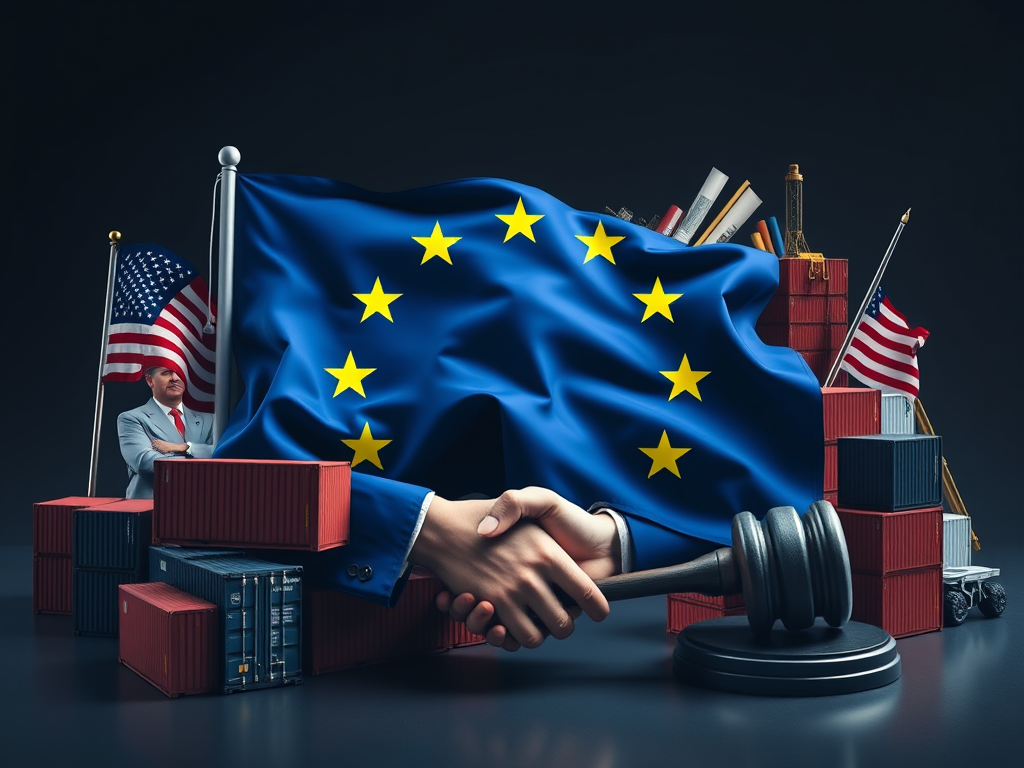

Europe’s Trump Playbook: Offer Carrots but Warn That You Have a Big Stick

Last year, the European Union secretly drafted contingency plans in preparation for the possibility that President Trump would follow through on his threats to impose higher tariffs on European goods and services.https://svtoday.org/
Now, as these threats shift from hypothetical to increasingly imminent, the bloc’s strategy is coming into focus.
The plan? Target politically sensitive industries—specifically those in Republican-led states—with tariffs designed to inflict maximum economic pain. Avoid unnecessary escalation into a full-blown trade war if possible. Act swiftly and decisively, potentially deploying new measures that could impact major service providers, such as Silicon Valley’s tech giants.
According to three diplomats, who spoke on condition of anonymity due to the ongoing discussions, this approach serves as a last resort—one the EU hopes to avoid. The primary objective remains de-escalation, offering negotiations and incentives, including increased European purchases of American natural gas, a key priority for Trump. EU officials have repeatedly warned that a trade conflict between the bloc and the United States would be mutually damaging, with potential benefits only for geopolitical competitors like China and Russia.
However, Trump has kept Europe firmly in his sights, stating this week that the bloc will “definitely” face tariffs “pretty soon.” If diplomatic efforts fail, the EU is making it clear that it is prepared to retaliate.
“We are ready,” European Commission President Ursula von der Leyen declared at a press conference in Brussels when asked about potential tariff hikes from the U.S. administration.
The European Commission, which functions as the bloc’s executive body, has been careful not to reveal specific products that may face increased tariffs, even in discussions with ambassadors and diplomats from EU member states. According to the three diplomats, who have been briefed on the strategies devised by the so-called Trump task force, the EU is being deliberately cautious. With 27 member countries, any leaked plans could compromise its strategic advantage.
Still, two of the diplomats indicated that key principles guiding the EU’s response are becoming increasingly evident, shaped by both internal deliberations and lessons from Trump’s first term. They requested anonymity due to the politically sensitive nature of the discussions.
The first guiding principle is precision-targeted tariffs, focusing on specific industries or geographically significant products. For example, in 2018, the EU countered U.S. tariffs on steel and aluminum by imposing heavy duties on American whiskey—impacting Kentucky’s bourbon industry and, by extension, a key political base of then-Senate Majority Leader Mitch McConnell, a Republican from Kentucky.
The second principle is a phased retaliation strategy, activating or escalating tariffs only if certain conditions are met or deadlines are crossed. This measured approach, two diplomats explained, would provide the EU with greater negotiating leverage while minimizing immediate economic disruption.
The third principle is avoiding a direct, proportionate response. All three diplomats agreed that if Trump were to impose a blanket 20% tariff on European imports, the EU would not necessarily respond with a matching tariff on U.S. goods. Instead, the bloc remains committed to adhering to global trade norms under the World Trade Organization, favoring a more strategic and calculated approach.
One tool under consideration is the bloc’s relatively new “anti-coercion instrument,” a legal mechanism that allows the EU to swiftly impose countermeasures, including tariffs on major U.S. service providers—such as tech firms—when a foreign government seeks to pressure the bloc politically or economically.

Since coming into effect in 2023, this instrument has empowered the EU to deploy a range of counteractions, from higher customs duties to import restrictions, in response to foreign economic coercion. The Financial Times first reported that the European Commission might leverage this tool against large Silicon Valley companies in response to American tariffs. Two diplomats confirmed that such discussions are taking place, though no final decision has been made.
They acknowledged that deploying the anti-coercion mechanism might be too aggressive, as the EU’s overarching objective remains avoiding a full-scale trade war.
For now, Europe’s response remains uncertain—largely because no one knows exactly what Trump will do next.
“They want a deal, but they’re still unsure about Trump’s actual objectives,” said Jörn Fleck, senior director at the Atlantic Council’s Europe Center.

Additionally, EU leaders have encountered difficulties in establishing direct communication with Washington. U.S. Secretary of State Marco Rubio has been invited to meet with European foreign ministers but has yet to do so, though he has spoken with the EU’s top diplomat, Kaja Kallas. Meanwhile, von der Leyen has not met with Trump since his inauguration in January.
Despite the lack of clarity on Trump’s exact tariff plans, he has repeatedly emphasized that he wants Europe to buy more American cars, agricultural products, and natural gas.
In an effort to stave off a trade conflict, European officials have offered economic incentives, signaling their willingness to purchase more U.S. energy. As the bloc continues to reduce its dependence on Russian gas, officials are actively exploring ways to diversify energy sources.
“We still import a significant amount of LNG from Russia—why not replace it with American LNG?” von der Leyen suggested shortly after Trump’s election, referring to liquefied natural gas.
Moreover, European leaders have indicated a growing interest in purchasing more U.S. defense equipment, aligning with Trump’s insistence that NATO allies increase their military spending.
Even Greenland—a strategically important territory of Denmark, an EU member, which Trump once expressed interest in acquiring—has become part of European discussions. The EU has stressed its commitment to investing more in the Arctic region.

“I fully agree with the Americans that the Arctic is becoming increasingly vital in terms of defense, security, and deterrence,” Danish Prime Minister Mette Frederiksen stated in Brussels this week. “We must find ways to strengthen our presence in Greenland.”
Above all, European leaders are emphasizing the economic and geopolitical significance of the transatlantic partnership.
When treated as a single bloc, the EU remains America’s most important trading partner. It is also a major importer of U.S. services and, as officials have repeatedly highlighted in recent days, European companies employ millions of Americans.
“There is a great deal at stake for both sides,” von der Leyen noted this week.
However, she made one thing clear: “We will always protect our interests—whenever and however necessary.”



Leave a Reply