
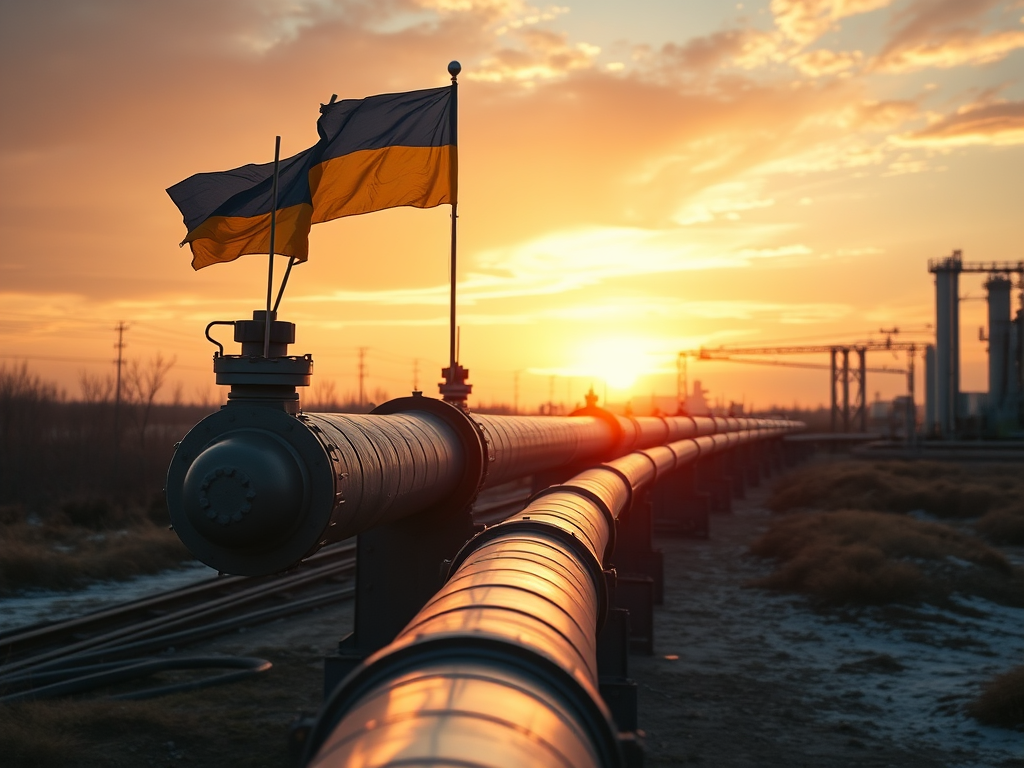

Ukraine Halts the Flow of Natural Gas From Russia to Europe

The flow of natural gas through a key pipeline from Russia to Europe was halted early Wednesday after Ukraine declined to renew an agreement allowing Russian gas transit through its territory.
Ukrainian President Volodymyr Zelensky had repeatedly stated that he would not extend the prewar contract, which expired at midnight on December 31, citing Russia’s large-scale invasion of Ukraine.
Kyiv’s decision to suspend gas transit via the pipeline, which had been a vital route for Soviet and later Russian gas to Europe for decades, is part of a broader effort by Ukraine and its Western allies to diminish Moscow’s financial capacity to sustain its war and to limit its use of energy as a political weapon in Europe.https://wordpress.com/

“This marks a historic turning point,” said Ukraine’s energy minister, Herman Galushchenko, in a statement. “Russia is losing markets and will face significant financial losses.”
The pipeline through Ukraine, originally constructed in the Soviet era to deliver Siberian gas to Europe, was Russia’s last major gas link to Europe following the 2022 sabotage of the Nord Stream pipeline to Germany—potentially involving Ukraine—and the closure of another route through Belarus to Poland.
Gazprom, Russia’s state-controlled energy giant, confirmed on Wednesday that it had stopped sending gas through the pipeline. Russian President Vladimir Putin had previously hinted at the decision during a December 19 news conference, remarking, “That’s fine—we will manage, and Gazprom will endure.”
Since European countries anticipated and prepared for the agreement’s expiration, analysts suggested it would likely have minimal impact on gas prices.
The decision is expected to reduce Russia’s gas revenue by approximately $6.5 billion annually. However, it also presents risks for Ukraine, as Moscow may now target Ukraine’s pipeline network, which has largely been spared from attacks thus far, according to military experts.
At its peak, Russia supplied nearly 40% of Europe’s imported gas, but this has dropped significantly in the past three years. Last year, the Ukrainian pipeline accounted for only about 5% of Europe’s gas imports.

After invading Ukraine in 2022, Moscow sharply reduced its gas supplies to Europe, driving up energy costs and prompting many governments to implement emergency measures to support businesses and households. In response, most EU countries have significantly reduced their reliance on Russian gas. However, Austria, Hungary, and Slovakia continue to purchase substantial amounts from Russia.
Austria announced it had secured alternative suppliers in advance. “We prepared thoroughly for this situation,” said Energy Minister Leonore Gewessler on social media.
Hungary, which had advocated for keeping the Ukrainian pipeline operational, primarily receives Russian gas through the TurkStream pipeline, which runs under the Black Sea to Turkey. Meanwhile, Slovakia, heavily dependent on Russian gas, reassured its citizens that it had sufficient reserves and alternative sources to prevent shortages.

Slovak Prime Minister Robert Fico, an ally of Putin, warned of a “drastic impact” on the EU from the pipeline shutdown but downplayed its effect on Russia. Moldova, the region’s most vulnerable country, declared a state of emergency, fearing that the disruption could jeopardize its primary electricity source—a gas-powered plant in the separatist region of Transnistria.
Gazprom has also threatened to halt all gas deliveries to Moldova, citing unpaid bills. Transnistria, reliant on Russian support, immediately curtailed gas supplies for heating and cooking, further highlighting the war’s shifting priorities for Moscow.
Ukraine, facing relentless assaults on its energy grid and front lines, opted to prioritize economic pressure on Russia over potential risks. “We won’t let them profit off our suffering,” Zelensky stated when announcing the decision. He later emphasized that Russia had lost one of its most lucrative and accessible energy markets due to its actions.
Energy analyst Bota Iliyas remarked that the shutdown reflects how dramatically Europe’s political and energy dynamics have shifted since Russia’s invasion.
Despite challenges, Ukraine continues reducing its reliance on Russian energy. It recently reported its first import of liquefied natural gas from the United States via Greece, marking a significant step in diversifying its energy sources.



Leave a Reply