

A Ride-Hailing Start-Up in Washington Tries to ‘Out-Uber Uber’

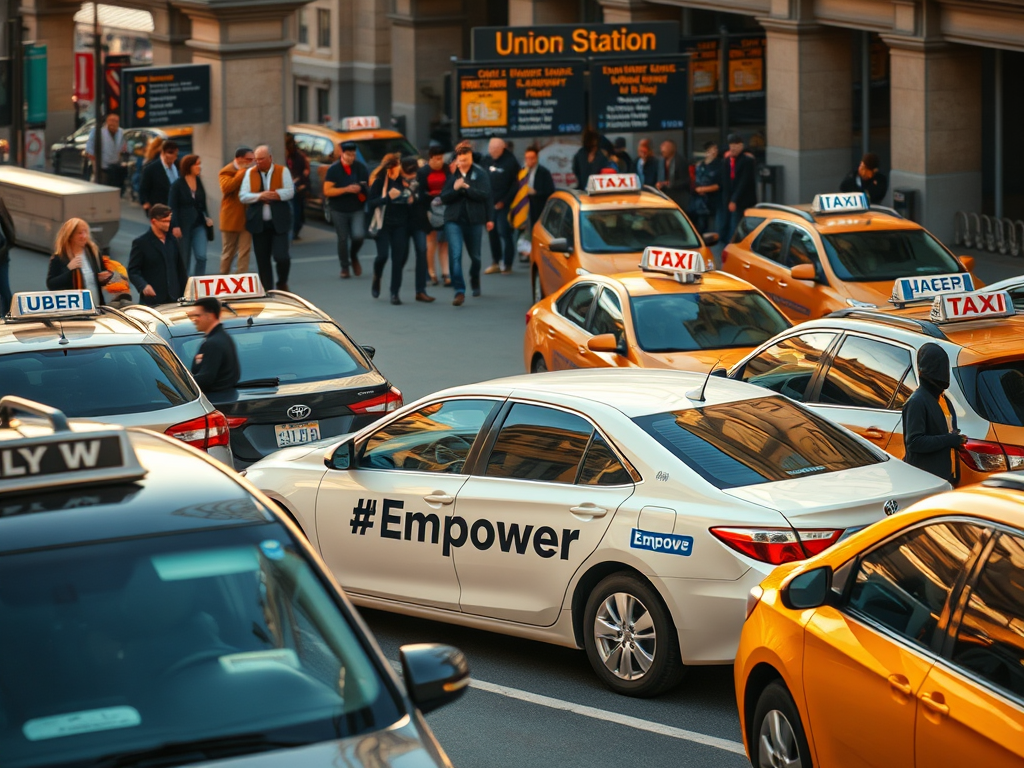
On a recent Tuesday morning outside Washington’s Union Station, a constant flow of taxis, Ubers, and Lyfts pulled up to pick up passengers. Amidst the usual vehicles, one type stood out.
“Right there,” said Jonathan Rogers, head of the city’s Department of For-Hire Vehicles, pointing to an unmarked sedan dropping off a passenger. “That’s an Empower.”https://wordpress.com/
Empower, a ride-hailing startup founded in 2019, has quickly gained ground as a serious competitor to Uber and Lyft in Washington. The company now handles 100,000 rides weekly, capturing 10 percent of the local market, a share larger than the city’s taxis.
However, Empower refuses to register with Rogers’s agency, operating in Washington without the necessary permits. While drivers and passengers flock to Empower for its low prices, the company’s rapid growth has sparked legal challenges. Now, both Rogers and Councilmember Brianne Nadeau, who chairs the Committee on Public Works and Operations, are pushing for the company’s closure.
Empower has accumulated over $100 million in unpaid fines, is under investigation by the Council, and faces a lawsuit from the District of Columbia’s attorney general. Just last month, a Superior Court judge ordered the company to cease operations.

Some regulators see Empower’s actions as strikingly similar to Uber’s tactics when it first arrived in Washington a decade ago, taking over the transit market from traditional taxis.
Under the leadership of Travis Kalanick, Uber became known for its disregard for local regulations, forcing cities worldwide to scramble to catch up. Through years of negotiations, Uber and Lyft faced a growing web of regulations, which new competitors now view as obstacles to be dismantled.
Empower, led by CEO Joshua Sear, launched in Washington in 2020 and immediately began flouting those rules.
“Empower is trying to out-Uber Uber,” said labor expert Katie Wells, co-author of Disrupting D.C.: The Rise of Uber and the Fall of the City.
Despite its mounting legal issues, Empower has no intention of slowing down. The company has raised $11 million from about 75 individual investors and operates with a small team of just 20 full-time employees, according to Sear.
“We’re expanding into new markets and working to raise more capital to grow even faster,” Sear said in an interview. “This is just the beginning.”
Empower’s business model is straightforward. Drivers pay a flat monthly subscription fee, typically $350, and set their own fares, keeping 100 percent of the earnings.
As a result, Empower’s fares are about 20 percent lower than Uber’s and Lyft’s, and drivers earn roughly 30 percent more for the same ride, based on pay records and interviews with over two dozen drivers.
Empower doesn’t market itself as a ride-hailing company. Instead, it positions its drivers as independent contractors, similar to how restaurant reservation apps connect diners with eateries, according to Sear.

This approach, Sear argues, exempts Empower from registering with the Department of For-Hire Vehicles, which would require the company to guarantee commercial insurance for its drivers and contribute 6 percent of its gross receipts to the agency.
Local officials, however, reject this reasoning. They argue that Empower doesn’t meet safety standards and issued a cease-and-desist order in 2020. Yet, in February, the D.C. Court of Appeals reversed the decision, ruling that while Empower didn’t pose a public safety threat, it still had to register with the city.
Sear has pushed back, claiming Nadeau and city regulators are acting under the influence of Uber’s lobbyists. While Uber didn’t directly address the allegations, it stated that it has “worked with policymakers to create a regulatory framework that ensures safe, affordable, and convenient rides while protecting both riders and drivers.”

In September, Sear rallied 1,300 people via the Empower app to testify against Rogers at his agency confirmation hearing, which Nadeau later postponed.
He has also organized rallies for Empower drivers at the city government building during Nadeau’s office hours. At one rally in November, drivers carried signs saying, “Barbers work for themselves. Why can’t drivers?” and “CM Nadeau, why can’t I work for myself?” A truck with an image of Nadeau as a marionette circled the block, with the caption, “The Uber Puppet.”
Empower provided the signs and gave drivers $20 in ride credit and free pizza for attending—an incentive some drivers admitted was appealing.

Nadeau criticized Empower’s tactics, calling them “a lot of gaslighting, publicity stunts, and misinformation.” She was particularly struck by the company’s lack of self-awareness, pointing out that Empower’s approach was strikingly similar to Uber’s when it first entered the market.
Empower has also mobilized riders to send hundreds of emails to Nadeau and Rogers, lobbying in favor of the service. One rider, a low-income cancer patient, shared how Empower helped them save money on rides to medical appointments in an area with no public transit. Another rider, who was disabled, praised Empower for being more affordable than Uber and Lyft.
However, some riders expressed frustrations with Empower’s service. One wrote about a driver who was drunk and driving erratically, while another reported losing their belongings during a ride.
As pay for gig workers on rival platforms has declined, Empower’s popularity has surged. While Uber became profitable last year, many of its drivers say their work has become more difficult and less rewarding.
Moses, a 33-year-old Nigerian immigrant, has driven for ride-hailing companies since 2015. He says he earns as much as $1,800 a week with Empower, but driving for the app carries risks. Local enforcement officers have fined and impounded Empower drivers’ vehicles during crackdowns.
Ridvan, 24, had his car impounded while driving for Empower earlier this year. He had to pay $500 to get it back but was back on the road for Empower the same day, knowing he could earn around $350 for every $200 he would make with Uber.

Despite the fines and legal actions, Empower continues to grow. The company has racked up millions in unpaid fines, and local authorities acknowledge that many drivers are unaware that Empower is operating illegally.
“We recognize that many of them are collateral damage,” said Rogers.
Consequently, enforcement has been light, with only about 45 vehicles impounded each month. Rogers has refrained from more aggressive tactics, such as sending officers to take fake rides to catch Empower drivers.
Sear, a former corporate lawyer, is seeking to save the company’s Washington operations through legislation. In May, he proposed a bill that would require individual drivers, rather than companies, to register with the city, similar to how Uber and Lyft drivers must register in New York City. He’s asked all 13 Council members to sponsor the bill, but none have taken it up, and Nadeau has dismissed the proposal.
“That we should change our laws to accommodate them is incredibly ridiculous,” Nadeau said, warning that Empower could face criminal charges if it continues to evade its fines.

Following a lawsuit by the attorney general, a Superior Court judge ordered Empower to cease operations last month. The attorney general’s office has since asked the court to hold Empower in contempt.
Sear remains unshaken. Empower is profitable and self-sustaining, and last month, it expanded into Baltimore.
When asked about the potential for criminal charges, Sear was unfazed. At an interview in Empower’s office, he raised his hands above his head, mockingly mimicking being handcuffed.



Leave a Reply